
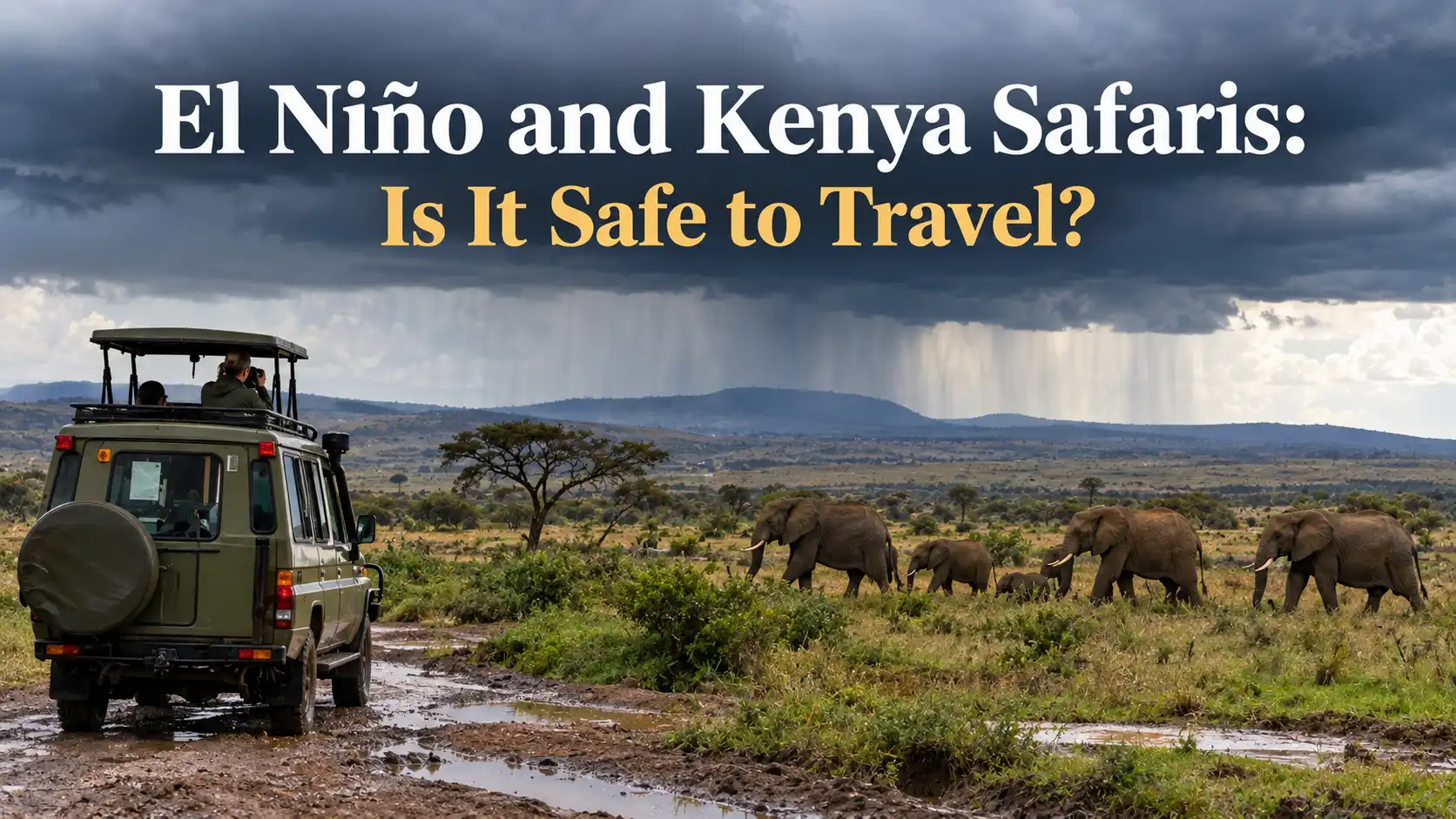
El Niño and Kenya Safaris 2026/27: How It Happens, Will It Affect Your Trip, and Travel Tips
By Olengugih Safaris | Kenya safari planning guide | Updated 15 October 2026
Quick answer: El Niño is a natural warming of the central and eastern Pacific Ocean that changes weather worldwide. In East Africa it usually brings heavier rain during the October to December "short rains". Kenya's weather service expects above-average rain across about 80% of the country this season, with El Niño possibly lasting into February 2027. A Kenya safari is still very possible, but you should expect some wet days, muddy roads and occasional disruptions, so plan with flexibility, choose your lodges carefully and book flights or transfers with buffer time.
What is El Niño?
El Niño is the warm phase of the El Niño-Southern Oscillation (ENSO), a recurring climate pattern in the Pacific Ocean. During an El Niño, surface water in the central and eastern equatorial Pacific becomes much warmer than normal. That warm water changes where storms form, which shifts rain and drought patterns across the globe, including in East Africa.
El Niño events return every few years and usually last around a year. Each one is different in strength and in how it affects each region.
How does El Niño occur?
El Niño develops in a chain of steps:
- Normal conditions: trade winds blow east to west across the tropical Pacific, pushing warm surface water toward Asia and Australia. Cooler water rises along South America.
- The winds weaken: when the trade winds ease, warm water that was piled up in the western Pacific flows back east.
- The ocean warms: surface temperatures in the central and eastern Pacific rise above normal, which feeds more heat and moisture into the air above.
- The atmosphere responds: rising air and storm clouds move eastward, shifting the global jet streams and rain belts.
- Distant regions feel it: these shifts are called teleconnections. They bring floods to some regions and drought to others, including wetter-than-normal conditions across much of East Africa.
The Indian Ocean matters too. East African rainfall also depends on the Indian Ocean Dipole (IOD), a temperature difference between the western and eastern Indian Ocean. When a strong El Niño combines with a positive IOD, East Africa often gets exceptionally heavy rain. This combination was behind severe flooding in Kenya in 1997 and 2023, and a positive IOD is expected to develop this season.
What is happening with El Niño right now?
As of mid-October 2026, forecasters describe a strong and strengthening event:
- The US Climate Prediction Center declared El Niño in June and now gives a greater than 90% chance of a very strong event this fall and winter, with a better than even chance of it exceeding any event on record since 1950.
- The World Meteorological Organization's outlook points to a rapid move toward strong El Niño conditions, with a positive Indian Ocean Dipole also developing.
- Kenya's national climate forum forecast above-average short rains over roughly 80% of the country, with rain starting in western Kenya as early as September and reaching most other regions between the second and fourth weeks of October.
- Kenya's weather service says El Niño could continue until February 2027, but also cautions that it does not automatically mean heavy rain everywhere, and that this event should not automatically be equated with the extreme 1997-98 episode.
Will El Niño hinder a Kenya safari?
Short answer: it can disrupt parts of a safari, but it rarely cancels one. Kenya's tourism industry is operating, and operators say bookings for the October to December period are holding. What changes is the experience and the logistics.
What can go wrong
- Muddy and flooded roads: park tracks can become slow or impassable, and long road transfers take longer. Main routes have been affected in the past, such as the Narok to Mai Mahiu road that serves the Masai Mara, which was closed by flooding in March 2026.
- Swollen rivers in the Masai Mara: lodges and camps beside the Mara and Talek rivers carry the most risk. In late 2023, flooding stranded around 100 tourists in Mara camps, and in March 2026 a helicopter had to rescue staff from a flooded camp.
- Flight and airstrip changes: in March 2026, Amboseli flights were rerouted to other airstrips because of airfield conditions, with guests using combined air and road transfers.
- Park access problems: some roads in Tsavo East were impassable during the February 2026 rains.
- Coastal flooding and heat: flooding has already been reported in parts of Mombasa and Kwale, and temperatures are forecast to be warmer than average, especially along the coast.
- Nairobi traffic: heavy rain can flood roads in the capital and delay airport transfers.
What might surprise you in a good way
- Lush, green landscapes and dramatic skies that photographers love.
- Newborn animals and abundant birdlife, as migrant birds arrive and the grass grows.
- Fewer vehicles at sightings and often better lodge rates in the green season.
- Plenty of dry hours: heavy rain often comes in the afternoon or evening, and many mornings stay clear for game drives.
Region-by-region outlook
Area | What to expect | How to plan |
|---|---|---|
Masai Mara | River-side camps carry flood risk; rain-affected tracks | Choose lodges on higher ground, allow buffer days, consider flying in |
Amboseli | Possible airstrip changes and muddy tracks | Confirm your airstrip and transfer plan shortly before travel |
Tsavo East and West | Some roads can become impassable in heavy rain | Use experienced guides and a flexible route |
Samburu and northern Kenya | Rains forecast from the third to fourth week of October to early December | Expect wet spells, keep plans flexible |
Kenya coast (Diani, Mombasa, Kwale) | Flooding reported in places; warm and humid | Choose elevated hotels, keep beach days flexible |
Nairobi | Flooded roads and traffic delays possible | Leave extra time for airport transfers |
What happens in each place depends on local rainfall, so we check current conditions before you travel.
Travel tips for a Kenya safari during El Niño
- Be flexible with dates and routes. If you have a choice, put the most weather-sensitive parts of the trip early in your itinerary and leave a spare night before long onward flights.
- Consider fly-in safaris. Scheduled or charter flights between parks avoid the worst of muddy road transfers, which is how many safari specialists are adapting itineraries this season.
- Choose lodges with care. Ask whether a camp sits near a river or in a flood-prone area, and whether the operator has a relocation plan.
- Insist on experienced guides and a 4x4 vehicle. Local guides know which tracks to avoid after heavy rain.
- Avoid travelling at night and follow Kenya Wildlife Service advisories to stay on designated roads and avoid flooded crossings.
- Build in buffer days at the start and end of your trip so a delayed flight or closed road does not cause you to miss an international connection.
- Check your insurance and booking terms. Ask what is covered if weather delays or cancels part of your trip, and what the lodge and operator policies are.
- Pack for rain. Bring a light waterproof jacket, quick-dry layers, closed shoes with grip, a dry bag for cameras and phones, and a power bank.
- Take mosquito protection seriously. Standing water can increase mosquitoes, so talk to a travel clinic about malaria prevention and use repellent.
- Keep up with forecasts. Follow Kenya Meteorological Service updates and ask your operator for a recent briefing before you leave.
When is the best time to travel if you are worried about El Niño?
The heaviest rain is expected from October through December, with some forecasts pointing to wet conditions lasting until February. If you can choose dates, travelling later in the year or after the rains ease usually gives easier driving, but forecasts change and no month can be guaranteed. If your dates are fixed, Kenya is still a rewarding destination with the right planning. Ask us for a current recommendation for your specific dates.
Planning a Kenya safari with Olengugih Safaris
We design flexible Kenya itineraries and can adjust lodges, routes, flights and buffer days to suit the season. Browse our Kenya safaris, explore luxury safari experiences, or plan your safari and we will build a trip around the weather.
Frequently asked questions
What is El Niño in simple terms? It is a natural warming of the Pacific Ocean that changes weather around the world, often bringing more rain to East Africa between October and December.
How does El Niño affect Kenya? It usually increases short-rains rainfall, raising the risk of flooding, flash floods and landslides, particularly when combined with a positive Indian Ocean Dipole.
Is it safe to go on safari in Kenya during El Niño? Safaris are running, but some areas face flood and road risks. Safety depends on your lodge choice, guide, route and flexibility, so plan carefully and follow park advice.
Will El Niño stop the wildebeest migration? The herds usually leave the Masai Mara and head back toward Tanzania around October and November, so the main Mara migration viewing season generally falls before the heaviest short rains. Rain can still affect travel in the reserve.
Which Kenya safari parks are most affected by heavy rain? River-side areas of the Masai Mara, parts of Tsavo and areas with poor road drainage have been most affected in past events. Amboseli has had airstrip changes.
Should I cancel or postpone my Kenya safari because of El Niño? Not necessarily. Many travellers continue as planned with adjusted itineraries. If you have flexible dates, you may prefer drier months, and we can advise based on your plans.
How long will El Niño last? Forecasters expect it to persist through at least the early months of 2027, and Kenya's weather service has warned it could extend to February 2027.
Is El Niño good or bad for wildlife? It can mean lush vegetation and plenty of water, which helps many animals, but flooding and unusual rain can also stress wildlife and communities.
Sources
- Kenya Met: 80% of Kenya faces above-average rains (Capital FM, 26 Aug 2026)
- Kenya Meteorological Service Authority, NCOF 13 statement (26 Aug 2026)
- Met: Prepare for heavy rainfall, floods and landslides (The Standard, 10 Sep 2026)
- Kenya Met warns of intense short rains as El Niño strengthens (Big3Africa)
- WMO Global Seasonal Climate Update, Aug to Oct 2026
- El Niño update (Newsweek, based on the US Climate Prediction Center)
- Tourism braces for El Niño rains as coast floods but bookings hold (Nation)
- Safari trade adapts itineraries ahead of El Niño season (ATTA, citing Travel Weekly)
- Adaptive operations maintain booking confidence (ATTA, March 2026)