About the Coke's hartbeest
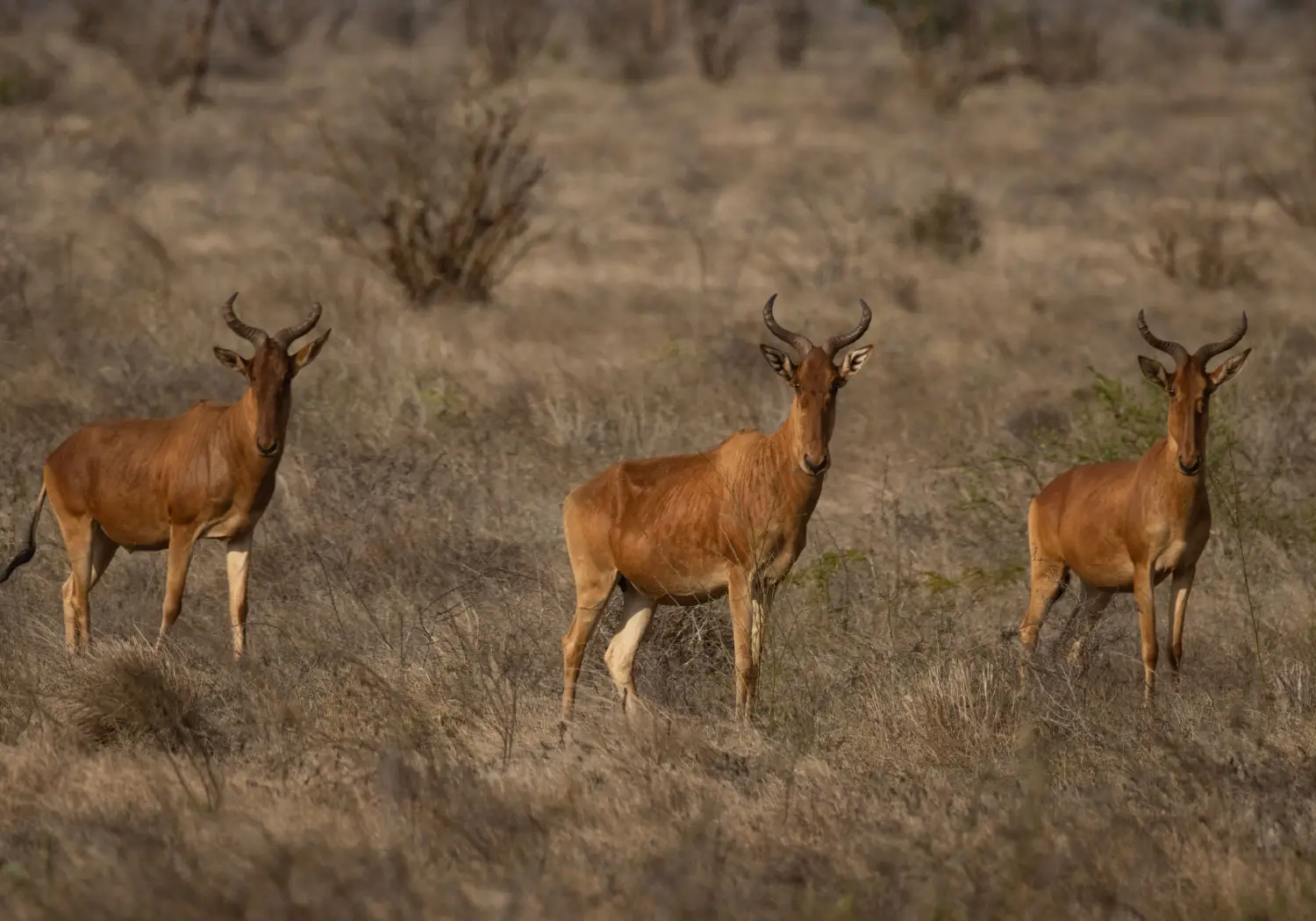
Coke’s hartebeest (Alcelaphus buselaphus cokii), widely known by its Swahili name kongoni, is a sandy-brown antelope with a long, narrow face, a steeply sloping back and horns in both sexes. It is a subspecies of hartebeest that is native to and confined within Kenya and northern Tanzania, which makes it a true East African original. Often seen standing alert on a termite mound, it is one of the most reliable animals on a Kenya safari, and one of the most overlooked.
Quick answer: Coke’s hartebeest is a medium-to-large grazing antelope found on Kenya’s open plains and in northern Tanzania. You can see it year-round in the Masai Mara, Nairobi National Park, Amboseli, Tsavo and Lake Nakuru, usually in small herds, with one animal acting as lookout.
What Does a Coke’s Hartebeest Look Like?
A Coke’s hartebeest is easy to recognise once you have seen one. The face is long and narrow, the shoulders are high and the back slopes down to the rump, which gives the animal a slightly awkward, hunched look. Its coat is a warm tan to light brown with a paler rump, and it carries horns on both males and females, set on a bony pedestal on the forehead.
Adults stand just over a metre at the shoulder and weigh roughly 100 to 200 kg, with males heavier than females. Its name comes from an old Dutch word that means “tough ox”, a fitting description of a hardy animal.
Where Do Coke’s Hartebeest Live?
Coke’s hartebeest favours open country with medium to tall grass, including savanna and grassland, and it will also use light woodland and scrub edges. It copes well with heat and can limit its water loss in hot, dry habitats, so herds are found well away from permanent water as well as near it.
In Kenya, it ranges across the south and centre of the country, from the Masai Mara and Amboseli to Nairobi National Park and Tsavo. Learn more about Kenya’s national parks and reserves where they live.
Behaviour and Social Life
Hartebeest society is built around territory. Males defend patches of open ground, often on a rise or ridge, and females and young move in loose herds. When one animal stands motionless on a termite mound, it is acting as a lookout for the herd, scanning for lions, leopards, cheetahs and hyenas.
Speed and Agility
Despite its heavy front end, the hartebeest is a strong runner. It can reach speeds of up to 70 km/h and can make sharp turns, a trick known as tacking, to throw off a chasing predator.
Calving
Females give birth to a single calf after a pregnancy of around eight months. They usually seek out quiet, scrubby cover to calve, and the calf stays hidden at first. The herd’s alertness is a big part of how these young survive on open plains full of predators.
Is Coke’s Hartebeest Endangered?
The hartebeest as a species is listed as Least Concern, but its range has shrunk a great deal. Coke’s hartebeest was once among the most abundant plains antelopes in East Africa, and it has declined because of hunting, farming and competition with livestock for grass. Some other hartebeest subspecies, such as Swayne’s and Tora, are in a much more serious situation. You can check the current assessment on the IUCN Red List.
Protected parks and wildlife corridors help keep the grassland that kongoni depend on. Learn more about conservation-based safaris in Kenya.
How to See Coke’s Hartebeest on Safari in Kenya
Coke’s hartebeest is one of the easiest antelopes to find on a Kenya safari, which makes it a rewarding animal to learn about and photograph. Here is how to make the most of it.
Choose open plains
Look in grassland rather than thick bush.
- Masai Mara: herds are common on the open plains and often seen near termite mounds.
- Nairobi National Park: a reliable place to see kongoni with the city skyline behind them. Try our Nairobi National Park private 4x4 safari or the layover safari if you have a short stopover.
- Amboseli and Tsavo: dry, open country with good visibility.
Watch for predators
Hartebeest are a regular target for big cats, so a herd that suddenly goes still and stares in one direction often means a predator is nearby. That makes them a good early-warning sign for lion and cheetah viewing.
Build a route with variety
The 7-day Kenya Elephants, Lakes and Masai Mara safari passes through Amboseli, Lake Naivasha, Lake Nakuru and the Mara, giving you hartebeest sightings alongside Kenya’s biggest stars. You can also browse Kenya wildlife safaris or time your trip for the migration safaris in Kenya.
Travel in the dry season
Visibility is best from June to October and January to February, when grass is shorter. See our best time to visit Kenya guide for month-by-month planning.
Photograph the lookout
A hartebeest on a termite mound against the sunrise is a classic East African frame. Early light and a long lens work best, and our photographic safaris in Kenya are designed with this in mind.
Responsible Wildlife Viewing
Keep your vehicle at a respectful distance and stay quiet. Avoid sudden movements, which can send the herd running and spoil the view for everyone, and always follow your guide’s instructions.
Frequently Asked Questions About Coke’s Hartebeest
What is a Coke’s hartebeest?
It is a large antelope with a long face, sloping back and horns on both sexes, found only in Kenya and northern Tanzania. It is also known as kongoni.
Where can I see Coke’s hartebeest in Kenya?
The Masai Mara, Nairobi National Park, Amboseli, Tsavo and Lake Nakuru are all good places to look, especially on open grassland.
What is the difference between a hartebeest and a topi?
A hartebeest has a lighter tan coat, a longer, narrower face and a more sloping back. A topi is darker, with a glossy purplish coat and dark patches on the upper legs.
What does Coke’s hartebeest eat?
Grass, almost exclusively.
Why does a hartebeest stand on a termite mound?
Standing on a mound gives it a higher view of the plains, so it can spot predators early and warn the herd.
Is Coke’s hartebeest endangered?
The hartebeest species is listed as Least Concern, but numbers have fallen across much of its range, and some other hartebeest subspecies are seriously threatened.
When is the best time to see Coke’s hartebeest?
They can be seen all year. The dry seasons, from June to October and January to February, offer the best visibility, and early morning and late afternoon are the best times of day.
Plan Your Kenya Plains Safari
Want to see kongoni, lions, cheetahs and more on the open plains? Olengugih Safaris can design a private, flexible Kenya itinerary around the Masai Mara, Amboseli, Nairobi National Park and beyond. Start planning your safari or contact our team for a free quote.
Interesting facts and identification clues
Interesting Facts About Coke’s Hartebeest
- The name hartebeest comes from an old Dutch phrase meaning tough ox, and kongoni is the Swahili name for Coke’s hartebeest.
- This antelope exists only in Kenya and northern Tanzania, so seeing one means you are in a very specific corner of Africa.
- A hartebeest can run at around seventy kilometres per hour and makes sharp turns to shake off predators.
- Both males and females carry horns, which are used in contests over territory and mates.
- One animal in the herd often stands on a termite mound and acts as a lookout, scanning the plains for danger.
- Researchers have found evidence that the ancient Egyptians once kept hartebeest as sacrificial animals.
Content reviewed 16 Oct 2026