
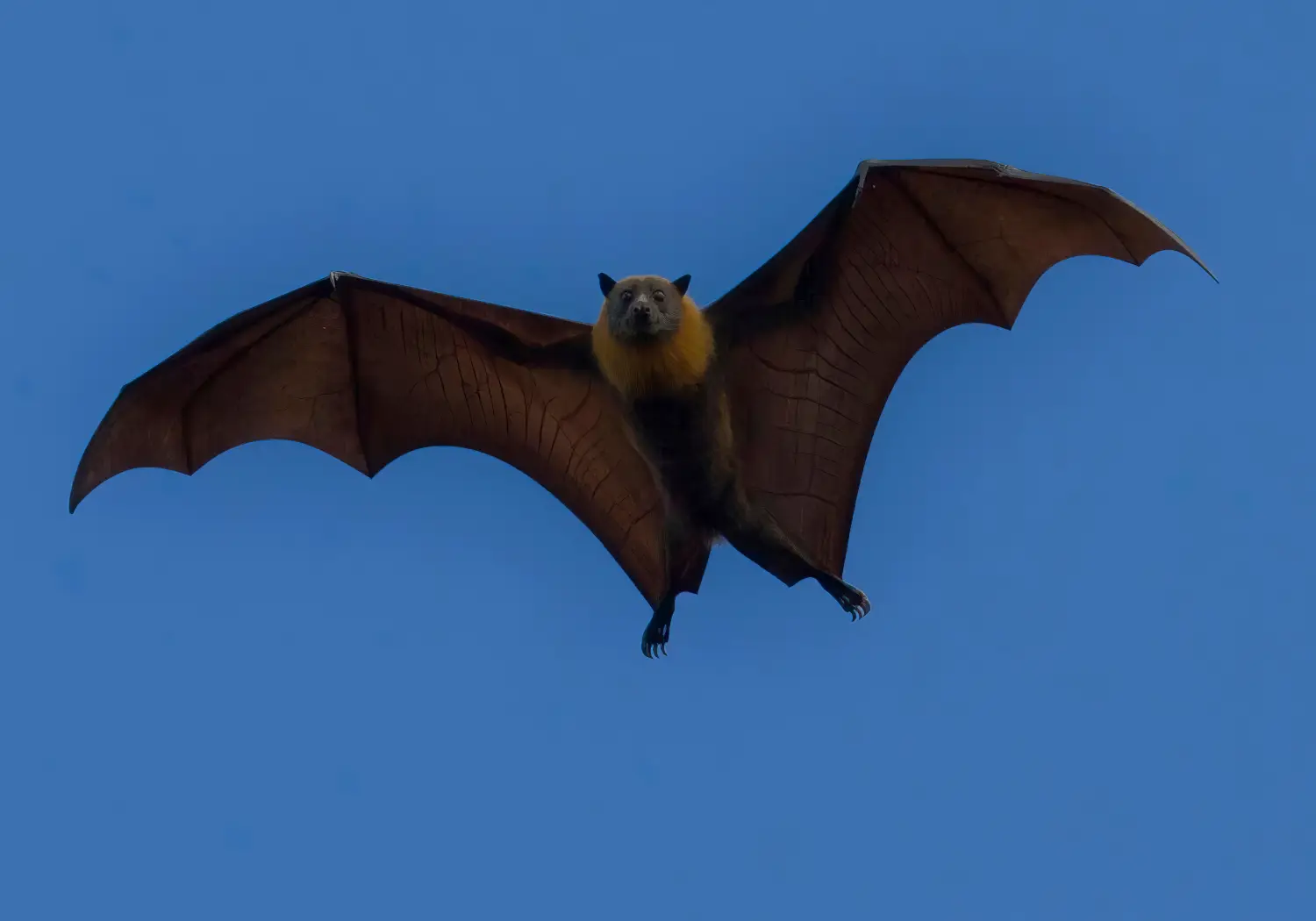
About the Fruit Bats
Fruit bats, sometimes called megabats or flying foxes, are large bats with fox-like faces, big eyes and a keen sense of smell. Unlike most smaller bats, which hunt insects with echolocation, fruit bats feed on ripe fruit, nectar and flowers. Kenya has several species. The most spectacular is the straw-coloured fruit bat (Eidolon helvum), which roosts in tall trees in colonies of thousands and migrates across Africa. Others include the Egyptian fruit bat, which roosts in caves, and the epauletted fruit bats, common in gardens and woodland. As they feed, fruit bats spread seeds and pollen, helping to regrow Africa's forests.
Quick answer: Fruit bats live across sub-Saharan Africa wherever there are fruiting trees. In Kenya, look for straw-coloured fruit bat roosts in tall trees in western Kenya, including Vihiga County near Kakamega Forest, and for fruit bats at dusk along the coast near Shimba Hills and Diani. Watch from outside; never enter bat caves. Sightings are never guaranteed.
What Do Fruit Bats Look Like?
Fruit bats look very different from the tiny insect-eating bats that flit around lights at night. They have long, dog- or fox-like muzzles, large dark eyes for seeing in low light, simple rounded ears and a well-developed sense of smell. Their wings are broad, leathery membranes stretched between long finger bones. Most have a claw on the thumb and, in many species, on the second finger, which they use for climbing among branches and holding fruit.
Main Fruit Bat Species in Kenya
Kenya has several fruit bat species. These are the ones you are most likely to come across.
Straw-Coloured Fruit Bat
The straw-coloured fruit bat (Eidolon helvum) is Africa's most widespread fruit bat and one of its largest. It is named for the silky straw-yellow fur on its neck and shoulders, and has long, narrow wings built for endurance, with a wingspan of up to about 1 m. It roosts by day in tall trees, often in towns, in colonies of thousands, and travels long distances each year following fruiting seasons. It is listed as Near Threatened.
Egyptian Fruit Bat
The Egyptian fruit bat, or Egyptian rousette (Rousettus aegyptiacus), is a medium-sized, greyish-brown fruit bat. Unlike most fruit bats, it roosts in caves, sometimes in colonies of thousands, and it can use simple tongue-click echolocation to find its way in the dark. In Kenya, it lives in caves such as Kitum Cave on Mount Elgon.
Epauletted Fruit Bats
Epauletted fruit bats (Epomophorus species, including Wahlberg's and the East African epauletted fruit bat) are common in woodland, gardens and towns. Males have white tufts of fur on their shoulders (the "epaulettes") which they fluff up to attract females, and they give loud, honking or bell-like calls at night.
Where Do Fruit Bats Live?
Fruit bats live across sub-Saharan Africa wherever there are trees that fruit or flower through the year. They are found in forests, riverine woodland, coastal bush, farmland, gardens and even city parks. Straw-coloured fruit bats often roost in tall trees in towns, while Egyptian fruit bats need caves. A study in western Kenya's Vihiga County, published in Acta Chiropterologica, recorded straw-coloured fruit bat roosts near towns, feeding on fruit from 31 plant species.
Browse our wildlife guide and Kenya destinations to learn more.
What Do Fruit Bats Eat?
Fruit bats eat ripe fruit such as wild figs, mangoes, dates, guavas and passion fruit, along with nectar, pollen, flowers and young leaves. They find food mainly by sight and smell; most don't echolocate. Many crush fruit in their mouths, swallow the juice and spit out the pulp and seeds. According to the World Land Trust, straw-coloured fruit bats can eat up to twice their body weight in a night.
Forest Gardeners
By carrying seeds far from parent trees and spreading pollen as they feed on flowers, fruit bats help forests regenerate. Bat Conservation International notes that straw-coloured fruit bats can fly upwards of 55 miles (about 90 km) in a night, spreading seeds over huge areas. Some important timber trees, such as iroko, depend on them.
Fruit Bat Behaviour
Fruit bats spend the day hanging upside down in trees or caves, often noisily squabbling and fanning themselves with their wings in the heat. At dusk they stream out to feed, sometimes in huge numbers.
Great Migrations
Straw-coloured fruit bats undertake some of the longest migrations of any African mammal. Each year, millions gather in Zambia's Kasanka National Park, in what is thought to be the largest mammal migration on Earth.
Predators
Eagles, hawks, owls, snakes and monitor lizards hunt fruit bats, and people hunt them for bushmeat in some areas.
Breeding
Most fruit bats have one young a year. The baby clings to its mother's fur for its first days or weeks, feeding on her milk.
Are Fruit Bats Endangered?
The straw-coloured fruit bat is listed as Near Threatened on the IUCN Red List because its numbers are falling. It is one of the most heavily hunted bats for bushmeat in Africa, and many roost trees are cut down or disturbed. In western Kenya, researchers have noted that roosts near towns are threatened by tree felling and the need for public education. The Egyptian and epauletted fruit bats are listed as Least Concern, though they face habitat loss, roost disturbance and persecution in places. You can explore recorded sightings on iNaturalist.
Protecting roost trees, forests and caves helps fruit bats and the many plants that depend on them. Learn how your trip can support wildlife with our conservation-based safaris in Kenya.
Fruit Bats and Health: Stay Safe
Like many wild animals, bats can carry diseases. In Kenya, the US Centers for Disease Control and Prevention reported finding Marburg virus in an Egyptian fruit bat from Kitum Cave on Mount Elgon, where two visitors fell ill in the 1980s. Fruit bats are not dangerous if you watch them from a distance.
- Never enter bat caves or mines, and avoid touching bat droppings (guano).
- Never touch, pick up or handle a bat, even if it seems sick or injured.
- Don't eat fruit that has been partly eaten by bats.
- If you are bitten or scratched, wash the wound with soap and water and see a doctor straight away.
Where to See Fruit Bats in Kenya
Fruit bats are often easier to see than people expect: look for noisy colonies hanging in tall trees by day, or bats streaming out at dusk.
Where to Look
- Western Kenya: straw-coloured fruit bat roosts in tall trees in Vihiga County and nearby towns, close to Kakamega Forest National Reserve, which also has forest fruit bats.
- The coast: epauletted and other fruit bats in coastal forest and gardens around Diani and Shimba Hills National Reserve.
- Lake Victoria and western Kenya: fruit bats around lakeside towns and fruit trees, near Ruma National Park.
- Lodges and towns: epauletted fruit bats often visit fruiting fig and mango trees around lodges, and their honking calls are a common night sound.
Watch the Evening Fly-Out
At dusk, find a safe viewpoint near a known roost and watch the bats leave to feed. It's a spectacular sight with a large colony.
Listen at Night
The loud, metallic honking of male epauletted fruit bats is a familiar sound in Kenyan gardens and lodges after dark.
Build a Route With Variety
Combine Kakamega, Ruma and the Lake Victoria shores on a western Kenya trip, or add the coast and Shimba Hills to a beach holiday. Browse our Kenya safaris and birding safaris in Kenya, which often visit the same forests.
Time Your Visit
Roost sizes change with the seasons as straw-coloured fruit bats follow fruiting trees. Ask our team about current roosts before you travel.
Responsible Wildlife Viewing
Watch roosts quietly from a distance and never shine bright lights, throw objects or make loud noises to make bats fly. Disturbing a roost by day can cause mothers to drop their young. Never enter caves where bats roost, and never touch a bat. Support local efforts to protect roost trees, which are often cut down.
Frequently Asked Questions About Fruit Bats
What is a fruit bat?
A large bat with a fox-like face and big eyes that feeds on fruit, nectar and flowers rather than insects. Fruit bats belong to the family Pteropodidae.
Which fruit bats live in Kenya?
The main species include the straw-coloured fruit bat, the Egyptian fruit bat and several epauletted fruit bats.
What do fruit bats eat?
Ripe fruit such as figs, mangoes and dates, plus nectar, pollen, flowers and young leaves.
Why are fruit bats important?
They spread seeds and pollinate flowers, helping forests regrow and supporting many plants that people rely on.
Are fruit bats dangerous?
Not if you watch them from a distance. Like many wild animals, they can carry diseases, so never touch them or enter bat caves.
Where can I see fruit bats in Kenya?
At roosts in tall trees in western Kenya, around Kakamega and Vihiga, along the coast near Diani and Shimba Hills, and around many lodges at night. Sightings are never guaranteed.
Are fruit bats endangered?
The straw-coloured fruit bat is listed as Near Threatened. The Egyptian and epauletted fruit bats are Least Concern.
Plan Your Western Kenya or Coast Safari
Want to explore Kakamega's rainforest, Lake Victoria and Ruma, or combine the coast and Shimba Hills with a beach break? Olengugih Safaris can design a private, flexible itinerary to the places where fruit bats and other forest wildlife thrive. Start planning your safari or contact our team for a free quote.
Sources
- Straw-coloured fruit bat: Near Threatened status, most widely distributed African fruit bat, large colonies and bushmeat hunting: Wikipedia
- Wingspan up to 1 m, weight up to 350 g, the Kasanka migration and eating up to twice its body weight a night: World Land Trust
- Flights of over 55 miles a night, seed dispersal and pollination, and the IUCN uplisting in 2008: Bat Conservation International
- No echolocation, finding food by sight and smell, and diet: Columbus Zoo
- Roosts and diet (31 plant species) in Vihiga County, western Kenya, and threats to roosts: Acta Chiropterologica (2014)
- Marburg virus found in an Egyptian fruit bat at Kitum Cave, Mount Elgon: CDC Emerging Infectious Diseases
- Kitum Cave location, the elephant caves and bat guano: Wikipedia: Kitum Cave
Interesting facts and identification clues
Interesting Facts About Fruit Bats
- Most fruit bats don't use echolocation; they find food by sight and smell.
- The straw-coloured fruit bat can have a wingspan of about 1 m.
- Millions of straw-coloured fruit bats gather each year in Zambia's Kasanka National Park, in what is thought to be the largest mammal migration on Earth.
- A fruit bat can fly up to about 90 km in a night to feed, spreading seeds as it goes.
- Male epauletted fruit bats have white shoulder tufts and honk loudly to attract mates.
- The Egyptian fruit bat is one of the few fruit bats that can echolocate, using tongue clicks.
Content reviewed 27 Oct 2026