
About the Large-Eared Greater Galago
The large-eared greater galago (Otolemur crassicaudatus), also called the brown greater galago, thick-tailed galago or greater bushbaby, is the largest of all galagos. About the size of a house cat, it weighs up to about 2 kg and has a thick, bushy tail longer than its body, large, mobile ears and big, shining eyes. Unlike its smaller cousins, it usually walks and runs along branches on all fours rather than leaping. Its loud, croaking wails, which can sound like a crying child, carry far through the night. In Kenya, it lives mainly in the south-west, around the Lake Victoria basin.
Quick answer: The large-eared greater galago lives in forest, thickets and well-wooded savanna from Kenya, Uganda and Rwanda south through Tanzania to South Africa and Angola. In Kenya, the local silver galago (O. c. argentatus) is found mainly in south-western and western Kenya, near Lake Victoria and around Ruma National Park. It is nocturnal, so look for it after dark with a torch. Sightings are never guaranteed.
What Does a Large-Eared Greater Galago Look Like?
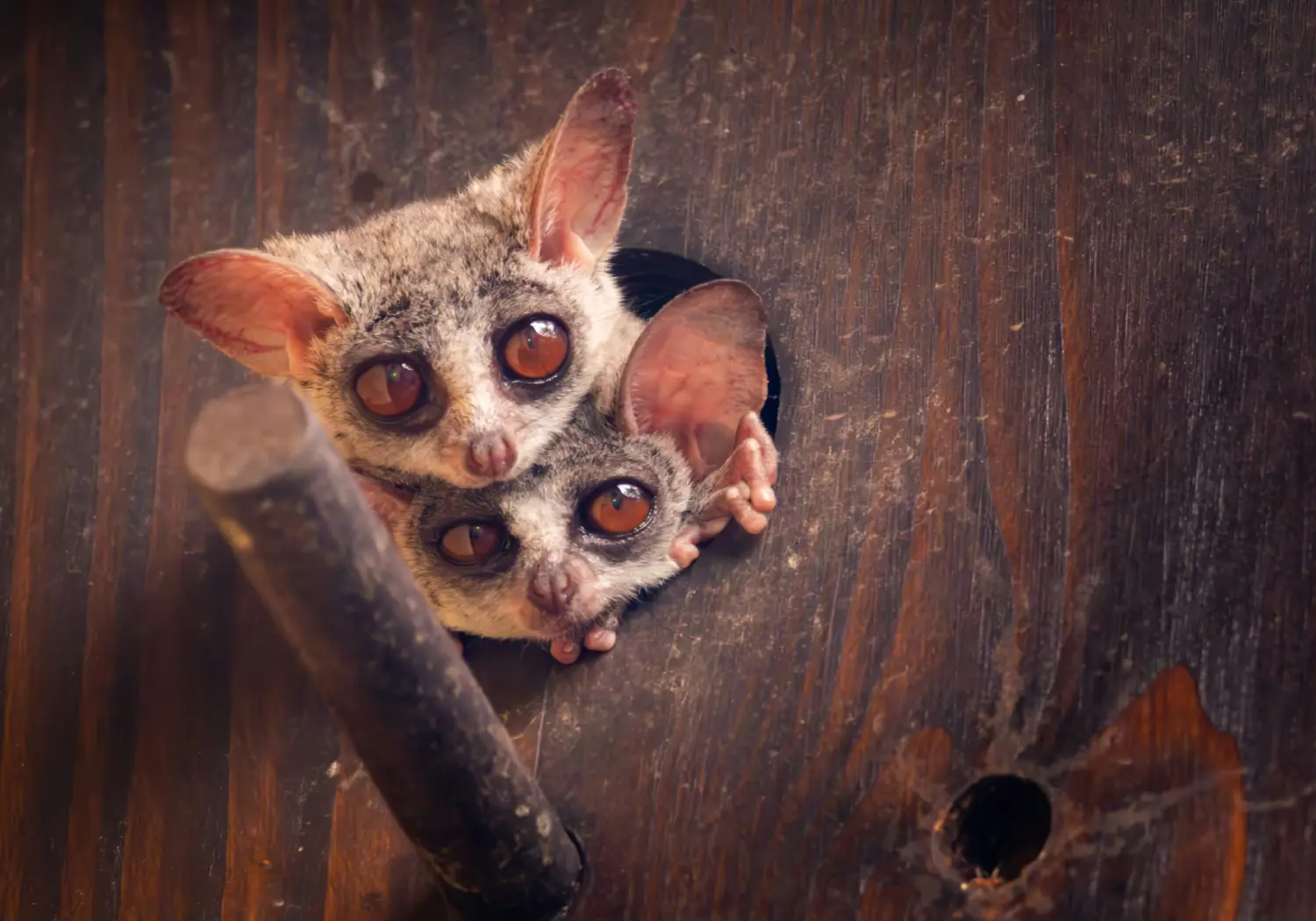
The large-eared greater galago looks rather like a small, woolly cat with a fox's tail. It has a rounded head, a short muzzle and large, forward-facing eyes that shine in torchlight. Its big, thin ears are ridged so it can fold and unfold them independently. Its thick, soft fur is silvery-grey to brown, often darker around the eyes and paler underneath, and its long, very bushy tail is often darker towards the tip. Like other galagos, it has flat pads on its fingers and toes for gripping branches. Males are larger than females.
Large-Eared vs Other Kenyan Galagos
Kenya has several galago species. Here's how to tell the large-eared greater galago apart.
- Large-eared greater galago: the largest galago, cat-sized, with big ears; mainly in south-western Kenya; usually walks and runs along branches.
- Small-eared greater galago: similar size but with noticeably smaller ears; lives on the coast, in the Taita Hills and in the central highlands.
- Senegal (northern lesser) galago: much smaller, squirrel-sized, with huge ears; a spectacular leaper common in acacia woodland across Kenya.
- Kenya coast dwarf galago: tiny; lives in coastal forest.
Where Do Large-Eared Greater Galagos Live?
Large-eared greater galagos live from Kenya, Uganda, Rwanda and Burundi south through Tanzania, Zambia, Malawi and Mozambique to South Africa and Angola. According to the New England Primate Conservancy, the silver subspecies O. c. argentatus is found in Kenya, Rwanda, Tanzania and Uganda.
They prefer riverine and coastal forest, thickets, well-developed woodland and miombo woodland, and can live in gardens and suburbs where there are enough trees and food. They sleep by day in dense tangles, tree holes or leafy nests. Browse our wildlife guide and Kenya destinations to learn more.
What Do Large-Eared Greater Galagos Eat?
Large-eared greater galagos feed on tree gum and sap, fruit, nectar and insects. Their diet varies a lot from place to place. According to the Animal Diversity Web, gums and saps made up about 62% of the diet in one South African study, while in Kenya insects may make up 50–70% of what they eat. They also take flowers, seeds and, occasionally, small birds or eggs.
Large-Eared Greater Galago Behaviour
These galagos are nocturnal and arboreal. They sleep together by day in small groups of about two to six, usually an adult pair with young or females with young, and split up to forage alone at night.
Walkers, Not Leapers
Unlike the small, bounding lesser galagos, large-eared greater galagos usually move slowly and deliberately on all fours along branches, only leaping when disturbed.
Loud Wails
They are known for loud, croaking wails, especially in the breeding season, which help announce their presence to others.
Scent Marking
Like other galagos, they rub urine onto their hands and feet to spread their scent along their routes.
Predators
Owls, eagles, leopards, genets and large snakes such as pythons hunt greater galagos.
Breeding
After a pregnancy of about four to four and a half months, the female gives birth to one or two young in a nest. Unlike many primates, the mother doesn't carry her young constantly but leaves them in the nest or on branches while she forages.
Is the Large-Eared Greater Galago Endangered?
No. The large-eared greater galago is listed as Least Concern on the IUCN Red List. It is widespread and can live in gardens and farmland with enough trees. Locally, it is affected by forest clearance, especially of riverine forest, by hunting, and by capture for the pet trade; galagos are protected under CITES Appendix II. Where conditions are good, it can be very common: densities of up to about 125 per km² have been recorded. You can explore recorded sightings on iNaturalist.
Learn how your trip can support wildlife and forest conservation with our conservation-based safaris in Kenya.
Where to See Large-Eared Greater Galagos
In Kenya, the large-eared greater galago has a fairly limited range, mainly in the south-west. It is shy and nocturnal, so sightings usually come from careful night-time searches with a torch.
Where to Look in Kenya
- Lake Victoria basin: riverine forest, thickets and well-wooded areas in south-western Kenya, including the country around Ruma National Park.
- Western Kenya: forest edges and well-wooded farmland. Combine with Kakamega Forest National Reserve for other forest primates.
Beyond Kenya
The species is more widespread further south. In Tanzania and Uganda it lives in riverine forest and miombo woodland, often around lodges. Ask about our multi-country safaris, or explore Uganda parks such as Queen Elizabeth National Park.
Search With a Torch
After dark, scan tall trees and thickets with a torch. Look for large, widely spaced, orange-red eyeshine and a cat-sized shape walking along a branch.
Listen for the Wail
The loud, croaking call of a greater galago, especially in the breeding season, can lead you to it.
Build a Western Kenya Route
Combine Ruma, Kakamega, Lake Victoria and Saiwa Swamp on a tailor-made trip through our Kenya safaris.
Responsible Wildlife Viewing
Use a dim or red torch and don't keep the beam on a galago's eyes for long. Never feed galagos; human food harms them and makes them bold around people. Never buy or keep a galago as a pet.
Frequently Asked Questions About the Large-Eared Greater Galago
What is a large-eared greater galago?
The largest bushbaby, a cat-sized, nocturnal African primate with big ears and a bushy tail. Its scientific name is Otolemur crassicaudatus.
Is it the same as the brown or thick-tailed galago?
Yes. Large-eared greater galago, brown greater galago and thick-tailed galago are all names for the same species.
How big is a large-eared greater galago?
About 26–47 cm long plus a 29–55 cm tail, and about 0.5–2 kg.
What do large-eared greater galagos eat?
Tree gum and sap, fruit, nectar and insects.
How is it different from the small-eared greater galago?
It has larger ears and lives mainly in south-western Kenya, while the small-eared greater galago lives on the coast, in the Taita Hills and in the central highlands.
Where can I see large-eared greater galagos in Kenya?
In south-western and western Kenya, around the Lake Victoria basin, after dark. Sightings are never guaranteed.
Is the large-eared greater galago endangered?
No. It is listed as Least Concern.
Plan Your Western Kenya Safari
Want to explore Kenya's wild west: Lake Victoria, Ruma's rare antelopes and Kakamega's rainforest primates, by day and night? Olengugih Safaris can design a private, flexible itinerary off the beaten track. Start planning your safari or contact our team for a free quote.
Sources
- Other names, the largest galago, head-body and tail length, weight of 0.5–2 kg, males larger, and riverine and coastal forest habitat: Wikipedia: Brown greater galago
- O. c. argentatus in Kenya, Rwanda, Tanzania and Uganda, densities of up to 125 per km², and appearance: New England Primate Conservancy
- Diet varying by place (about 62% gum in South Africa, 50–70% insects in Kenya), groups of 2–6 and movement on all fours: Animal Diversity Web
- Fur colour, ridged ears, habitat including urban areas, social groups, loud croaking wail and urine washing: Comparative Mammalian Brain Collections
- Range countries, a Kenyan specimen of O. c. argentatus, and alternative names: Mammal Diversity Database
Interesting facts and identification clues
Interesting Facts About the Large-Eared Greater Galago
- It is the largest of all galagos, about the size of a house cat.
- Its bushy tail can be longer than its head and body.
- It usually walks on all fours along branches instead of leaping like smaller galagos.
- Its loud, croaking wails can sound like a crying child.
- In Kenya, insects can make up more than half of its diet.
- It can fold its large ears down independently.
Content reviewed 28 Oct 2026