
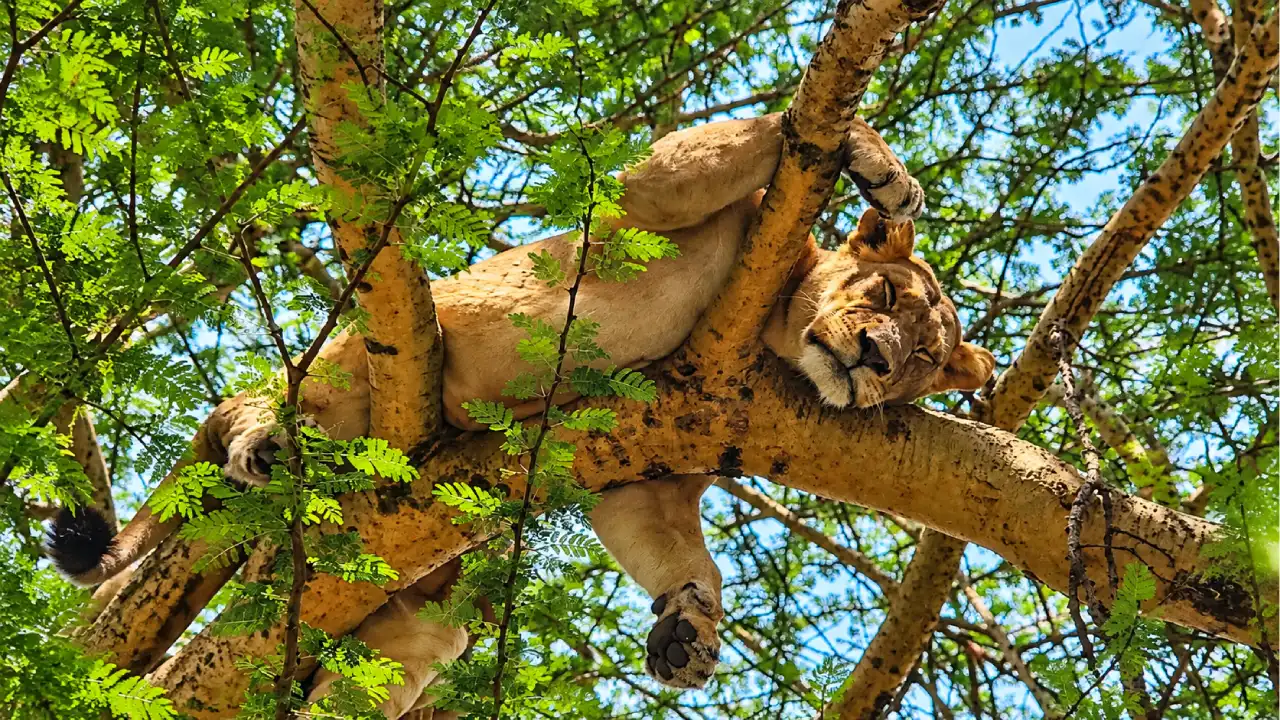
Can Lions Climb Trees? Yes, and Here Is Why They Do
Yes, lions can climb trees. They do it less often than leopards, but it is a real and well-documented behaviour.
Lions are heavy and not built for climbing. They still climb when a tree has a low, wide branch. You will usually find them resting on a sturdy limb in the afternoon.
Tree-climbing lions are best known in Uganda's Ishasha sector and Tanzania's Lake Manyara. They are also seen in Kenya's Lake Nakuru. This guide explains why they climb, where to look and how to see them.
Last updated October 2026. Wildlife sightings are never guaranteed.
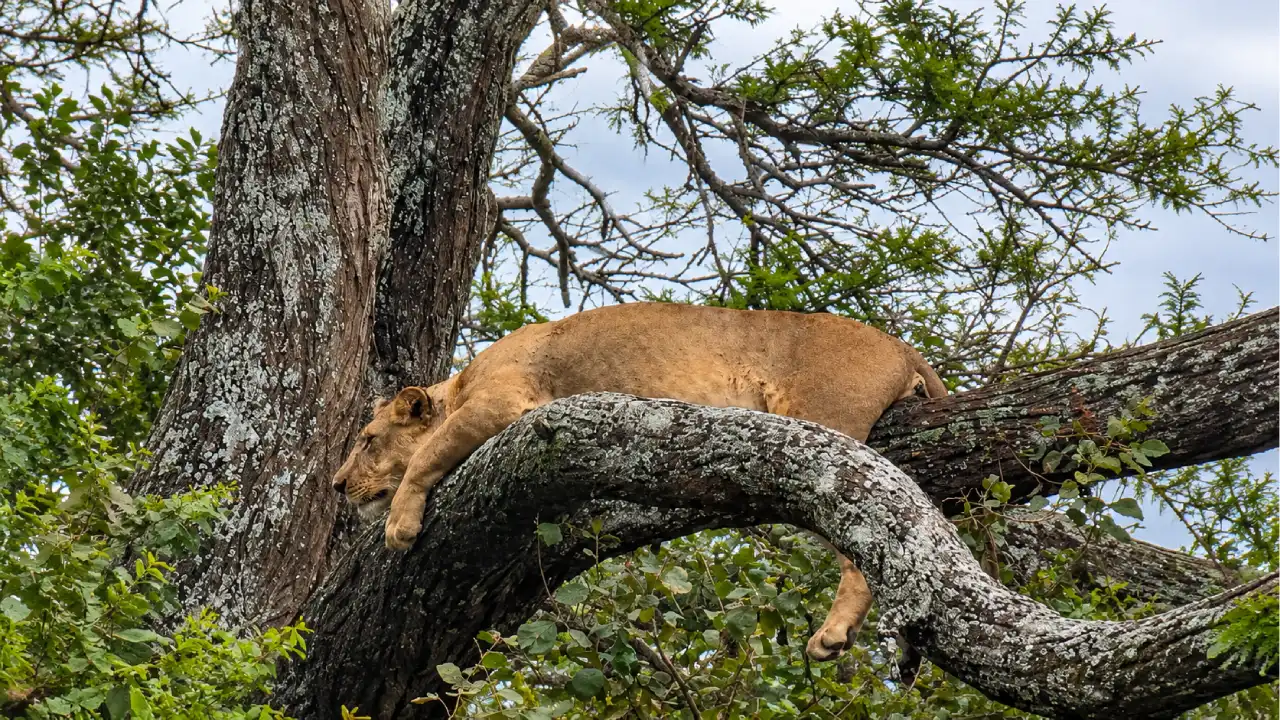
Can lions climb trees? Key facts
Question | Answer |
|---|---|
Can lions climb trees? | Yes, but they do it less often than leopards |
Who climbs most? | Young lions and lionesses, often resting in small groups |
Best-known places | Ishasha in Uganda and Lake Manyara in Tanzania |
In Kenya | Seen in Nairobi National Park, Lake Nakuru, and Naboisho. |
Favourite trees | Wide trees with low, strong, nearly horizontal branches |
Best time of day | Afternoon, after a morning hunt or when it is warm |
Why they climb | Rest, cool air, a view, fewer insects and safety |
Is it common? | No. It is a special sighting |
Can lions climb down? | Yes, though they often come down awkwardly |
Why do lions climb trees?
Scientists are not sure of the full answer. Several reasons are likely. They may vary by place and lion.
Possible reason | How it helps the lion |
|---|---|
Escape the heat | Branches catch a breeze and offer cooler air |
Avoid biting insects | Flies and ticks are fewer above the ground |
A better view | Height helps lions spot prey, rivals and the rest of the pride |
Rest and comfort | A branch is dry and away from damp grass |
Safety | Lions can avoid buffalo, elephants and other threats |
Play and learning | Cubs and young lions climb to explore |
Stealing kills | Lions sometimes climb to take a leopard's meal |
No single reason fits every case. The shape of the tree matters as much as the lion's mood. A tree with low, wide branches is easy to climb. A tall, straight trunk is not.
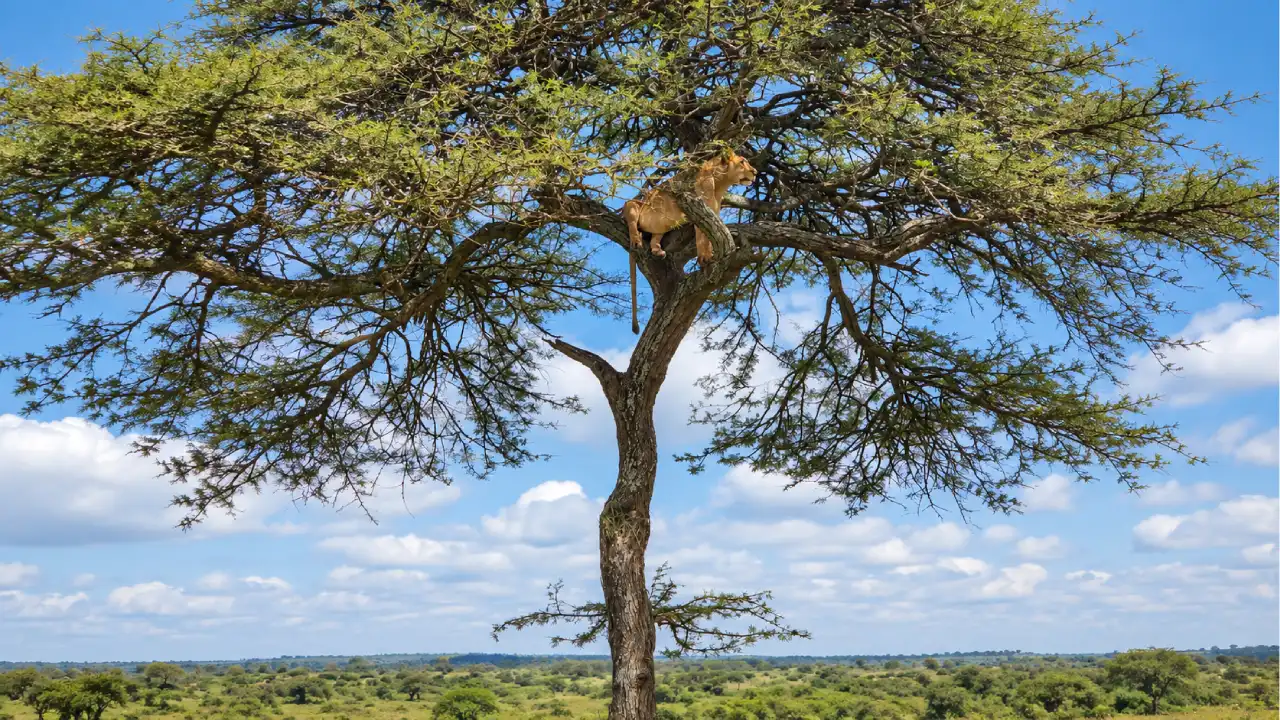
How do lions climb trees?
Lions are not natural climbers. They are large cats built for power on the ground, not for gripping bark.
What helps them climb
- Strong legs. Powerful shoulders and hind legs push them upward.
- Claws. Retractable claws grip the bark.
- Good balance. A long tail helps them steady themselves.
- Smart choice of tree. They pick trees with low, wide, sloping limbs.
What holds them back
- Heavy bodies. Adult males can weigh about 150 to 250 kilograms.
- Long legs. They have a high centre of gravity, which makes climbing harder.
- Tree shape. A tall, straight trunk with no low branches is hard to climb.
Who climbs most?
Cubs and young lions climb most, because they are lighter. Lionesses are often seen in trees too. Big males climb less often, because of their weight.
Coming down is harder than going up. Some lions slide down backwards or jump the last part.
Where to see tree-climbing lions
Tree-climbing lions are rare. Some places give you better odds than others.
Place | Country | What to know |
|---|---|---|
Ishasha sector, Queen Elizabeth National Park | Uganda | The most famous spot, known for lions resting in fig trees |
Lake Manyara National Park | Tanzania | Many sightings are documented in acacia woodland |
Masai Mara | Kenya | Seen in lone trees on the plains, especially in Naboisho Conservancy |
Other East African parks | Several | Reported in more places than once believed |
Kafue National Park | Zambia | Lions are reported climbing, possibly to avoid tsetse flies |
Tree-climbing lions in Kenya
Kenya is not as famous for this as Uganda. But the Lake Nakuru National Park gives good chances. Lone trees dot its open plains. Lions often rest in them after a morning hunt.
Sausage trees are a favourite. They are short, with wide and nearly flat limbs. A cluster of safari vehicles under a tree often means a lion or leopard is up there.
Sightings are never guaranteed. Wildlife is wild. Your guide can improve your odds by knowing which lions and trees to check.
Best places in Kenya to see lions in trees
Three Kenyan areas are well known for lions resting in trees. Guides report sightings there often.
Place | Where | What to know |
|---|---|---|
Nairobi National Park | Nairobi city edge | Lions rest in acacia trees near roads and picnic sites |
Lake Nakuru National Park | Rift Valley | Lions use trees in the woodland around the lake |
Next to the Masai Mara | Lions rest in scattered trees on open plains |
Nairobi National Park
This is the easiest place to try. It is minutes from the city. Lions here have been seen climbing acacia trees near roads and picnic sites. Entire prides have been seen resting in trees at once.
A game drive here can fit into a half day. See our private Nairobi National Park safari for details.
Lake Nakuru National Park
Lake Nakuru is a small park with a lot of woodland. Lions often rest in the trees around the lake. The lake also draws flamingos, rhino and buffalo.
Naboisho Conservancy
Naboisho is a private conservancy beside the Masai Mara. Fewer vehicles are allowed than in the national reserve. This gives you quiet, unhurried time with lions in the trees. Guided walks and night drives are also possible.
Sightings are never guaranteed. Ask your guide to check shady trees in the afternoon.
Lions vs leopards: who climbs better?
Leopards win easily. They are the experts of the tree.
Feature | Lion | Leopard |
|---|---|---|
Body | Large and heavy | Lighter and more flexible |
Climbing skill | Fair, in suitable trees | Excellent in almost any tree |
Why climb | Rest, view, cooler air | Hide kills, sleep, avoid lions and hyenas |
Carries prey up | Rarely | Often, and can hoist heavy kills |
Coming down | Often awkward | Smooth and confident, even headfirst |
Where seen | Mid-sized, wide trees | Tall trees, large branches |
A leopard often stores its kill in a tree to keep it from lions and hyenas. Lions sometimes climb trees to steal that kill.
Other big cats climb too. Cheetahs sometimes use low branches or termite mounds as lookouts. Lions use trees for rest, while leopards use them as a home.
Which trees do lions climb, and when?
Best trees for lions
- Wide, low branches. A branch near the ground is the easiest start.
- Strong, thick limbs. The branch must hold a heavy cat.
- Flat or gently sloping crowns. Lions can lie flat without slipping.
- Shade. Dense leaves keep the lion cool.
In East Africa, lions are seen in sausage trees, fig trees and acacias. The type of tree matters less than its shape.
Best time of day
Afternoon is best. Lions rest through the heat of the day. Morning hunts end, and the pride settles down. Early evening can also work, as lions wake up.
Best time of year
Months | What to expect |
|---|---|
January to March | Dry. Lions use shade and trees to stay cool |
April to May | Long rains. Wet weather makes tree sightings less predictable |
June to October | Dry season. Good game viewing, and lions often rest in trees |
November to December | Short rains. Lush scenery, with lions spread out |
In the Masai Mara, July to October is the busiest season. Book early for the best guides and camps.
Tips for spotting and photographing lions in trees
- Look for lone trees. Scan scattered trees on open plains.
- Watch for dangling tails. A hanging tail or paw is a clue.
- Follow the vehicles. A cluster of safari cars may mark a sighting.
- Go in the afternoon. Lions often rest in trees after a morning hunt.
- Use binoculars. They help you spot lions hidden in leaves.
- Bring a zoom lens. A 200 to 400 mm lens works well.
- Shoot from the side. This shows the lion's shape on the branch.
- Stay quiet and still. This keeps the lion relaxed.
Keep a safe distance
Never crowd a tree. Vehicles too close can stress the lion. It may jump down and run. Follow your guide's advice and park rules.
Myths and facts about lions climbing trees
Myth | Fact |
|---|---|
Lions cannot climb trees | They can, when the tree suits them |
All lions climb trees | Only some lions do, and not often |
Only Ishasha lions climb | Lions also climb in Tanzania, Kenya, Zambia and elsewhere |
Lions are as good as leopards | Leopards are far better climbers |
Lions climb to hunt | They mainly rest, watch or cool off |
A lion in a tree is harmless | It is still wild. Stay in the vehicle and keep your distance |
Lions climb down easily | Coming down is often clumsy |
Frequently asked questions
Can lions climb trees?
Yes, lions can climb trees. They do it less often than leopards. They choose trees with low, wide branches.
Why do lions climb trees?
Experts are not certain. Likely reasons include escaping heat and insects, getting a better view, resting and staying safe.
Do all lions climb trees?
No. Only some lions climb, and not very often. It is a special sighting on safari.
Where can I see tree-climbing lions?
Ishasha in Uganda and Lake Manyara in Tanzania are the best known. They also appear in the Masai Mara in Kenya.
Are there tree-climbing lions in Kenya?
Yes. Lions are seen resting in trees in Nairobi National Park, Lake Nakuru, Naboisho Conservancy and the Masai Mara.
Can lions climb down from trees?
Yes. They can come down, though it can look clumsy. Some slide backwards or jump the last part.
Can male lions climb trees?
Yes, but they climb less often than lionesses and young lions. Their heavy bodies make it harder.
Can lions climb better than leopards?
No. Leopards are much better climbers. They even carry kills into trees.
Can cubs climb trees?
Yes. Cubs and young lions climb most often, because they are light and curious.
What is the best time to see lions in trees?
Afternoon is best. Lions rest after the morning hunt and look for shade.
Is it safe to watch lions in trees on safari?
Yes, if you stay in the vehicle and keep a safe distance. Follow your guide's instructions.
Can lions climb any tree?
Yes & no. But they prefer trees with low, wide, strong branches. A tall, straight trunk is hard for them.
See Kenya's lions with Olengugih Safaris
Olengugih Safaris is a Kenya-based safari operator. We plan private safaris to the Masai Mara, Laikipia, Samburu and more. Our guides know where lions rest and which trees they use.
Contact Olengugih Safaris to plan your lion safari in Kenya.
Guests can read reviews from other travellers on GetYourGuide, SafariBookings and Tripadvisor.