
Remembering Sudan: The Last Male Northern White Rhino
Sudan was the last male northern white rhino. He died on 19 March 2018 at Ol Pejeta Conservancy in Laikipia, Kenya. He was 45 years old. Only two females remain, his daughter Najin and granddaughter Fatu. Scientists are now using advanced reproductive technology to try to save the subspecies.
Last updated: October 2026.
Sudan the last male northern white rhino: key facts
- Name: Sudan, named after the country where he was born
- Species: Northern white rhino, a subspecies of white rhino
- Died: 19 March 2018, aged 45
- Where: Ol Pejeta Conservancy, Laikipia, Kenya
- Survivors: Najin, his daughter, and Fatu, his granddaughter
- Status of the subspecies: Functionally extinct, with two females left
- Main threat: Poaching for rhino horn
- Hope: Frozen sperm, stored eggs and embryos, and southern white rhino surrogates
Sudan's final days at Ol Pejeta Conservancy
Sudan's last days were quiet and heavy with sorrow. His health had been failing for months. Deep sores covered his legs, and one infection would not heal. His carers fought to ease his pain. They stuffed bananas with medicine and packed his wounds with clay.
On 17 March 2018, Sudan collapsed. His keepers tried to help him stand, but his legs were too weak. The world watched as news of his decline spread.
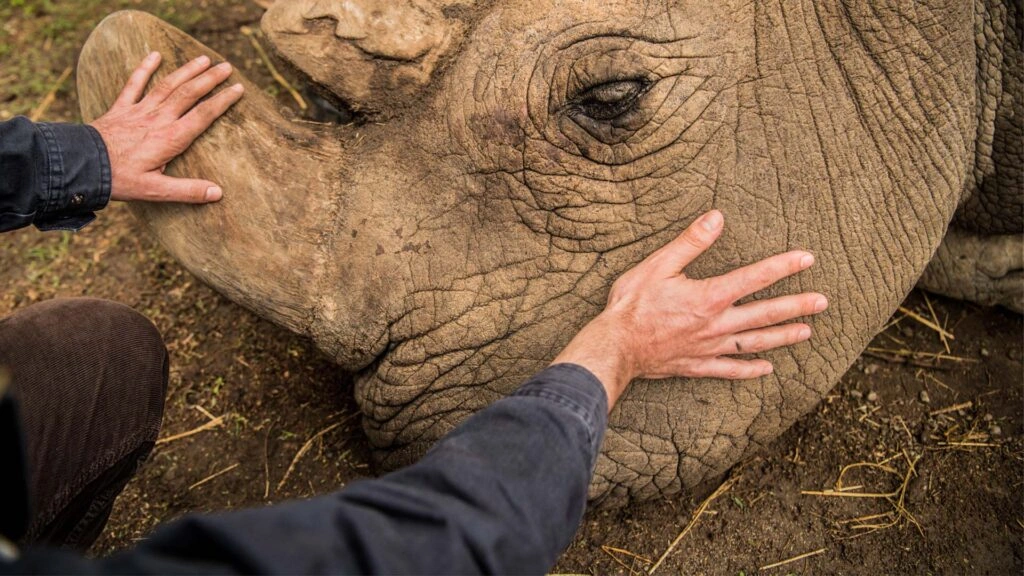
On 19 March, the vet team made the humane decision to end his suffering. His keepers surrounded him. One of them, Joseph Wachira, rubbed Sudan behind the ear one last time. Sudan rested his huge head against him. Rain fell softly, and a bird called in the distance. Around the enclosure, the wildlife of Laikipia carried on as usual.
The keepers wept. They had spent more time with Sudan than with their own families.
Why northern white rhinos disappeared
Sudan's death was the end of a crisis decades in the making. Northern white rhinos once lived across parts of central and east Africa. Poachers hunted them for their horns, which are sold on illegal markets. War and instability made protection hard. By the early 2000s, almost none were left in the wild.
Despite scientific, legal and political efforts, the subspecies reached the brink. Sudan was born in the wild and later lived in a zoo in Czechia. In 2009 he moved to Ol Pejeta with three other northern white rhinos. The hope was that the Kenyan climate would help them breed. It did not work.
By 2018, only three northern white rhinos were left. Sudan was the last male.
Sudan, a global icon for conservation
In his final years, Sudan became a global symbol of conservation. Armed guards protected him around the clock. He lived like a retired head of state. Visitors travelled from around the world to see him.
Sudan weighed about two tonnes, yet he was gentle like a golden retriever. He let people touch him and hand-feed him snacks. He crunched carrots between his huge teeth. Many visitors cried. They knew they were seeing the last of his kind.
His story reached millions. Remembering Sudan reminds us of our duty to protect all wild species.
Najin and Fatu: the last two northern white rhinos
Though Sudan is gone, his legacy lives on. He left two female descendants, his daughter Najin and his granddaughter Fatu. They grazed close by as Sudan declined, unaware of what was coming.
Scientists describe the subspecies as functionally extinct. Without a fertile male, natural breeding is impossible. Najin and Fatu are the last two of their kind.
Today they live in a large, predator-free enclosure at Ol Pejeta. Rangers guard them around the clock, and vets monitor their health. Fatu was born in 2000. Najin is older, and her hind legs make egg collection unsafe for her. Fatu's eggs are used in the breeding programme.
Hope for the future: saving the northern white rhino
After Sudan's death, scientists moved quickly. They had already collected his sperm, and they preserved it for future use. His remains were also preserved for a future museum display. Future generations will see his skeleton and struggle to imagine him alive.
The plan is to use advanced reproductive technology. Scientists collect eggs from Fatu and fertilise them with stored sperm. Embryos are frozen. A southern white rhino female then carries the embryo as a surrogate mother.
Milestone | What happened |
|---|---|
2018 | Sudan dies, leaving two females |
2023 and 2024 | The first rhino embryo transfer is proven to work, using a southern white embryo |
Second half of 2025 | Three northern white embryo transfers, none leading to a long-term pregnancy |
Early 2026 | More eggs collected from Fatu at Ol Pejeta |
By April 2026 | Six embryo transfers in total, and two more proven surrogates added |
The work is slow and uncertain. Each step teaches scientists how to save other endangered species. Progress depends on funding, expertise and protection on the ground.
Visit Ol Pejeta and help protect rhinos
You can honour Sudan by visiting Ol Pejeta Conservancy in Laikipia. The conservancy is home to the world's last two northern white rhinos. It also protects southern white rhinos, black rhinos, lions and chimpanzees.
- Meet the rhinos: Visits to Najin and Fatu are arranged in advance, with their keepers.
- Learn the story: Keepers explain the breeding programme and the threats rhinos face.
- Go on safari: Combine your visit with game drives in the conservancy.
- Support conservation: Your park fees help fund rangers and rhino protection.
You can also help from home:
- Share Sudan's story.
- Support conservation groups that protect rhinos.
- Never buy products made from rhino horn.
Check current visiting rules with your operator before you travel.
Frequently asked questions
Who was Sudan the rhino?
Sudan was the last male northern white rhino. He lived at Ol Pejeta Conservancy in Kenya and died in 2018.
When did Sudan the last male northern white rhino die?
Sudan died on 19 March 2018. He was 45 years old.
How did Sudan die?
His health declined from age-related illness and infections. His carers made a humane decision to end his suffering.
Where did Sudan live?
He lived at Ol Pejeta Conservancy in Laikipia, Kenya. Armed guards protected him around the clock.
How many northern white rhinos are left?
Two. They are Najin, his daughter, and Fatu, his granddaughter. Both are female.
Are northern white rhinos extinct?
They are functionally extinct. Two females remain, and no male can breed naturally.
Why did northern white rhinos go extinct?
Poaching for rhino horn drove the collapse. War and weak protection made it worse.
Can the northern white rhino be saved?
Scientists are trying with frozen sperm, eggs and embryos. Southern white rhinos act as surrogates. The work is uncertain.
What is the difference between northern and southern white rhinos?
They are two subspecies of white rhino. Southern white rhinos number in the thousands. Northern whites are almost gone.
Can you visit Najin and Fatu?
Yes, with pre-arranged visits to Ol Pejeta Conservancy. Their keepers guide you into the enclosure.
Why was Sudan so famous?
He was the last male of his subspecies. His gentle nature and global media coverage made him an icon.
How can I help protect rhinos?
Support conservation groups, visit responsibly and share Sudan's story. Never buy rhino horn products.
Visit Ol Pejeta with Olengugih Safaris
Olengugih Safaris is a Kenya-based operator. We can help you plan a safari to Ol Pejeta Conservancy, the home of Najin and Fatu. Contact us with your dates and we will plan your trip.
Sources
- Leibniz Institute for Zoo and Wildlife Research, BioRescue press release, April 2026 (embryo transfers, surrogates, Fatu)
- BBC Future, Remembering Sudan