
About the Mountain bongo
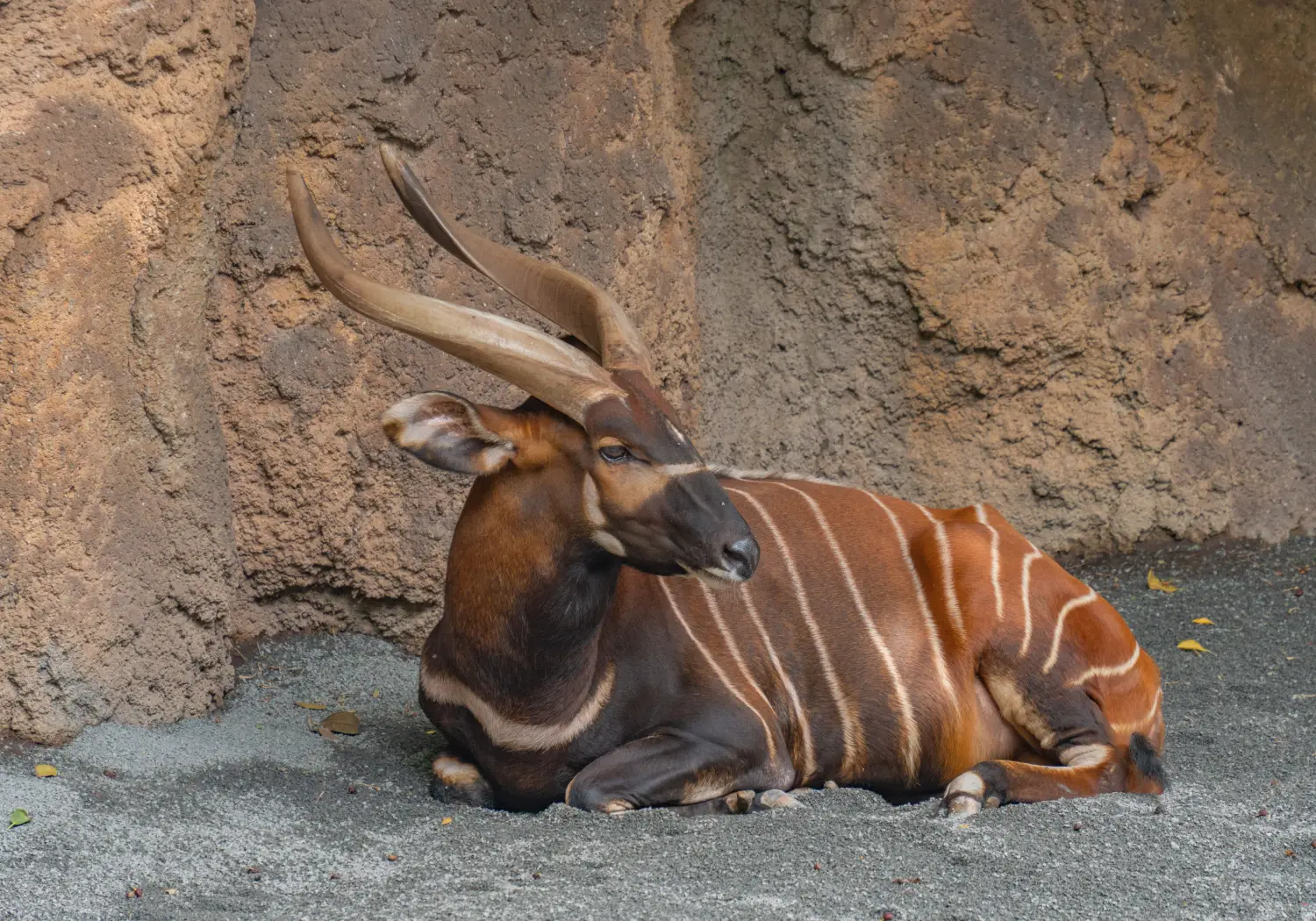
The bongo antelope (Tragelaphus eurycerus) is the largest forest antelope in Africa, a shy, chestnut-coated giant with bold white stripes, a white chevron between its eyes and long, spiralling horns. The Kenyan form, the mountain bongo, is nicknamed the “ghost of the forest” because it is so secretive that even researchers rarely see it. It is also found in the wild only in Kenya and is critically endangered, so learning about it is as much a conservation story as a wildlife one.
Quick answer: The bongo is a large, striped forest antelope of Africa’s dense forests. Kenya’s mountain bongo lives in high-altitude forests around Mount Kenya and the Aberdares, and fewer than 100 are thought to remain in the wild. Wild sightings are extremely rare, so most visitors learn about bongos through conservation visits and forest-focused safari.
What does the Bongo Look Like?
A bongo is unmistakable. Its rich chestnut coat is marked with up to a dozen or so narrow white stripes down the flanks, and a white chevron runs between the eyes. Both males and females carry lyre-shaped, spiralling horns, and the ears are large and rounded, helping the animal hear in dense forest.
Bongos are big. Males can weigh around 400 kg, and the mountain form is larger than the lowland bongo, which is far more common in Central and West Africa. Despite their size, their stripes break up their outline so well that they can vanish into the forest in seconds.
Where Do Bongo Live?
Bongos need thick forest with plenty of leafy food. In Kenya, the mountain bongo was once widespread across the montane forests of Mount Kenya, the Aberdares, the Mau and even Mount Elgon. Today the remaining wild animals are scattered across isolated forests, mainly in the Aberdares and Mount Kenya, with smaller groups in places such as the Eburu forest and the Maasai Mau.
What Do Bongo Eat?
Bongos are browsers. They feed at dawn, dusk and through the night on leaves, shoots, vines and bark, and they are known to visit natural mineral sources. Their forest habitat gives them cover as well as food, which is why forest loss matters so much.
Bongo Behaviour
Bongos are shy and wary. Females and young usually live in small groups, while adult males tend to be more solitary. They rely on stillness and camouflage, and a bongo that senses danger will often slip away without a sound, which is part of the reason they are so hard to count.
Is the mountain Bongo Endangered?
Yes, the mountain bongo is in serious trouble. It is classed as Critically Endangered, and fewer than 100 are thought to survive in the wild, far below the number needed for a genetically healthy population. The main threats are habitat loss, illegal logging and encroachment on forest edges, snares set for other animals, and disease.
There is hope. A conservation breeding programme at the Mount Kenya Wildlife Conservancy has produced a growing herd, and bongos born there are gradually moved to the Mawingu Mountain Bongo Sanctuary within the Mount Kenya forest, with a long-term goal of rebuilding the wild population to at least 750 animals. Trail cameras have also recorded wild bongos in forests where they were feared lost.
Travel that supports forest protection and community conservation helps this effort. Explore our conservation-based safaris in Kenya to see how responsible tourism fits in.
How to Experience the Bongo on a Kenya Safari
A bongo safari is different from a typical game drive. The animal is shy, the forest is dense, and the real reward is the habitat and the conservation story as much as any sighting. Here is how to approach it.
Visit the Mount Kenya region
The foothills of Mount Kenya, around Nanyuki, are the heart of bongo conservation in Kenya. Visits to the conservancy that runs the breeding programme are usually arranged in advance, so check current visiting arrangements and we can build them into your itinerary. Pair it with Mount Kenya National Park or mountain climbing tours in Kenya for high-altitude scenery.
Add the Aberdares
The Aberdare National Park is the stronghold of the wild population. Bongo sightings there are rare and should be treated as a bonus, but its misty moorland, bamboo and forest are a rewarding wildlife destination in their own right, with elephants, buffalo and forest birds.
Combine with Laikipia and Ol Pejeta
Laikipia and Ol Pejeta sit on the northern slopes of Mount Kenya and offer far more reliable wildlife viewing, including rhino, lion, chimpanzees and, with luck, wild dogs. See Ol Pejeta Conservancy, Laikipia or our 8-day Samburu, Ol Pejeta, Naivasha and Mara safari for a route that links several areas.
Travel in the dry season
The drier months, generally June to October and January to February, make tracks and roads easier and mountain weather more predictable. Forest weather is always changeable, so pack warm and waterproof layers. See our best time to visit Kenya guide for month-by-month planning.
Go with realistic expectations
Spotting a wild mountain bongo is a rare privilege. We never promise a sighting, but a well-planned itinerary built around the right forests, an experienced guide and plenty of patience makes the most of the trip. Browse more routes through Kenya wildlife safaris.
Responsible Bongo Viewing
Keep voices low, stay on marked paths and follow your guide’s instructions. Never approach a bongo or try to track one on foot without a ranger. Noise and disturbance can push a very shy animal deeper into the forest, and the conservancies protect these animals by managing access carefully.
Frequently Asked Questions About Bongos
What is a mountain bongo?
A bongo is a large forest antelope with a chestnut coat, white stripes and spiralling horns. It is the largest forest antelope in Africa.
Where can I see a bongo antelope in Kenya?
Wild sightings are very rare and happen mainly in the Aberdares and the Mount Kenya forests. The Mount Kenya region, near Nanyuki, is where conservation breeding takes place, and visits there are usually arranged in advance.
Is the bongo endangered?
The mountain bongo is Critically Endangered, with fewer than 100 thought to remain in the wild. The wider species is considered Near Threatened.
What is the difference between a mountain bongo and a lowland bongo?
The mountain bongo lives in Kenya’s high-altitude forests and is larger and much rarer. The lowland bongo lives in West and Central African forests and is more common.
What do bongos eat?
They browse on leaves, shoots, vines and bark, and visit natural mineral sources.
Why are bongos so hard to find?
They are shy, live in dense forest and are mostly active at dawn, dusk and night, so even researchers use trail cameras to find them.
Can I guarantee a bongo sighting on safari?
No. Wild sightings are exceptional, so plan the trip around the forests and conservation story, and treat any sighting as a bonus.
Plan Your Forest and Conservation Safari in Kenya
Interested in Kenya’s rarest antelope? Olengugih Safaris can design a private itinerary through the Mount Kenya region, the Aberdares and Laikipia that puts forest, wildlife and conservation at the centre. Start planning your safari or contact our team for a free quote
Interesting facts and identification clues
- The bongo is the largest forest antelope in Africa.
- Kenya’s mountain bongo exists nowhere else in the wild, which makes it one of the rarest large mammals in the country.
- Both males and females carry spiralling horns, which they use to push through thick undergrowth.
- The white stripes on a bongo’s flanks help break up its outline in dappled forest light.
- Bongos are known to visit natural mineral sources, and in some places they have been recorded chewing burnt wood, which is thought to give them extra minerals.
- Conservationists often call the mountain bongo the ghost of the forest, because it is so shy that even the people who study it rarely see one.
Content reviewed 16 Oct 2026