About the Common Duiker
The common duiker (Sylvicapra grimmia), also called the grey duiker or bush duiker, is a small, wiry antelope with a greyish-fawn coat, a dark tuft of hair on its forehead and short, straight horns. Its name comes from the Afrikaans word for “diver”, because it plunges headlong into thick cover when startled. It is one of Africa’s most widespread antelopes, yet it is easy to miss unless you know where to look.
Quick answer: The common duiker is a small, solitary antelope found across most of sub-Saharan Africa. In Kenya, look for it in bushy savanna and woodland edges in places like the Masai Mara, Lake Nakuru and Nairobi National Park, mostly at dawn and dusk. Sightings are never guaranteed.
What Does a Common Duiker Look Like?
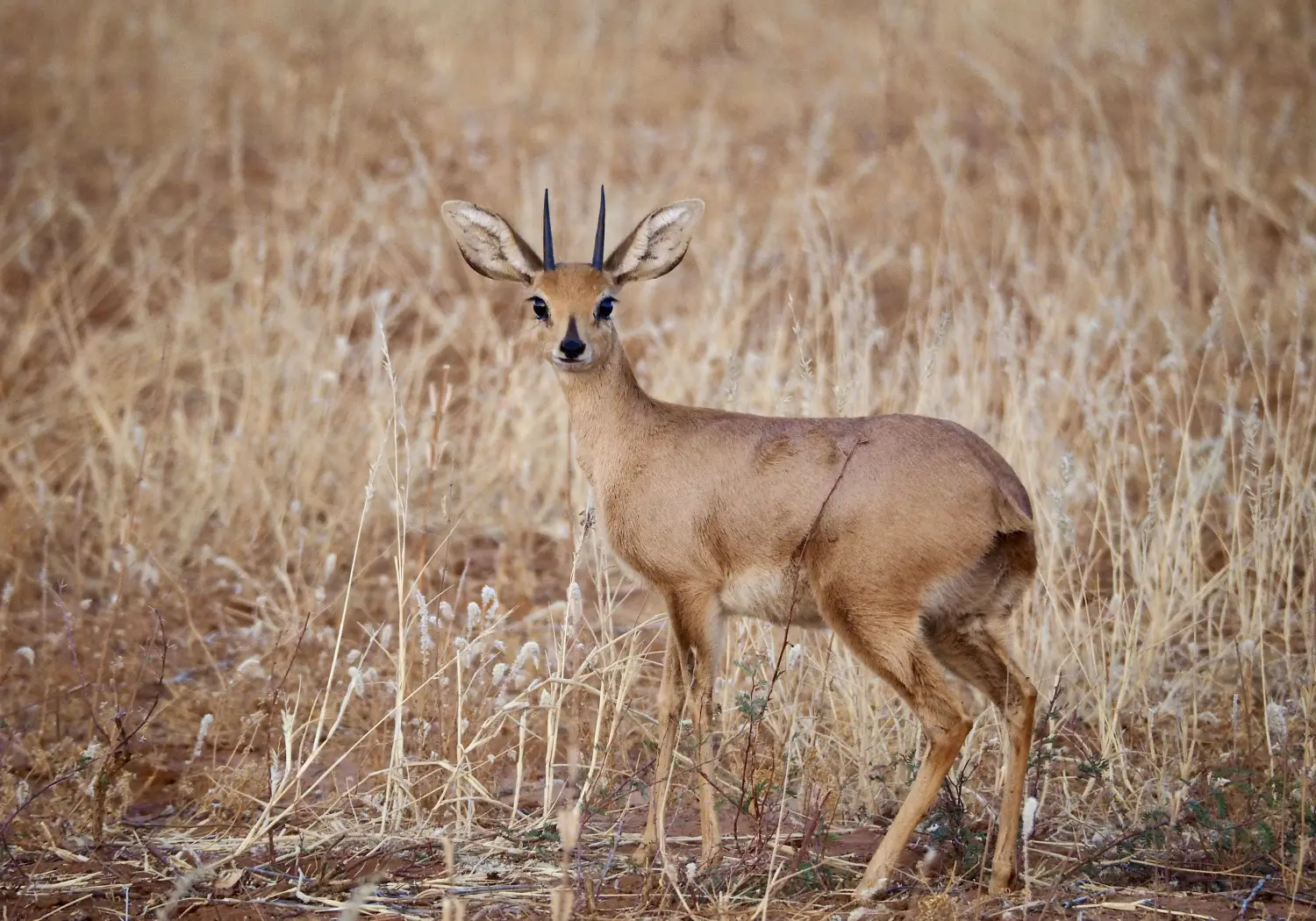
The common duiker is small and compact, with a slim body, a slightly arched back and long, thin legs. Its coat is grizzled grey to yellowish-brown with a paler belly, and a dark stripe often runs down the face. The most telling feature is the tuft of long hair on the forehead, which can partly hide the horns.
Males carry short, sharp, nearly straight horns, while females are usually hornless or have tiny stubs. Females are often slightly larger than males.
Where Do Common Duikers Live?
Unlike its forest-dwelling cousins, the common duiker is a generalist. It thrives wherever there is bush for cover: savanna thickets, scrub, woodland edges, rocky hills, and even gardens and farmland. It avoids true rainforest and very open, treeless plains, and it copes well with dry conditions because it gets much of its moisture from food.
In Kenya, it ranges across most of the country’s bushed and wooded landscapes. Browse our guide to Kenya’s national parks and reserves to see where these habitats are found.
What Do Common Duikers Eat?
The common duiker is a flexible feeder. It browses on leaves, shoots, flowers, seeds and fruit, often picking up fallen fruit beneath trees. It also eats insects and, occasionally, other small animal food, which is unusual for an antelope. This varied diet is a big reason it survives in so many habitats.
Common Duiker Behaviour
Duikers are solitary or live in pairs, and each animal keeps a territory marked with scent from glands near the eyes. They are shy and mostly active at dawn, dusk and through the night, resting in thick cover during the day.
The “Dive” Escape
When threatened, a duiker freezes, then bolts in a zigzag and plunges into thick vegetation. This is the behaviour that gave the animal its name. A duiker may also give a short snort or whistle as an alarm.
Breeding
Females usually give birth to a single young after a pregnancy of roughly four months. The calf is hidden in dense cover for its first weeks while its mother returns to nurse it.
Is the Common Duiker Endangered?
No. The common duiker is widespread and is assessed as Least Concern on the IUCN Red List. Its adaptability helps, but local pressure from snaring, bushmeat hunting and habitat clearance is real. You can see where people have recorded it across Africa on iNaturalist.
Protected areas and community conservancies keep the bushy habitat many small antelopes rely on. Learn more about conservation-based safaris in Kenya.
How to See a Common Duiker on Safari in Kenya
Duikers reward patience. Here is how to improve your chances.
Look at the edges
Scan bushy margins where thick cover meets open ground, such as riverbanks, thickets and woodland clearings.
- Masai Mara: check the thickets along drainage lines and rivers. See our Masai Mara safaris.
- Lake Nakuru: the bushland and woodland around the lake. See our Lake Nakuru National Park page.
- Nairobi National Park: scrub and valley bush. Try our Nairobi National Park private 4x4 safari.
Go early and late
Ask your guide to be on the road at first light and again before dusk, when duikers step out to feed.
Build a varied route
The 7-day Kenya Elephants, Lakes and Masai Mara safari passes through woodland, lakes and plains, which gives you more chances to spot small antelope. You can also browse Kenya wildlife safaris.
Travel in the dry season
Short grass and thinner undergrowth make animals easier to see. The drier months are generally June to October and January to February. See our best time to visit Kenya guide.
Photograph with patience
A duiker pausing at the bush edge is a quick, rewarding shot. Bring a long lens and keep the vehicle still. Our photographic safaris in Kenya are designed for moments like this.
Responsible Wildlife Viewing
Switch off the engine, keep your voice low and avoid sudden movements. A calm duiker may linger, while a startled one vanishes in a second.
Interesting Facts About the Common Duiker
The word duiker comes from an Afrikaans word meaning diver, a nod to how it plunges into cover.
The common duiker is one of the most widespread antelopes in Africa and lives in many different habitats.
Unlike most antelopes, it will eat insects and occasionally other small animal food.
Only males usually carry horns, and they are short and sharp.
A tuft of hair on the forehead is the easiest feature for spotting a common duiker.
It can survive without drinking regularly because it gets much of its moisture from leaves and fruit.
Frequently Asked Questions About the Common Duiker
What is a common duiker?
A small, shy antelope with a grey to fawn coat, a forehead tuft and short horns in males. It lives in bush and woodland across much of sub-Saharan Africa.
Why is it called a duiker?
Duiker is Afrikaans for “diver”, because the animal dives into thick cover when alarmed.
Where can I see a common duiker in Kenya?
Try the Masai Mara, Lake Nakuru, Nairobi National Park, Amboseli and Tsavo, especially at bushy edges at dawn and dusk. Sightings are never guaranteed.
What does a common duiker eat?
Leaves, shoots, flowers, seeds and fruit, plus some insects.
Do female duikers have horns?
Usually not. Females are mostly hornless or have tiny stubs.
Is the common duiker endangered?
No. It is listed as Least Concern, though snaring and habitat loss affect it locally.
What is the difference between a duiker and a dik-dik?
Dik-diks are even smaller, with a distinctive long, flexible nose and a rounded body, and prefer dry bush. Duikers are larger, with a forehead tuft and a more arched back.
When is the best time to see a common duiker?
Dawn and dusk. The dry months, June to October and January to February, make viewing easier.
Plan Your Bush and Woodland Safari in Kenya
Want to explore the thickets where duikers, dik-diks and bushbuck hide? Olengugih Safaris can design a private, flexible Kenya itinerary around the Mara, Nakuru, Nairobi and beyond. Start planning your safari or contact our team for a free quote.
Interesting facts and identification clues
Interesting Facts About the Common Duiker
- The word duiker comes from an Afrikaans word meaning diver, a nod to how it plunges into cover.
- The common duiker is one of the most widespread antelopes in Africa and lives in many different habitats.
- Unlike most antelopes, it will eat insects and occasionally other small animal food.
- Only males usually carry horns, and they are short and sharp.
- A tuft of hair on the forehead is the easiest feature for spotting a common duiker.
- It can survive without drinking regularly because it gets much of its moisture from leaves and fruit.
Content reviewed 16 Oct 2026