About the Defassa Waterbuck
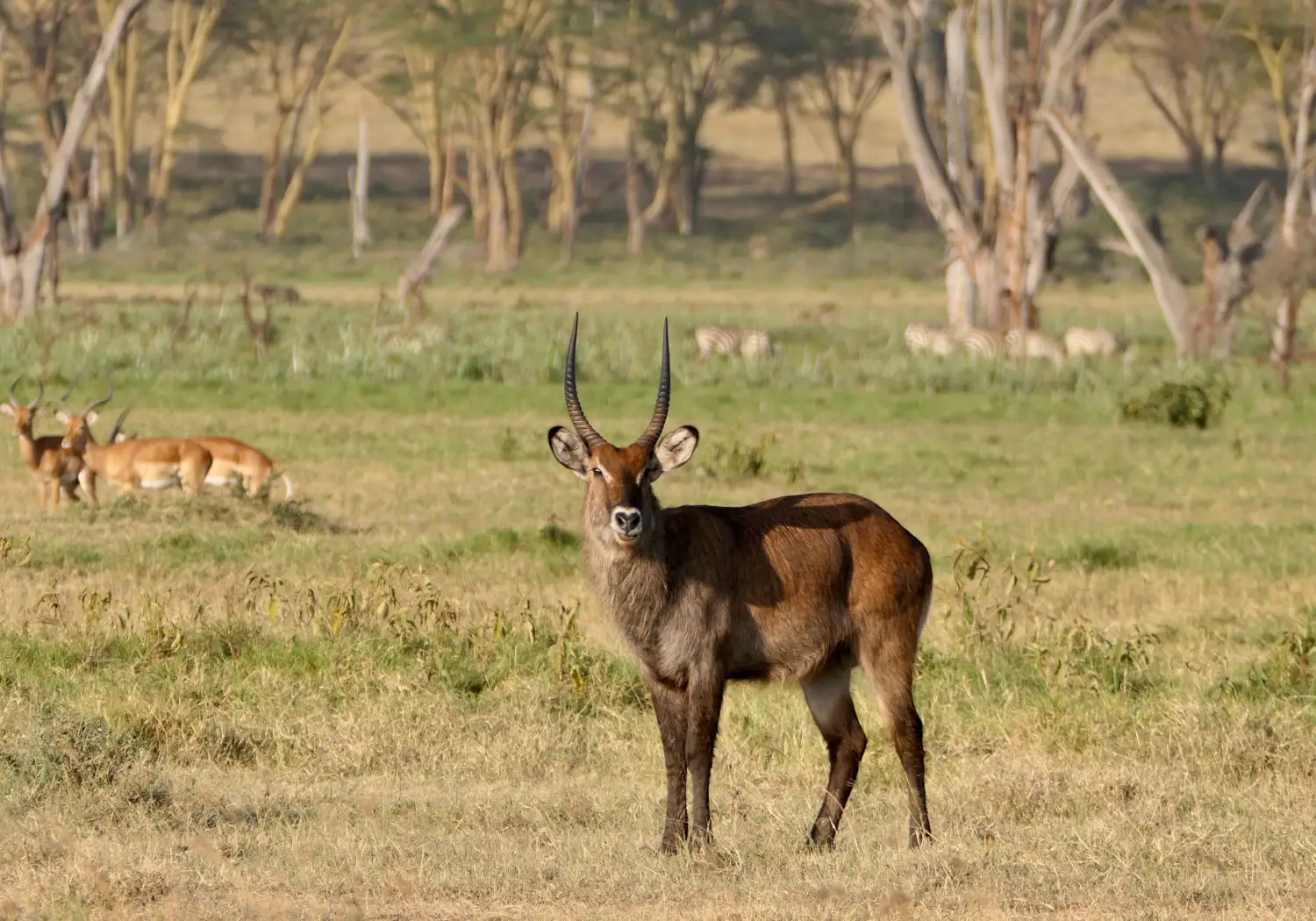
The defassa waterbuck (Kobus ellipsiprymnus defassa) is a large, heavily built antelope with a long, shaggy, grey-brown coat, a white throat patch and, in males, long ridged horns that sweep upward. It is a subspecies of the waterbuck and is easy to tell from its cousin by one feature: a solid white patch on the rump, rather than a white ring. In Kenya, it is a regular sight along rivers, lakes and marshy edges of the Rift Valley.
Quick answer: The defassa waterbuck is a large, water-dependent antelope found across central and western Africa and the western side of Kenya’s Rift Valley. In Kenya, look for it in the Masai Mara, Lake Nakuru and around Lake Naivasha, usually grazing near water at dawn and dusk. Sightings are never guaranteed.
What Does a Defassa Waterbuck Look Like?
A waterbuck is a big, robust antelope with a thick neck, a stocky body and a coarse, shaggy coat that ranges from grey-brown to dark brown. A pale throat patch and white markings around the muzzle and eyes lighten the face. Only males carry horns. These are long, ridged and curve gently backward and then up, often reaching around 80 cm or more.
The defassa’s solid white rump patch is the main giveaway. The common waterbuck, by contrast, has a clear white ring on the rump.
Defassa Waterbuck vs Common Waterbuck: What Is the Difference?
The two forms are closely related and are considered one species, but they look different and occupy different ranges.
- Defassa waterbuck: solid white rump patch; found mainly in western and central Africa and in Kenya west of the Rift Valley.
- Common (ellipsen) waterbuck: a white ring on the rump; found mainly in eastern and southern Africa, including Kenya’s eastern parks.
- Where they meet: the two forms overlap and interbreed in some places, so you may see animals with in-between markings.
Ask your guide which form you are looking at, because the rump is the quickest way to tell.
Where Do Defassa Waterbuck Live?
Waterbuck are tied to water. They live on grassland and in open woodland close to rivers, lakes and marshes, and they need to drink regularly. They avoid very dry country, and they often rest in the shade of trees near water in the heat of the day.
In Kenya, that means lakeshores, riverbanks and wet grassland. Browse our guide to Kenya’s national parks and reserves to see where these habitats are found.
What Do Waterbuck Eat?
Waterbuck are mostly grazers. They feed on grass, often longer, coarser grass that other antelopes pass by, and they add leaves and herbs when grass is scarce. They graze mainly in the morning and late afternoon and spend the middle of the day resting in cover.
Waterbuck Behaviour
Waterbuck live in a loose social system. Females and young gather in herds. Adult males hold territories close to water, while younger males form bachelor groups.
The Water Escape
When a predator approaches, a waterbuck will often run into the water and stand there, a tactic that helps it escape. It also relies on its speed and on sheer size to deter smaller predators.
The Oily Coat
The shaggy coat carries an oily secretion that gives waterbuck a distinctive musky smell. Some say it makes them less tasty to predators, but lions, leopards and crocodiles still take waterbuck regularly.
Breeding
Females give birth to a single calf after a pregnancy of about eight months. The calf is hidden in thick cover for its first weeks, and the mother returns to nurse it.
Is the Defassa Waterbuck Endangered?
The waterbuck is listed as Least Concern on the IUCN Red List, but its numbers are falling in places because of habitat loss, hunting and the drying of wetlands. You can explore recorded sightings across Africa on iNaturalist.
Protecting rivers, lakes and wetlands helps waterbuck and countless other species. Learn more about conservation-based safaris in Kenya.
How to See Defassa Waterbuck on Safari in Kenya
Waterbuck are among the easier large antelopes to find if you look near water.
Check the water’s edge
- Masai Mara: riverbanks and wet grassland. See our Masai Mara safaris.
- Lake Nakuru: the grassy shoreline and woodland edges. See our Lake Nakuru National Park page.
- Lake Naivasha area: fringes of the lake and nearby woodland. See our Lake Naivasha page.
- Nairobi National Park: valley grassland and dams. Try our Nairobi National Park private 4x4 safari.
Go early and late
Morning and evening bring waterbuck out to graze. Ask your guide to check shaded water margins at midday.
Build a route with variety
The 7-day Kenya Elephants, Lakes and Masai Mara safari crosses lakes, wetlands and plains, which suits waterbuck. You can also browse Kenya wildlife safaris.
Travel in the dry season
Animals gather close to water and the grass is shorter. The drier months are generally June to October and January to February. See our best time to visit Kenya guide.
Photograph the white rump
A waterbuck walking away with its white rump patch glowing is a classic frame. Bring a long lens and shoot in soft light. Our photographic safaris in Kenya are built for moments like this.
Responsible Wildlife Viewing
Keep a respectful distance, switch off the engine and avoid sudden movements. Males can be territorial, so never approach on foot.
Frequently Asked Questions About the Defassa Waterbuck
What is a defassa waterbuck?
A large, shaggy antelope with a solid white rump patch that lives near water in western, central and parts of eastern Africa. It is a subspecies of the waterbuck.
What is the difference between a defassa and a common waterbuck?
The defassa has a solid white rump patch, while the common waterbuck has a white ring on the rump. Their ranges also differ.
Where can I see defassa waterbuck in Kenya?
Try the Masai Mara, Lake Nakuru, the Lake Naivasha area and Nairobi National Park, especially near rivers and lakes. Sightings are never guaranteed.
What do waterbuck eat?
Mostly grass, plus some leaves and herbs.
Do female waterbuck have horns?
No. Only males carry horns.
Why do waterbuck stay near water?
They need to drink regularly and use water as an escape route from predators.
Are waterbuck endangered?
No. The waterbuck is listed as Least Concern, though numbers are falling in some areas.
When is the best time to see waterbuck?
Early morning and late afternoon. The dry months, June to October and January to February, help because animals gather near water.
Plan Your Lakes and Rivers Safari in Kenya
Want to watch waterbuck, hippos and waterbirds along Kenya’s lakes and rivers? Olengugih Safaris can design a private, flexible Kenya itinerary through the Mara, Nakuru, Naivasha and Nairobi. Start planning your safari or contact our team for a free quote.
Interesting facts and identification clues
Interesting Facts About the Defassa Waterbuck
- The defassa waterbuck is told apart by its solid white rump patch, while its cousin shows a white ring.
- Waterbuck never stray far from water and need to drink regularly.
- Its shaggy coat carries an oily secretion that gives it a musky smell.
- When threatened, a waterbuck will often run into water to escape.
- Only males carry horns, and these are long, ridged and curved.
- Defassa and common waterbuck overlap in some areas and sometimes interbreed.
Content reviewed 16 Oct 2026