About the Serval Cat
Serval Cat: Africa’s High-Jumping Grassland Hunter
The serval cat (Leptailurus serval) is a slender, golden-coated wild cat with the longest legs, neck and ears for its size of any African small cat, which is why guides often call it the “giraffe cat”. It is a master of tall grass: it stands over the stems on stilt-like legs, listens for rodents with ears that rotate like radar dishes, then launches into a spectacular pounce. For many travellers, a serval is the highlight of a Kenya safari, and it is one of the most rewarding small cats to look for on an early-morning game drive.
Quick answer: The serval is a medium-sized wild cat found across most of sub-Saharan Africa, living in long grass near water. In Kenya, you can look for servals in places such as the Masai Mara, Amboseli, Lake Nakuru and Nairobi National Park. They are best seen at dawn and dusk, but sightings are never guaranteed.
What Does a Serval Cat Look Like?
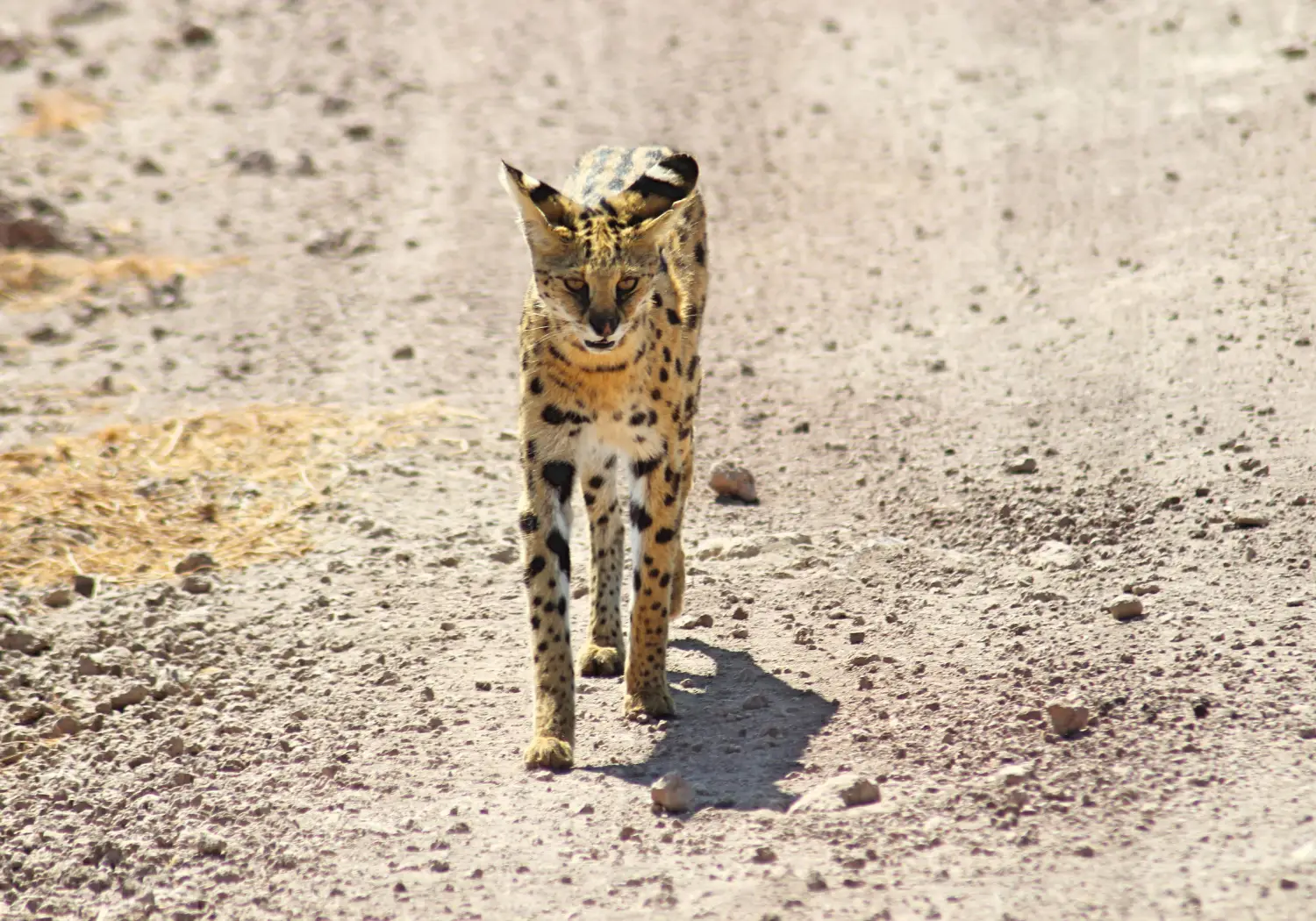
A serval cat is easy to recognise once you know what to look for. Its pale yellow-to-tawny coat is covered in bold black spots that often merge into stripes along the neck and back, and its short tail is ringed in black. The ears are large, rounded and set close together, with black backs and a white spot, and the head looks small compared with the long neck and body.
Adults stand about 45-60 cm at the shoulder and weigh roughly 9-18 kg, so they are much lighter than a leopard or cheetah. In some highland areas of East Africa, entirely black (melanistic) servals are regularly reported, a rare treat for sharp-eyed guests.
Serval or caracal? A caracal has a plain, uniform tawny coat and black ear tufts, while a serval has spots and stripes and rounded ears without tufts. Servals also have much longer legs.
Where Do Servals Live?
Servals are wetland specialists. They live in well-watered savanna with long grass, reed beds and riverside vegetation, and they avoid dense forest and very dry deserts. Water matters because their favourite prey, rodents, are most abundant in damp, thick grass.
In Kenya, that means marshy plains, river lines and lake edges. Read more about similar landscapes in our guide to Kenya’s national parks and conservancies.
How Servals Hunt
The serval’s hunting style is what makes it famous. It stands still, tilts its ears and pinpoints a rodent by sound, even underground. Then it leaps up to 3 metres into the air and pounces, stunning prey with its forepaws. It can also hook rodents out of burrows with its long, flexible toes and snatch birds in mid-air.
The results are remarkable: servals succeed in roughly half of their hunts, a rate far higher than most cats and well above that of a lion hunting alone. Servals avoid hunting on very windy days, because rustling grass makes it hard to hear prey.
Behaviour and Breeding
Servals are mostly solitary and most active at dawn, dusk and through the night. A female raises one to four kittens, after a pregnancy of around 70 days, in a den hidden in thick grass or a burrow. The kittens stay hidden for their first weeks, so a sighting of a mother with young is a rare and special moment.
How to See Servals on Safari in Kenya
A serval sighting takes patience and good guiding, but a few choices raise your chances:
1. Choose grass and water.
Focus on the edges of marshes, rivers and tall grass.
- Masai Mara: the open plains, riverbanks and surrounding conservancies are among Kenya’s best-known serval areas.
- Amboseli: swamp edges and grassy fringes beneath Kilimanjaro can produce sightings.
- Lake Nakuru: grassland and woodland around the lake.
- Nairobi National Park: servals are occasionally seen, making it a good option for a short stay.
2. Go early and late.
Servals are crepuscular, so sunrise and late afternoon are your best windows. Our Nairobi National Park private 4x4 safari starts early for just this reason.
3. Pick a route that covers several habitats.
The 7-day Kenya Elephants, Lakes and Masai Mara safari links Amboseli, Lake Naivasha, Lake Nakuru and the Mara, giving you several serval habitats in one journey. For something shorter, try a 3-day Masai Mara safari. You can also browse more routes through Kenya wildlife safaris.
4. Travel in the dry season.
Shorter grass makes cats easier to spot, generally June to October and January to February. See our best time to visit Kenya guide.
5. Be ready to photograph.
Servals move quickly and often stay half hidden in grass. A zoom lens, quick shutter speed and a patient driver help, so our photographic safaris in Kenya are a good fit.
6. Ask your guide to stop and listen.
Servals often freeze in tall grass. A quiet engine and a few minutes of patience can reveal a cat that you would otherwise drive past.
Is the Serval Cat Endangered?
No. The serval is rated Least Concern and is widespread south of the Sahara, though some local populations are under pressure. The main threats are wetland drainage and conversion to farmland, persecution by people protecting poultry, and the sale of pelts. Because servals depend on healthy wetlands, they are a useful sign of how well those habitats are doing. Protecting wetlands and conservancy land helps servals and the many other species that share them. Learn more about conservation-based safaris in Kenya.
Responsible Serval Viewing
- Keep a respectful distance and avoid sudden noise or movement.
- Never chase a serval or block its path through the grass.
- Follow your guide’s directions, especially near dens.
Frequently Asked Questions About Servals
What is a serval?
A serval is a medium-sized African wild cat with very long legs, big ears and a spotted golden coat, known for its high pounces.
Where can I see servals in Kenya?
Look in the Masai Mara and its conservancies, Amboseli, Lake Nakuru, Ol Pejeta and Nairobi National Park. Sightings are never guaranteed.
How high can a serval jump?
Up to about 3 metres, which lets it catch birds in mid-air.
What do serval cats eat?
Mostly rodents, plus birds, frogs, reptiles and insects.
What is the difference between a serval and a caracal?
Servals have spots, long legs and rounded ears. Caracals have plain tawny coats and black ear tufts.
Are servals dangerous to people?
Servals are shy and avoid people. Treat them as any wild animal and keep your distance.
Can a serval be a pet?
No. Servals are wild animals and do not make suitable pets. The popular Savannah cat is a hybrid of a serval and a domestic cat, and keeping them is restricted in some places.
Are servals endangered?
No. They are listed as Least Concern, though wetland loss is a concern in some areas.
Plan Your Serval Safari in Kenya
Hoping to spot Africa’s giraffe cat? Olengugih Safaris can design a private, flexible Kenya itinerary through the Mara, Amboseli, Nakuru and beyond, with early starts and guides who know where to look. Start planning your safari or contact our team for a free quote.
Interesting facts and identification clues
- A serval can leap up to three metres straight up, high enough to snatch a bird out of the air.
- Servals succeed in roughly half of their hunts, far more often than a lone lion.
- Their large ears swivel like radar dishes and can pinpoint rodents moving underground.
- Wind spoils their hunting, because rustling grass drowns out the sounds of prey, so servals usually avoid hunting on windy days.
- Their long legs and neck have earned them the nickname giraffe cat, and they are the tallest of Africa’s small cats.
- The popular Savannah cat is a cross between a serval and a domestic cat, but servals themselves are wild animals and not pets.
Content reviewed 16 Oct 2026