About the Grant's gazelle
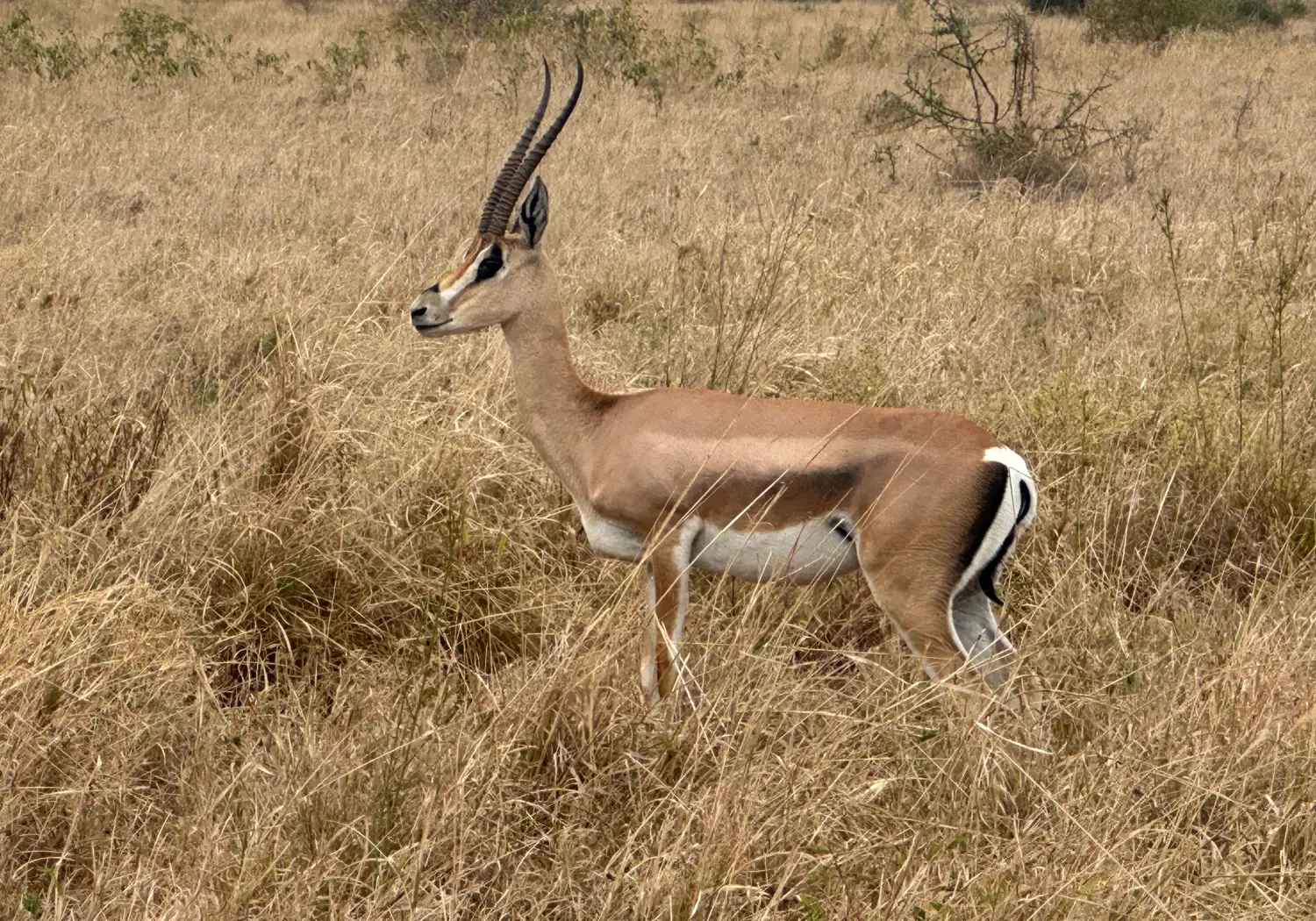
Grant's gazelle (Nanger granti) is a medium-sized, sandy-fawn gazelle with a white belly, a white rump and long, ringed horns shaped like a lyre. It is one of the most common antelopes on Kenya's plains: the 2021 national wildlife census counted 66,709, one of the country's largest wildlife populations. In Swahili it is called swala granti. It is often seen alongside the smaller Thomson's gazelle, but it is larger, paler and has much bigger horns.
Quick answer: Grant's gazelle is a plains antelope of Kenya, Tanzania and neighbouring countries in East Africa. In Kenya, look for it on open grassland and dry bush in the Masai Mara, Amboseli, Nairobi National Park, Tsavo, Samburu and Laikipia. It can live in drier country than most antelopes and is active through the day. Sightings are never guaranteed.
What Does a Grant's Gazelle Look Like?
Grant's gazelle is a slender, long-legged antelope with a sandy-fawn back, a white belly and a white rump. The white of the rump runs up above the base of the tail, framed by thin dark edges. Dark lines run from the eyes to the muzzle. Some animals, especially young ones and females, show a faint dark stripe along the flank.
Both sexes carry horns. A male's horns are thick at the base, heavily ringed and curve up and back in a lyre shape, reaching about 45–81 cm. A female's horns are shorter, thinner and straighter.
Grant's Gazelle vs Thomson's Gazelle: How to Tell Them Apart
The two gazelles often graze together on the same plains, so this is one of the first things guides teach.
- Size: Grant's gazelle is clearly bigger and taller; Thomson's gazelle is small and compact.
- Rump: on a Grant's, the white rump patch extends above the tail. On a Thomson's, the white stops below the tail.
- Flank stripe: a Thomson's gazelle has a bold black stripe along each side. Grant's gazelles usually have no stripe, or only a faint one.
- Tail: Thomson's gazelles flick their black tails almost constantly.
- Horns: Grant's males carry much longer, heavier horns.
Peters's and Bright's Gazelle
In 2021, the American Society of Mammalogists recognised two former Grant's gazelle subspecies as full species. Bright's gazelle (Nanger notata) lives in northern Kenya, and Peters's gazelle (Nanger petersii) lives in the coastal and eastern lowlands. Many field guides still treat them as Grant's gazelles, so ask your guide which form you are looking at in northern and eastern Kenya.
Where Do Grant's Gazelles Live?
Grant's gazelles live on open grassland, savanna and dry bushland, from moist highland plains to semi-desert. They avoid thick woodland and tall grass, where predators can hide. Their range covers Kenya and northern Tanzania, reaching into Ethiopia, South Sudan, Somalia and north-eastern Uganda. Kenya holds the largest share of the population.
They are well suited to dry country. They can go long periods without drinking, getting most of their water from their food, and they let their body temperature rise during the heat of the day to save water.
Browse our wildlife guide and Kenya destinations to see where these habitats are found.
What Do Grant's Gazelles Eat?
Grant's gazelles are mixed feeders. They graze fresh grass in the wet season and switch to leaves, shoots, herbs and shrubs as the grass dries out. In the dry season they also feed at night, when plants hold more moisture.
Grant's Gazelle Behaviour
Grant's gazelles live in herds that range from a handful of animals to several hundred. Females and young form nursery herds, young males form bachelor groups, and mature males hold territories.
Territorial Males
A territorial male stands in plain view to show off his status. He marks his boundary with dung and urine and sometimes rips up grass with his horns. Rival males fight by locking horns and twisting their necks.
Safety in Mixed Herds
Grant's gazelles often join herds of Thomson's gazelle, impala, plains zebra and wildebeest, so more eyes watch for danger. When alarmed, they flee in high, springing bounds called stotting. Cheetahs, lions, leopards, wild dogs and hyenas hunt them, and jackals take young fawns.
Breeding
Females give birth to a single fawn after a pregnancy of about six and a half to seven months. The fawn lies hidden in grass for its first weeks while the mother grazes nearby, returning to nurse it.
Is Grant's Gazelle Endangered?
No, but it is in decline. The IUCN Red List lists Grant's gazelle as Least Concern with a falling population, and conservationists warn it could be moved to Near Threatened. Kenya's 2024–25 national wildlife census reported further declines in Grant's gazelle on the country's rangelands. Drought, bushmeat poaching, competition with livestock and the loss of open rangeland to farms and fences are the main pressures. You can explore recorded sightings on iNaturalist.
Community conservancies that keep rangelands open help Grant's gazelles and many other plains animals. Learn more about our conservation-based safaris in Kenya.
How to See Grant's Gazelle on Safari in Kenya
Grant's gazelles are among the easiest antelopes to see in Kenya, especially on short-grass plains.
Scan the Open Plains
- Masai Mara: herds on the open grassland, often mixed with Thomson's gazelles. See our Masai Mara National Reserve guide.
- Amboseli: dry, open plains with Kilimanjaro behind. See our Amboseli National Park guide or the 3-day private Amboseli safari from Nairobi.
- Nairobi National Park: the open southern plains. Try our Nairobi National Park private 4x4 safari.
- Tsavo East and Samburu: drier bush country, where some guides will point out Peters's or Bright's gazelle. See our Tsavo East National Park and Samburu National Reserve guides.
- Laikipia: conservancy plains with mixed herds of plains game, such as Ol Pejeta and Lewa. Browse all Kenya conservancies.
Watch Through the Day
Grant's gazelles graze through much of the day, so you can see them on any game drive. Early morning and late afternoon give the best light and the most activity from predators hunting them.
Build a Route With Variety
The 7 Day Kenya Elephants, Lakes and Masai Mara Safari covers Amboseli and the Mara, two of the best places for Grant's gazelle. You can also browse our Kenya wildlife safaris.
Travel in the Dry Season
Short grass makes herds easy to spot. The drier months are generally June to October and January to February. Travelling in the wet months instead? Read Can I do a Kenya safari during the rainy season?
Photograph the Horns
A territorial male standing alone on the plain, horns outlined against the sky, makes a striking photo. Shoot low and in soft light. Our photographic safaris in Kenya are built for moments like this.
Responsible Wildlife Viewing
Keep your distance, switch off the engine and avoid sudden movements. If you find a fawn lying alone in the grass, leave it be: its mother is nearby and will return once you move on.
Frequently Asked Questions About Grant's Gazelle
What is a Grant's gazelle?
A medium-sized East African gazelle with a sandy-fawn coat, a white belly and rump and long, ringed, lyre-shaped horns. Its scientific name is Nanger granti.
How big is a Grant's gazelle?
Adults stand about 75–95 cm at the shoulder. Males weigh up to about 80 kg, and females are smaller.
Do female Grant's gazelles have horns?
Yes. Both sexes have horns, but females' horns are shorter, thinner and straighter.
What is the difference between Grant's and Thomson's gazelle?
Grant's gazelle is bigger, with longer horns and a white rump patch that extends above the tail. Thomson's gazelle is smaller, has a bold black side stripe and a constantly flicking black tail.
What do Grant's gazelles eat?
Grass in the wet season, and more leaves, shoots and shrubs in the dry season.
Where can I see Grant's gazelle in Kenya?
Try the Masai Mara, Amboseli, Nairobi National Park, Tsavo, Samburu and Laikipia. Sightings are never guaranteed.
Is Grant's gazelle endangered?
No. It is listed as Least Concern, but numbers are falling, including in Kenya.
When is the best time to see Grant's gazelle?
Year-round, on almost any game drive on the plains. The dry months, June to October and January to February, give the best visibility.
Plan Your Kenya Plains Safari
Want to see gazelles, zebras and the big cats that hunt them? Olengugih Safaris can design a private, flexible Kenya itinerary through the Mara, Amboseli, Nairobi and beyond. Start planning your safari or contact our team for a free quote.
Interesting facts and identification clues
- Grant's gazelle is named after the Scottish explorer James Augustus Grant, who travelled through East Africa in the 1860s.
- Both males and females carry horns, but the males' are far longer and heavier.
- It can go a long time without drinking, getting most of its water from the plants it eats.
- It lets its body temperature rise in the midday heat to save water instead of sweating it away.
- Territorial males stand out in the open so that rivals and females can see them.
- It often joins herds of Thomson's gazelle, which gives both species more eyes to watch for predators
Content reviewed 19 Oct 2026