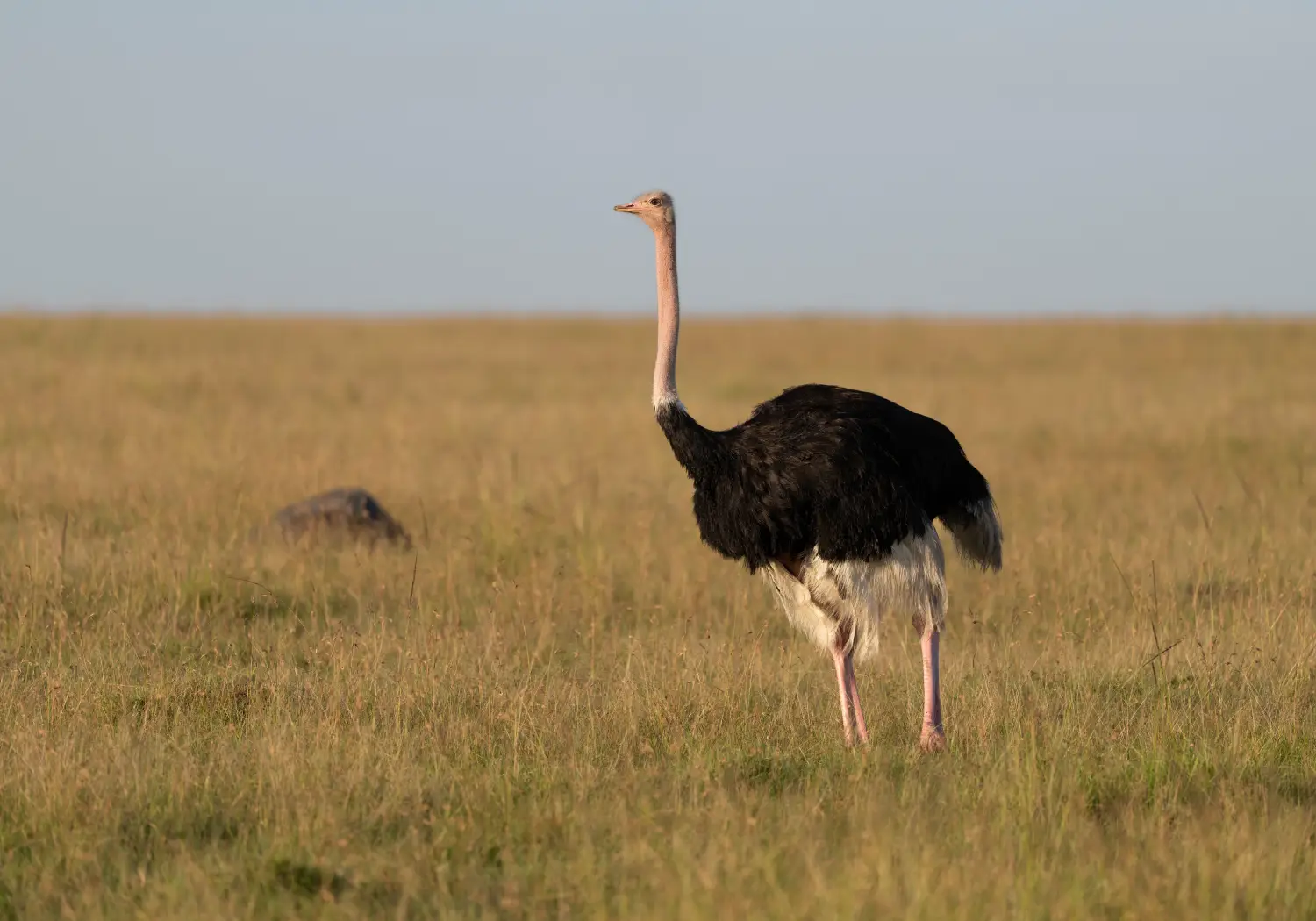
About the Masai Ostrich
The Masai ostrich (Struthio camelus massaicus), also called the pink-necked or East African ostrich, is a subspecies of the common ostrich, the largest and heaviest bird alive. Males stand up to about 2.75 m tall, with black-and-white plumage and bare pink skin on the neck and thighs that turns almost red in the breeding season. Females are greyish-brown. Ostriches cannot fly, but they can sprint at up to about 70 km/h, faster than any other bird on land, and they lay the biggest eggs of any living bird.
Quick answer: The Masai ostrich lives on the open plains and savanna of southern Kenya, Tanzania and parts of Uganda. In Kenya, look for it in the Masai Mara, Amboseli, Nairobi National Park, Tsavo West and the Chyulu Hills. In northern and eastern Kenya you'll find its blue-necked cousin, the Somali ostrich, instead. Sightings are never guaranteed.
What Does a Masai Ostrich Look Like?
The Masai ostrich is unmistakable: a huge bird with a long, almost bare neck, long powerful legs and a small head with large eyes. Adult males have black body feathers with white plumes on the wings and tail, and the bare skin of their neck and thighs is pink. In the breeding season it brightens to a deep pinkish-red. Masai ostriches also have small bristle-like feathers on the crown and a thin white ring at the base of the neck. Females are greyish-brown with paler, beige-pink skin, and they are smaller than males.
Ostriches have only two toes on each foot, the inner one much larger and tipped with a long, sharp claw. These feet and legs make them superb runners, and dangerous kickers.
Masai Ostrich vs Somali Ostrich
Kenya is home to two kinds of ostrich, and they look and behave quite differently.
- Masai ostrich: males have pink to red necks and thighs. It is a grazer of open savanna in southern Kenya and Tanzania.
- Somali ostrich: males have blue-grey necks and thighs, turning bright blue in the breeding season, with no broad white neck ring. It prefers dry bushland in northern and eastern Kenya, Ethiopia and Somalia. Since 2014 it has been recognised as a separate species, Struthio molybdophanes, and it is listed as Vulnerable. Read our Somali ostrich profile.
- Where they meet: the two overlap in parts of north-eastern Kenya, but rarely interbreed because they use different habitats.
Where Do Masai Ostriches Live?
Masai ostriches live on the open grassland and savanna of southern Kenya and Tanzania, and in parts of Uganda. They prefer flat, open country with good visibility, where they can spot predators from a distance and outrun them. They can go for long periods without drinking, getting much of their water from plants.
Browse our wildlife guide and Kenya national parks to see where these habitats are found.
What Do Masai Ostriches Eat?
Ostriches are mainly plant eaters. They peck at grasses, seeds, leaves, shoots, flowers and fruit, and also eat insects, lizards and other small animals when they find them. They swallow small stones and grit, which help grind food in their gizzard.
Masai Ostrich Behaviour
Ostriches are active by day. Outside the breeding season they may form loose, nomadic groups, often mixing with zebras and antelopes on the plains.
Built for Speed
An ostrich can sprint at up to about 70 km/h and keep up about 50 km/h over long distances, covering 3–5 m in a single stride. It uses its wings like rudders to change direction.
Powerful Kicks
When cornered, an ostrich kicks forward and down with enormous force. The long claw on its inner toe can seriously injure or even kill a predator.
Not Head in the Sand
Ostriches don't bury their heads in the sand. When threatened or sitting on a nest, they may lie flat with their neck stretched along the ground, which from a distance makes them look like a mound of earth.
Courtship Dance
In the breeding season, a male with a bright pink neck performs a dramatic display, sinking to the ground, spreading and waving his wings, and swinging his neck from side to side.
Communal Nests
A territorial male scrapes a shallow nest in the ground. His dominant female, the "major hen", lays her eggs there, and other females add theirs, so a single nest can hold dozens. The major hen sits on the eggs by day, when her brown feathers blend in, and the black male sits by night. Eggs hatch after about six weeks.
Predators
Adult ostriches are taken mainly by lions, cheetahs and leopards. Eggs and chicks fall to hyenas, jackals and Egyptian vultures, which crack eggs by throwing stones at them.
Is the Masai Ostrich Endangered?
Not as a species. The common ostrich, which includes the Masai ostrich, is listed as Least Concern on the IUCN Red List, but National Geographic notes that its population is decreasing. Ostriches have disappeared from much of their former range because of hunting for feathers, meat and eggs, and the loss of open grassland to farming and fencing. Masai ostriches remain common in protected areas, but little is known about their numbers outside them. The closely related Somali ostrich of northern Kenya is listed as Vulnerable. You can explore recorded sightings on eBird and iNaturalist.
Learn how your trip can support wildlife with our conservation-based safaris in Kenya.
How to See Masai Ostriches on Safari in Kenya
Masai ostriches are easy to see on Kenya's open southern plains. Their height makes them visible from far away.
Where to Look
- Masai Mara: open plains throughout the reserve and conservancies. See our Masai Mara National Reserve guide.
- Amboseli: the dry lakebed and open plains, with Kilimanjaro behind. See our Amboseli National Park guide.
- Nairobi National Park: the open southern plains, just outside the city. Try our Nairobi National Park private 4x4 safari.
- Tsavo West and Chyulu Hills: open grassland and volcanic plains. See our Tsavo West and Chyulu Hills guides.
- Northern Kenya: for the blue-necked Somali ostrich instead, head to Samburu.
Watch for the Courtship Dance
In the breeding season, look for males with bright pink necks displaying to females, a spectacular sight on the open plains.
Look for Nests and Chicks
After the rains, you may see a male ostrich leading a crèche of dozens of chicks across the grass.
Build a Route With Variety
The 7 Day Kenya Elephants, Lakes and Masai Mara Safari visits Amboseli and the Mara, both excellent for Masai ostriches. Add Samburu to see the Somali ostrich too, with the 8 Day Kenya Safari: Samburu, Ol Pejeta, Naivasha, Mara.
Travel in the Dry Season
Short grass makes the plains easy to scan. The drier months are generally June to October and January to February. Travelling in the wet months instead? Read Can I do a Kenya safari during the rainy season?
Photograph the Giant
A male Masai ostrich, neck glowing pink, striding across the Amboseli plains with Kilimanjaro behind, is a classic Kenyan shot. Our photographic safaris in Kenya are built for moments like this.
Responsible Wildlife Viewing
Keep your distance, especially from nests and chicks; adult ostriches defend them fiercely and can deliver a dangerous kick. Stay in the vehicle, switch off the engine and never chase a running ostrich with a vehicle.
Frequently Asked Questions About the Masai Ostrich
What is a Masai ostrich?
The pink-necked subspecies of the common ostrich, found in southern Kenya, Tanzania and parts of Uganda. Its scientific name is Struthio camelus massaicus.
How big is a Masai ostrich?
Males stand about 2.1–2.75 m tall and weigh about 100–150 kg; females are smaller.
How fast can an ostrich run?
Up to about 70 km/h in short bursts, and about 50 km/h over longer distances.
What is the difference between the Masai and Somali ostrich?
Masai ostrich males have pink necks and thighs and live in southern Kenya. Somali ostrich males have blue-grey skin and live in northern and eastern Kenya. The Somali ostrich is now considered a separate species.
What do ostriches eat?
Mainly plants, including grass, seeds, leaves, flowers and fruit, plus some insects and small animals.
Where can I see Masai ostriches in Kenya?
The Masai Mara, Amboseli, Nairobi National Park, Tsavo West and the Chyulu Hills. Sightings are never guaranteed.
Are Masai ostriches endangered?
The common ostrich is listed as Least Concern, but its numbers are falling. The Somali ostrich is Vulnerable.
Plan Your Kenya Safari
Want to see Masai ostriches dancing on the Mara plains and Somali ostriches in Samburu on one trip? Olengugih Safaris can design a private, flexible Kenya itinerary through the south and north. Start planning your safari or contact our team for a free quote.
Sources
- Pink neck and thighs brightening in the breeding season, females' beige skin, range in Kenya, Tanzania and Uganda, and Least Concern status: Wikipedia: Masai ostrich
- Somali ostrich's blue-grey skin, Vulnerable status and genetic separation: Wikipedia: Somali ostrich
- Habitat separation from the Somali ostrich (bushland browser vs savanna grazer) and overlap in north-eastern Kenya: Wikipedia for Schools: Ostrich
- Male height of 2.75 m, weight of 150 kg, egg size and the male sitting by night: Britannica
- Sprint and cruising speeds, the major hen, communal nests and up to 60 young per nest: San Diego Zoo Wildlife Alliance
- Decreasing population, powerful kicks and long strides: National Geographic
- Head-in-the-sand myth and lying flat to hide: Szeged Zoo
- Bristle feathers on the crown and a thinner white neck ring: Pierre
Interesting facts and identification clues
Interesting Facts About the Masai Ostrich
- The ostrich is the largest and heaviest living bird.
- It can sprint at up to about 70 km/h, faster than any other bird on land.
- An ostrich egg weighs about 1.35–1.5 kg, about as much as two dozen hen's eggs.
- Male Masai ostriches' necks and thighs turn bright pinkish-red in the breeding season.
- The brown female sits on the nest by day and the black male by night, matching their colours to the light.
- Ostriches don't bury their heads in the sand; they lie flat with their necks along the ground to hide.
Content reviewed 27 Oct 2026