About the Black-Backed Jackal:
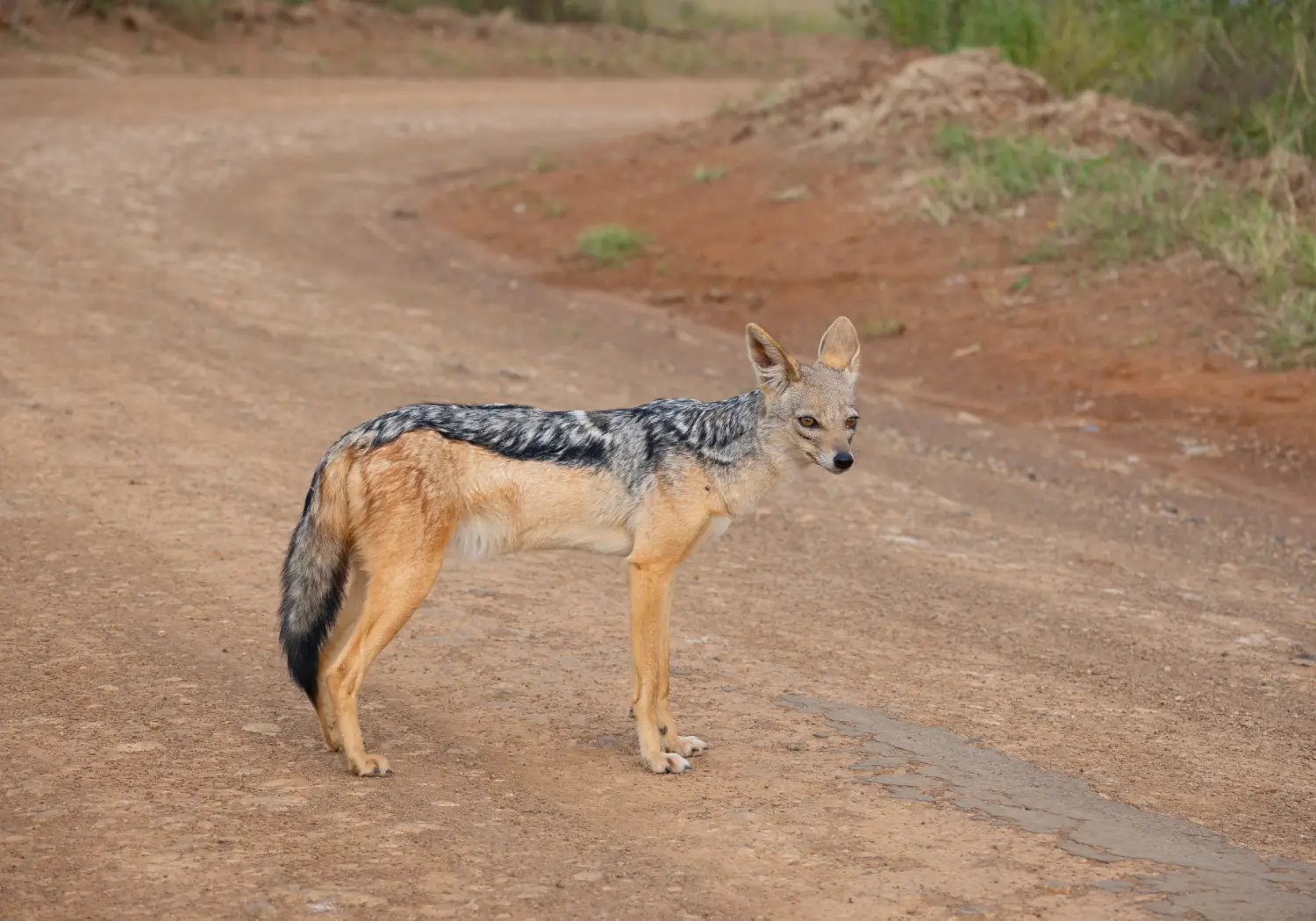
The black-backed jackal (Lupulella mesomelas) is a slender, fox-sized wild dog with a reddish-brown coat, big pointed ears and a striking saddle of silver-flecked black hair along its back. It is one of the most adaptable predators in Africa: it hunts small animals, scavenges at lion kills and eats fruit and insects. Pairs usually stay together for life, and older offspring often help raise the next litter. Its sharp, wailing calls at dusk are one of the classic sounds of the African night.
Quick answer: The black-backed jackal lives in two separate areas of Africa: East Africa and southern Africa. In Kenya, it is common in open savanna parks such as the Masai Mara, Nairobi National Park, Amboseli, Lake Nakuru and Tsavo. Look for pairs trotting across the plains or waiting near a kill. Sightings are never guaranteed.
What Does a Black-Backed Jackal Look Like?
The black-backed jackal is lean and long-legged, about the size of a fox, with a narrow muzzle and large, upright ears. Its coat is reddish-brown to ginger on the head, legs and flanks, with a white throat and chest. Its trademark is the saddle on its back: a broad band of black hair flecked with silver that runs from the neck to the base of the tail. The bushy tail ends in a black tip. Males are slightly larger than females.
Black-Backed Jackal vs Other Jackals in Kenya
Kenya has three jackal-like canids, and you may see more than one in the same park.
- Black-backed jackal: reddish with a bold silver-black saddle; the most commonly seen jackal in Kenya's savanna parks.
- Side-striped jackal: greyer, with a pale stripe along each side and a white-tipped tail. It prefers wooded and wetter areas and is more nocturnal.
- African golden wolf: sandy or yellowish-grey with no saddle, and longer legs. It was once called the golden jackal but is now known to be closer to wolves, according to Discover Wildlife.
Where they share a range, black-backed jackals tend to use the more open grassland, leaving the woodland to their side-striped cousins.
Where Do Black-Backed Jackals Live?
Black-backed jackals live in two separate parts of Africa, about 900 km apart. One population lives in East Africa, from Kenya and Tanzania north to Ethiopia and Somalia. The other lives in southern Africa, from Angola and Zimbabwe to South Africa. They live in open savanna, grassland, scrub and light woodland, and adapt well to farmland and even the edges of towns.
Browse our wildlife guide and Kenya destinations to see where these habitats are found.
What Do Black-Backed Jackals Eat?
Black-backed jackals are true opportunists. They hunt rodents, hares, birds, lizards and insects, and pairs work together to catch young antelopes such as Thomson's gazelle fawns. They also scavenge at kills made by lions and hyenas, and eat fruit, berries and termites. On the coasts of southern Africa they even feed on seals, fish and mussels.
Black-Backed Jackal Behaviour
Black-backed jackals usually live in pairs that bond for life. A pair defends a territory, marks it with urine and dung, and hunts and travels together.
Family Helpers
Young jackals from a previous litter often stay with their parents for a year and help raise the new pups, bringing them food and guarding the den. According to the Handbook of the Mammals of the World, one helper can raise the average number of surviving pups from one to three.
Calls of the Night
The black-backed jackal is known for a sharp, wailing call, which family members answer straight away, as the South African National Biodiversity Institute describes. In East Africa, where the golden wolf also lives, black-backed jackals are often quieter.
Predators
Adults have few predators, but leopards, lions, hyenas and eagles kill jackals, especially pups. Pythons can also take young jackals.
Breeding
Females give birth in a den, often an old aardvark burrow or a hollow in a termite mound, after a pregnancy of about 60 days. Litters usually have about one to six pups, which start to leave the den at around three weeks.
Is the Black-Backed Jackal Endangered?
No. The black-backed jackal is listed as Least Concern on the IUCN Red List. It is widespread, adaptable and common in most protected areas within its range. However, it is still persecuted in many places as a livestock killer and as a carrier of rabies, and it can catch diseases such as rabies and distemper from domestic dogs. You can explore recorded sightings on iNaturalist.
Learn how your trip can support wildlife and the communities who live alongside it with our conservation-based safaris in Kenya.
How to See Black-Backed Jackals on Safari in Kenya
Black-backed jackals are common in Kenya's open savanna parks, and an observant guide will often find a pair within a few game drives.
Where to Look
- Masai Mara: pairs trotting across the plains and hanging around lion and cheetah kills. See our Masai Mara National Reserve guide.
- Nairobi National Park: on the open southern plains, just outside the city. Try our Nairobi National Park private 4x4 safari.
- Amboseli: on the dry lakebed and open plains. See our Amboseli National Park guide.
- Lake Nakuru: on the grassy lakeshore. See our Lake Nakuru National Park guide.
- Tsavo, Samburu and Laikipia: drier country where jackals hunt and scavenge. See our Tsavo East, Samburu National Reserve and Ol Pejeta Conservancy guides.
Watch the Kills
Where lions, cheetahs or hyenas have made a kill, jackals are rarely far away, waiting for a chance to dart in and steal a scrap. Watching them is often as entertaining as watching the big cats.
Go Early and Late
Jackals are most active at dawn and dusk, and you'll often hear them calling at night from your camp. Early morning drives give the best chance of seeing families near their dens.
Build a Route With Variety
The 7 Day Kenya Elephants, Lakes and Masai Mara Safari passes Amboseli, Lake Nakuru and the Mara, all good jackal country. You can also browse our Kenya wildlife safaris.
Travel in the Dry Season
Short grass makes jackals easier to spot. The drier months are generally June to October and January to February. Travelling in the wet months instead? Read Can I do a Kenya safari during the rainy season?
Photograph the Saddle
A jackal trotting side-on in golden light, its silver-black saddle shining, makes a beautiful photo. Use a fast shutter speed, as they rarely stand still. Our photographic safaris in Kenya are built for moments like this.
Responsible Wildlife Viewing
Keep your distance, switch off the engine and stay in the vehicle, especially near dens with pups. Never feed jackals at camps or lodges; it makes them bold and spreads disease. Don't crowd a kill, so the predators and jackals can feed naturally.
Frequently Asked Questions About the Black-Backed Jackal
What is a black-backed jackal?
A fox-sized African wild dog with a reddish coat and a silver-flecked black saddle on its back. Its scientific name is Lupulella mesomelas.
How big is a black-backed jackal?
About 32–42 cm at the shoulder and about 6–13.5 kg.
What do black-backed jackals eat?
Almost anything: rodents, hares, birds, insects, young antelopes, carrion, fruit and berries.
Do jackals hunt or scavenge?
Both. They hunt small animals, often in pairs, and scavenge at kills made by lions, cheetahs and hyenas.
Do black-backed jackals mate for life?
Yes. Pairs usually bond for life, and older offspring often help raise new pups.
Are jackals dangerous to people?
No. They are shy of people, though, like any wild animal, they should never be approached or fed.
Where can I see black-backed jackals in Kenya?
The Masai Mara, Nairobi National Park, Amboseli, Lake Nakuru, Tsavo, Samburu and Laikipia. Sightings are never guaranteed.
Is the black-backed jackal endangered?
No. It is listed as Least Concern.
Plan Your Kenya Predator Safari
Want to watch jackals, lions, cheetahs and hyenas in action? Olengugih Safaris can design a private, flexible Kenya itinerary through the Mara, Amboseli, Nairobi and beyond. Start planning your safari or contact our team for a free quote.
Sources
- Least Concern status, genus Lupulella and the East African subspecies: Wikipedia
- Habitat use alongside other jackals, helpers raising pup survival, quieter calls where golden wolves live, 60-day pregnancy and persecution: Handbook of the Mammals of the World, via Zenodo
- Wailing call, monogamy, helpers and one to six pups: South African National Biodiversity Institute
- Weight and two separate populations: Active Wild
- Shoulder height, weight range and the 900 km gap between populations: Wikipedia for Schools
- The three jackal-like canids and the African golden wolf: Discover Wildlife
Interesting facts and identification clues
Interesting Facts About the Black-Backed Jackal
- The black-backed jackal lives in two separate parts of Africa, about 900 km apart.
- Pairs usually stay together for life.
- Older pups often stay on to help raise their younger brothers and sisters.
- Its wailing call is answered almost at once by other members of the family.
- In southern Africa, coastal jackals even feed on seals and mussels.
- Scientists now place it in its own genus, Lupulella, separate from wolves and dogs.
Content reviewed 22 Oct 2026