About the Olive Baboon
Olive Baboon: Kenya's Clever Troop-Living Primate
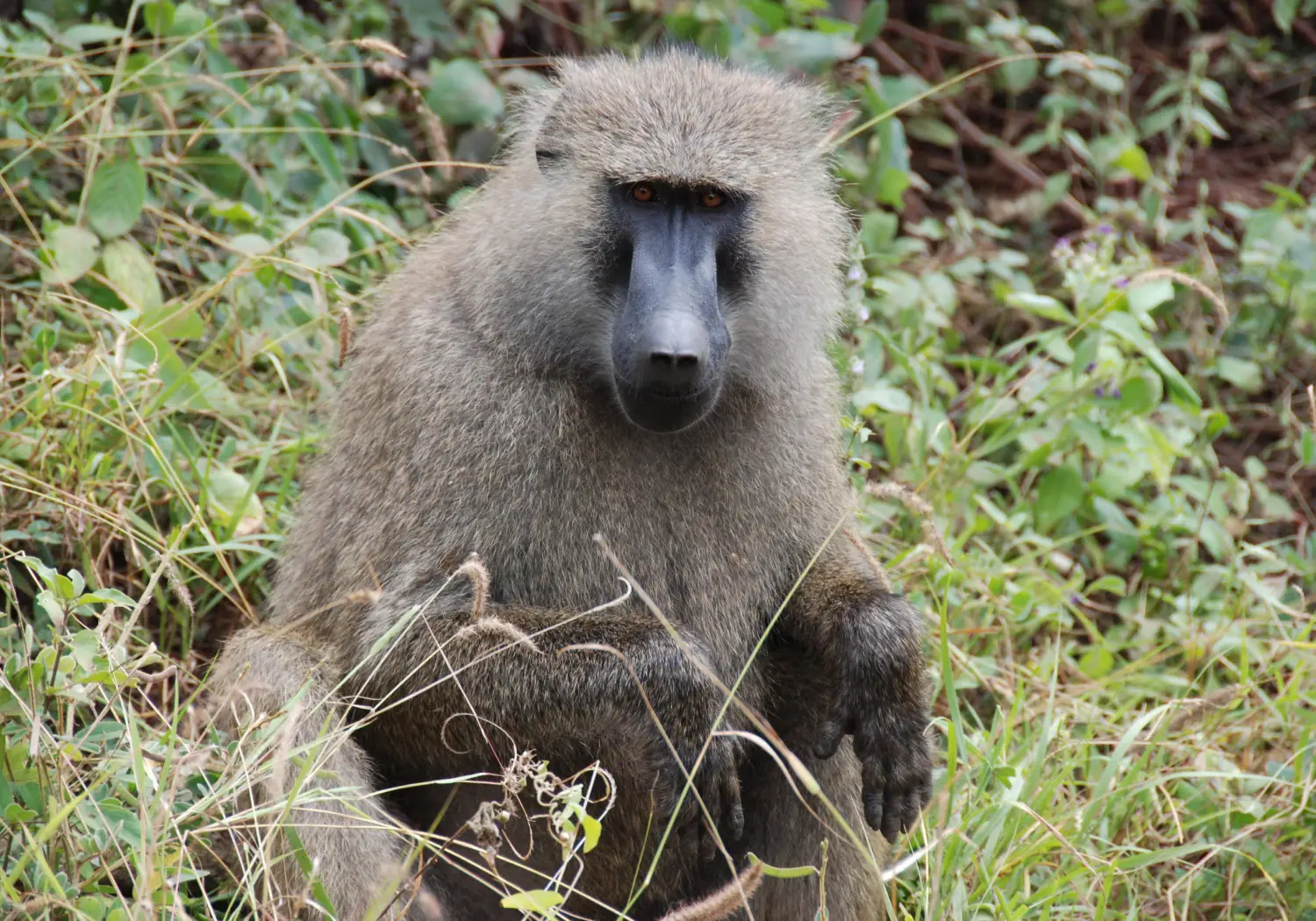
The olive baboon (Papio anubis), also called the anubis baboon and known in Swahili as nyani, is one of Africa's most widespread and adaptable monkeys. It gets its name from its thick, olive-grey coat, flecked with black and yellow, and its scientific name from the dog-headed Egyptian god Anubis. Olive baboons live in large, noisy troops with complex social lives, friendships and rivalries, and they have been studied in Kenya for more than 50 years. Few safari animals are as entertaining to watch.
Quick answer: The olive baboon lives in savanna, woodland, forest edges and rocky hills across a wide belt of Africa, from Mali to Ethiopia and south to Tanzania. It has the largest range of any baboon. In Kenya, it is common in most of the west and centre of the country, including the Masai Mara, Lake Nakuru, Nairobi National Park, Lake Naivasha and Laikipia. Sightings are very likely but never guaranteed.
What Does an Olive Baboon Look Like?
The olive baboon is a large, powerfully built monkey. From a distance its thick coat looks olive-grey; up close, each hair is banded with black and yellow. It has a long, dog-like muzzle, a dark grey to black face, close-set eyes under a heavy brow, and large canine teeth, especially in males. Its tail is held up and bends sharply downwards a short way from the base, as if broken. Males are nearly twice the size of females, with a thick mane of longer hair around the head and shoulders. Infants are born black with pink faces and gradually turn olive-brown.
Olive Baboon vs Yellow Baboon
Kenya has two baboon species, and they meet and interbreed in some areas.
- Olive baboon: heavier, with a darker olive-grey coat and a mane on males; found in western, central and northern Kenya, including the Mara, the Rift Valley and Laikipia.
- Yellow baboon: slimmer and longer-legged, with a yellowish-brown coat, paler cheeks and no real mane; found in eastern and coastal Kenya, including Tsavo and the coast.
- Where they meet: in places such as Amboseli, olive and yellow baboons interbreed, and many animals show a mix of features.
Where Do Olive Baboons Live?
Olive baboons have the largest range of any baboon, found in about 25 countries from Mali and Guinea in the west to Ethiopia, Kenya and Tanzania in the east. They live in savanna, open woodland, forest edges, rocky hills, gorges and farmland, as long as there is water nearby and safe places to sleep, such as tall trees or cliffs. They are highly adaptable and often live close to people.
Browse our wildlife guide and Kenya national parks to learn more.
What Do Olive Baboons Eat?
Olive baboons are opportunistic omnivores. According to Mpala Research Centre in Laikipia, it is easier to list what they don't eat than what they do. They eat grasses, seeds, fruit, leaves, flowers, bark, roots, tubers and bulbs, digging up food with their strong hands. They also eat insects, eggs, birds and small mammals, and males sometimes hunt young gazelles or hares. Near farms, they raid crops, which brings them into conflict with people.
Olive Baboon Behaviour
Olive baboons are active by day and spend most of their time on the ground, walking long distances to feed. At night, the troop sleeps high in trees or on cliff ledges, safe from predators.
Troop Life
Troops can number from about a dozen to more than 100 baboons. Females stay in the troop they were born into for life and form ranked family lines, while males leave when they mature and move between troops. Grooming, friendships and alliances are vital to troop life.
Communication
Baboons use barks, grunts, screams and coughs, as well as facial expressions, such as eyebrow flashing and yawning to show their canines.
Facing Predators
Leopards are the baboon's main predator, along with lions, spotted hyenas and Nile crocodiles. Adult males, and sometimes females, may mob a leopard to drive it away.
Breeding
Olive baboons breed throughout the year. After about six months' pregnancy, the female gives birth to a single infant, which clings to her belly and later rides on her back.
Studied for Decades in Kenya
Kenya is one of the world's most important places for baboon research. Shirley Strum has studied olive baboons since 1972, starting with a troop near Gilgil nicknamed the Pumphouse Gang, which she later wrote about in her book Almost Human. Robert Sapolsky has studied the stress and social lives of olive baboons in the Masai Mara since 1978, and researchers continue to study baboons on the Laikipia Plateau. According to the Wisconsin National Primate Research Center, these long-term studies have taught scientists a great deal about primate behaviour.
Is the Olive Baboon Endangered?
No. The olive baboon is listed as Least Concern on the IUCN Red List, and Mpala Research Centre notes that its numbers seem to be stable or increasing in places. However, baboons often raid crops and livestock near farms, and many are trapped, poisoned or shot in conflict with people. Habitat loss and baboons becoming used to human food around towns and lodges also cause problems. You can explore recorded sightings on iNaturalist.
Learn how your trip can support wildlife and communities with our conservation-based safaris in Kenya.
Staying Safe Around Baboons
Baboons are intelligent and strong, with large canine teeth. Most are wary of people, but baboons that have learned to associate people with food can become bold and aggressive.
- Never feed baboons, and never leave food, bags or bins open in vehicles, tents or lodge rooms.
- Keep vehicle windows and roof hatches closed when baboons are near, especially at picnic sites.
- Don't stare at, smile at or approach baboons; showing your teeth and staring are signs of threat to them.
- If a baboon grabs something, let it go. Don't try to fight it for your belongings.
Where to See Olive Baboons in Kenya
Olive baboons are common and easy to see in many Kenyan parks. Look for troops foraging on the ground in the morning and late afternoon.
Where to Look
- Masai Mara: troops on the plains, along rivers and around rocky areas. See our Masai Mara National Reserve guide.
- Lake Nakuru: troops in the woodland and along the escarpment, including Baboon Cliff. See our Lake Nakuru National Park guide.
- Nairobi National Park: troops in the woodland and along the river. Try our Nairobi National Park private 4x4 safari.
- Lake Naivasha and Hell's Gate: troops on cliffs and in acacia woodland. See our Lake Naivasha and Hell's Gate guides.
- Laikipia and Samburu: troops in conservancies such as Ol Pejeta and along the river in Samburu.
Watch a Troop at Work
Spend time with a troop rather than driving straight past. You'll see grooming, playing infants, squabbles and alliances, and you may notice males standing guard.
Visit Sleeping Sites at Dusk
Troops gather at their sleeping trees or cliffs late in the day, which is a great time to watch them settle for the night.
Build a Route With Variety
The 7 Day Kenya Elephants, Lakes and Masai Mara Safari passes Lake Nakuru, Lake Naivasha and the Mara, all great places to see olive baboons. You can also browse our Kenya wildlife safaris.
Responsible Wildlife Viewing
Watch baboons from your vehicle or from a safe distance on foot, and never feed them. Fed baboons become dangerous and are often shot as a result, so feeding them harms the animals as well as people. Keep your voice low and avoid getting between a mother and her infant or between troop members during a squabble.
Frequently Asked Questions About the Olive Baboon
What is an olive baboon?
A large, olive-grey monkey with a dog-like face that lives in big troops across equatorial Africa. Its scientific name is Papio anubis.
How big is an olive baboon?
Males average about 24 kg and can reach about 37 kg; females average about 14–15 kg.
What do olive baboons eat?
Almost anything: grasses, seeds, fruit, roots, insects, eggs and small animals.
Are olive baboons dangerous?
They usually avoid people, but baboons that have been fed can become aggressive. Never feed them, and keep food out of sight.
What is the difference between olive and yellow baboons?
Olive baboons are heavier and darker, and males have a mane. Yellow baboons are slimmer, with a yellowish coat. In Kenya, olive baboons live in the west and centre, and yellow baboons in the east and on the coast.
Where can I see olive baboons in Kenya?
The Masai Mara, Lake Nakuru, Nairobi National Park, Lake Naivasha, Hell's Gate, Laikipia and Samburu. Sightings are very likely but never guaranteed.
Are olive baboons endangered?
No. They are listed as Least Concern.
Plan Your Kenya Safari
Want to watch baboon troops, big cats and the rest of Kenya's wildlife up close? Olengugih Safaris can design a private, flexible itinerary through the Mara, the Rift Valley lakes and beyond. Start planning your safari or contact our team for a free quote.
Sources
- Average weights (males 24 kg, females 14.7 kg), range, overlap with yellow baboons in Amboseli, and long-term Kenyan research by Sapolsky (Masai Mara since 1978), Strum (Gilgil since the early 1970s) and Palombit (Laikipia since 2000): Wisconsin National Primate Research Center
- Swahili name, troop sizes of 12–130, mobbing leopards, calls, sunbathing at sleeping sites, year-round breeding, Least Concern status and conflict with farmers: Mpala Research Centre (Laikipia, Kenya)
- Largest range of any baboon (25 countries), opportunistic diet, females staying in their birth troop, and the Anubis name: New England Primate Conservancy
- Weight range of 10–37 kg and the plant foods in the diet: Active Wild
- The Pumphouse Gang and Almost Human: CARTA Anthropogeny bibliography
Interesting facts and identification clues
Interesting Facts About the Olive Baboon
- The olive baboon has the largest range of any baboon species.
- Its scientific name comes from Anubis, the dog-headed Egyptian god.
- Males can weigh nearly twice as much as females.
- Females stay in their birth troop for life, while males move between troops.
- Troops sometimes mob leopards to drive them away.
- Olive baboons have been studied in Kenya since the early 1970s.
Content reviewed 28 Oct 2026