
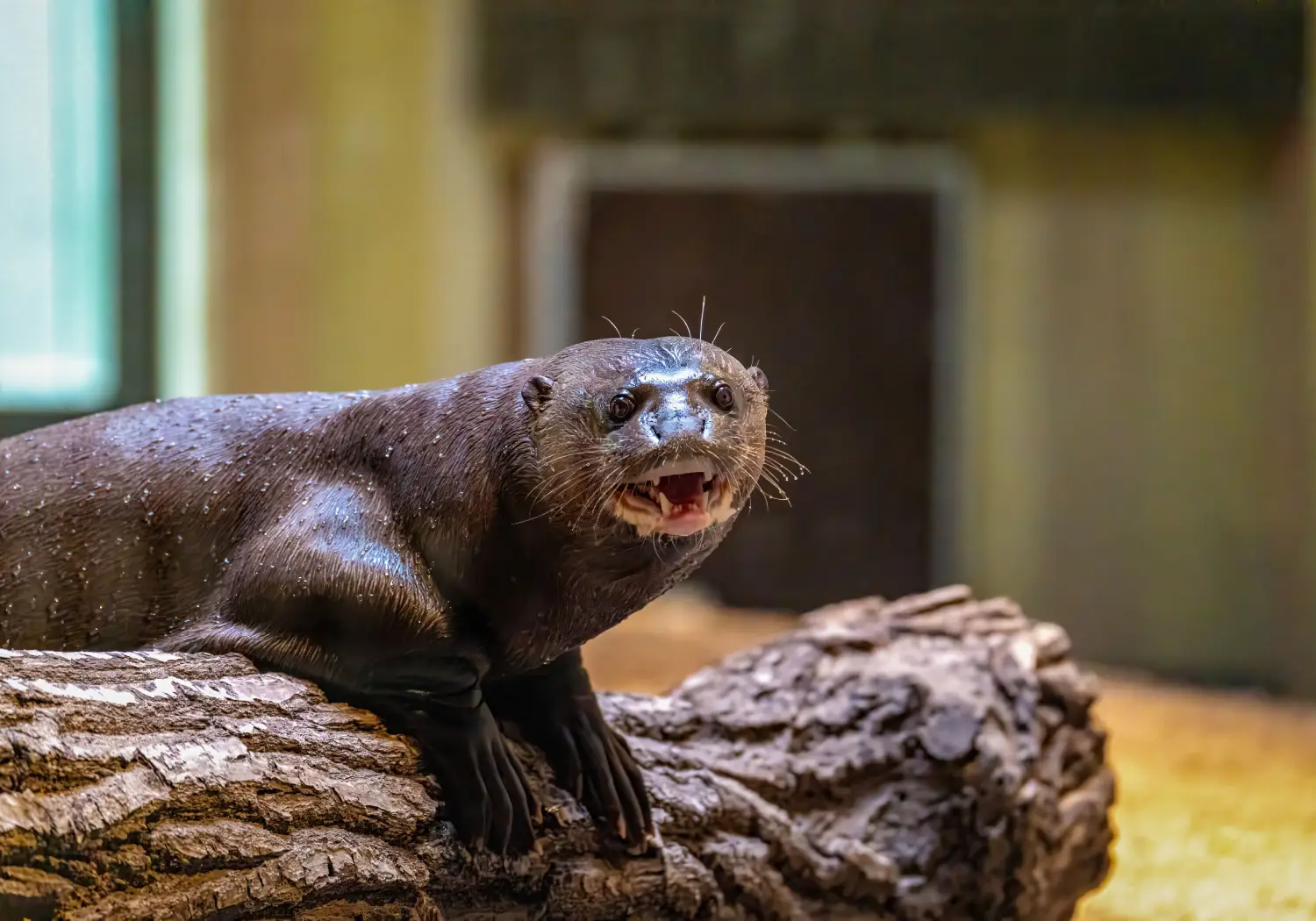
About the Spotted-Necked Otter
The spotted-necked otter (Hydrictis maculicollis), also called the speckle-throated otter and known locally as the "water hyena", is the smallest of Africa's otters. It has a sleek chocolate-to-reddish-brown body, a white chin and upper lip, and creamy blotches scattered over its throat and chest, which give it its name. Unlike the clawless otter, it has fully webbed feet with sharp claws, making it a superb swimmer and diver. It hunts mainly fish by day in clear water, and is noisy and sociable, chattering and whistling to its companions. It is listed as Near Threatened.
Quick answer: The spotted-necked otter lives in clear lakes and larger rivers across much of sub-Saharan Africa. Lake Victoria holds some of its largest populations, including on Tanzania's Rubondo Island. In Kenya, look for it along the clear, rocky shores and islands of Lake Victoria, near Ruma National Park, and in some western Kenya rivers. Sightings are never guaranteed.
What Does a Spotted-Necked Otter Look Like?
The spotted-necked otter has a long, slim, streamlined body, a long tapering tail and a small, flattened head. Its fur is chocolate to reddish-brown, with two layers: dense underfur that traps air for warmth, and longer outer guard hairs. The chin and upper lip are white, and the throat and chest are marked with creamy or white blotches. The pattern varies so much that individuals can be told apart by their spots.
All four feet are fully webbed and have well-developed claws. On land the otter moves rather clumsily, but in water it is fast and agile.
Spotted-Necked Otter vs Cape Clawless Otter
Kenya has two otter species, and they sometimes share the same lakes.
- Spotted-necked otter: smaller and slimmer, with cream blotches on the throat and fully webbed, clawed feet. It eats mainly fish and needs clear water.
- Cape (African) clawless otter: much larger and heavier, with a plain white chin and throat and clawless, unwebbed front paws. It eats mainly crabs and copes with murkier water.
- Where they meet: both live around Lake Victoria, where they can coexist because they eat different food.
Where Do Spotted-Necked Otters Live?
Spotted-necked otters live in lakes and larger rivers across much of sub-Saharan Africa south of about 10°N. They are common in Lake Victoria and Lake Tanganyika, and across Zambia, but are absent from the Zambezi below Victoria Falls. They never enter salt water. Because they hunt by sight, they need clear, unpolluted water with plenty of fish, and they seldom move more than about 10 m from the water's edge.
In Kenya, they are found mainly around Lake Victoria and in some rivers in the west of the country. Browse our wildlife guide and Great Lakes of Kenya to see where these habitats are found.
What Do Spotted-Necked Otters Eat?
Fish dominate the diet, especially small cichlids such as Haplochromis in Lake Victoria. According to San Diego Zoo Wildlife Alliance, they also eat crabs, frogs, insect larvae and water snails where fish are scarce. They often catch fish among rocks and sticks rather than in open water, and they eat small prey while floating on their backs. In Lake Victoria they have been seen catching fish as large as themselves.
Spotted-Necked Otter Behaviour
Spotted-necked otters are active by day, especially in the early morning and late afternoon. They can be solitary, but often live in groups, sometimes in same-sex groups for much of the year.
Group Fishing
Groups sometimes work together to herd shoals of fish, though each otter catches and eats its own prey.
Chattering and Whistling
This is a very vocal otter, using high whistles, rapid shrill chatters and grunts to stay in touch with its group.
Dens and Holts
They rest in holes among rocks, under tree roots or in dense reeds near the water.
Predators
Known predators include Nile crocodiles, lions and African fish eagles.
Breeding
After a pregnancy of about two months, the female gives birth to one to three cubs in a den. The cubs stay with their mother for about a year.
Is the Spotted-Necked Otter Endangered?
It is listed as Near Threatened on the IUCN Red List, and its population is decreasing. Because it needs clear, fish-rich water, it is especially sensitive to pollution, siltation from deforestation and farming, and the loss of lakeshore vegetation. Many otters drown after getting tangled in nylon fishing nets, and some are killed by fishermen who see them as competitors or are hunted for their skins and for traditional uses. In Lake Victoria, the introduction of Nile perch and the decline of native cichlids changed the food available to otters. Because they sit at the top of the aquatic food chain, they can also build up harmful chemicals from polluted water.
Conservation work is making a difference. The International Otter Survival Fund reports that, in Kenya, it helped local people set up tilapia fish farms to provide food for both people and otters and reduce conflict. The IUCN Otter Specialist Group also supports research across Africa. You can explore recorded sightings on iNaturalist.
Learn how your trip can support wildlife and wetland conservation with our conservation-based safaris in Kenya.
Where to See Spotted-Necked Otters in Kenya and East Africa
Spotted-necked otters are active by day, but they are shy and live mainly in quieter parts of Lake Victoria and clear rivers. A boat trip along rocky shores and islands gives the best chance.
Where to Look
- Lake Victoria, Kenya: rocky shorelines, islands and quiet bays along the Kenyan shore, around Homa Bay and Mbita. Combine a lake visit with nearby Ruma National Park, home to roan antelope and oribi.
- Western Kenya: clear streams and rivers around Kakamega Forest and the highlands.
- Rubondo Island, Tanzania: an island national park in Lake Victoria, one of the best places in Africa to watch spotted-necked otters. Ask about our multi-country safaris.
Take a Boat Trip
A quiet boat ride along rocky shores in the early morning or late afternoon gives the best chance of seeing otters fishing, surfacing with prey and chattering to each other.
Scan Rocky Shorelines
Look for heads breaking the surface near rocks and reeds, and for otters resting on rocks at the water's edge.
Build a Western Kenya Route
Combine Lake Victoria, Ruma, Kakamega and Saiwa Swamp on a tailor-made trip through our Kenya safaris.
Travel in the Dry Season
Clearer water and calmer conditions make otters easier to spot. In western Kenya, the drier months are generally December to February and June to September. Travelling in the wet months instead? Read Can I do a Kenya safari during the rainy season?
Responsible Wildlife Viewing
Keep boats at a respectful distance and cut the engine when otters are near. Never chase or surround them. Don't leave fishing line or nets in the water, as otters easily get tangled and drown. Support local fishing communities and lodges that protect lakeshores and clean water.
Frequently Asked Questions About the Spotted-Necked Otter
What is a spotted-necked otter?
A slim, fish-eating African otter with a cream-speckled throat and fully webbed feet. Its scientific name is Hydrictis maculicollis.
How big is a spotted-necked otter?
About 85–110 cm long including the tail, and usually about 3–6 kg, though males can reach about 9 kg.
What do spotted-necked otters eat?
Mainly fish, especially small cichlids, plus crabs, frogs, insects and snails.
What is the difference between spotted-necked and clawless otters?
Spotted-necked otters are smaller, with spotted throats and webbed, clawed feet, and eat mostly fish. Clawless otters are larger, with plain white throats and clawless front paws, and eat mostly crabs.
Where can I see spotted-necked otters in Kenya?
Along rocky shores and islands of Lake Victoria and in some clear western Kenya rivers. Rubondo Island in Tanzania is one of the best places in Africa. Sightings are never guaranteed.
Is the spotted-necked otter endangered?
It is listed as Near Threatened, and its numbers are falling because of pollution, fishing nets and habitat loss.
Plan Your Western Kenya and Lake Victoria Safari
Want to explore Lake Victoria, Ruma's rare antelopes and the forests of Kakamega, or add Rubondo Island in Tanzania? Olengugih Safaris can design a private, flexible itinerary off the beaten track. Start planning your safari or contact our team for a free quote.
Sources
- Near Threatened status, range south of 10°N, common in Lake Victoria, absent below Victoria Falls, no salt water, vocal behaviour, predators, and decline from habitat loss and pollution: Wikipedia
- The "water hyena" name, smallest African otter, males up to 9 kg on Rubondo Island, same-sex hunting groups, active by day, drowning in nylon nets, and the Kenyan tilapia fish-farm project: International Otter Survival Fund
- Weight of 3–6 kg, head-body and tail length, fur and white chin, and the 2020 IUCN assessment: San Diego Zoo Wildlife Alliance: summary
- Cichlid diet, eating while floating on the back, catching fish among rocks, fish as large as themselves, and contaminants: San Diego Zoo Wildlife Alliance: diet
- Webbed feet with claws, length of 85–105 cm, needing clear water, staying within 10 m of water, a two-month pregnancy and one to five cubs: Toronto Zoo
- Research and threats in the Lake Victoria area: IUCN Otter Specialist Group
Interesting facts and identification clues
Interesting Facts About the Spotted-Necked Otter
- It is the smallest of Africa's otters.
- Each otter's throat spots are different, so researchers can identify individuals.
- It is sometimes called the "water hyena" in parts of Africa.
- It often eats small fish while floating on its back.
- It needs clear water because it hunts mainly by sight.
- It never enters salt water.
Content reviewed 27 Oct 2026