About the Oribi
The oribi (Ourebia ourebi) is a small, slender antelope with a long neck, long legs and a glossy, sandy to rufous coat. Its giveaway feature is a bare black patch of skin just below each ear, and it has a short, black-tipped tail and a white crescent above each eye. Males carry short, straight, spike-like horns. It lives in open grassland, and when alarmed it gives a sharp whistle and bounds away with stiff-legged leaps. In Kenya it is scarce: the Kenya Wildlife Service names Ruma National Park as the easiest place in the country to see it.
Quick answer: The oribi is a small grazing antelope of open grasslands in eastern, southern and western Africa. In Kenya, your best chance is Ruma National Park in the Lambwe Valley near Lake Victoria. In Uganda it is common in Murchison Falls, Queen Elizabeth and Kidepo Valley national parks. Sightings are never guaranteed.
What Does an Oribi Look Like?
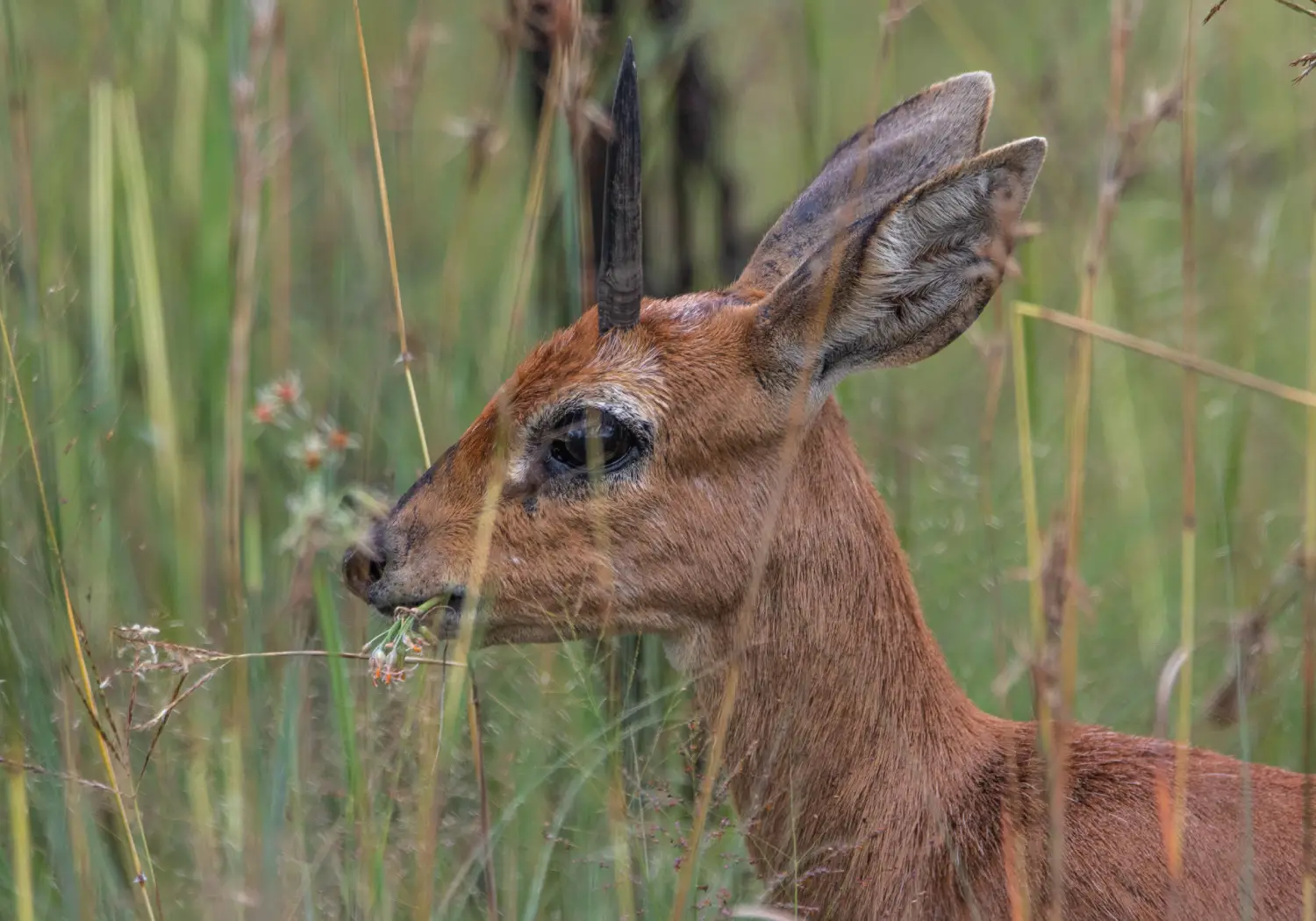
The oribi is small and elegant, with a slightly raised rump, a long neck and long, slim legs. Its coat is glossy and ranges from yellowish-fawn to rich rufous brown, contrasting with a white chin, throat, belly and rump. A white crescent sits above each eye, and tufts of long hair grow on the knees. The short tail has a black tip that flashes as the oribi runs.
The best clue is a round, bare black patch of skin just below each ear, which is a scent gland. The oribi has at least six well-developed scent glands, more than most antelopes. Only males carry horns: thin, straight spikes about 8–18 cm long, ringed at the base and smooth at the tips. Females are slightly larger than males.
Oribi vs Similar Small Antelopes
Several small antelopes share the oribi's grassland and bush. Here is how to tell them apart.
- Oribi: slim and long-necked, with a bare black spot below each ear and a black-tipped tail. Lives in open grassland.
- Bohor reedbuck: stockier and heavier, with forward-curving horns on males and no black ear spot. Lives near water and wet grassland. See our common reedbuck profile.
- Common duiker: rounder, with a tuft of hair between the horns. It prefers bush and dives into cover.
- Kirk's dik-dik: much smaller, with a trunk-like nose. Lives in dry thornbush, not open grassland.
- Thomson's gazelle: has a bold black side stripe and both sexes carry horns.
Where Do Oribi Live?
Oribi live in open grassland, grassy floodplains and lightly wooded savanna. They prefer flat ground with short grass for feeding and patches of taller grass to hide in, and they avoid steep slopes and thick bush. Their range is patchy and broken, stretching across eastern, southern and western Africa.
In Kenya, oribi are now scarce and found mainly in the west. The Lambwe Valley grasslands of Ruma National Park are their stronghold. Uganda's open savanna parks hold much larger numbers. Browse our wildlife guide and Uganda national parks to see where these habitats are found.
What Do Oribi Eat?
Oribi are mainly grazers. They are selective, choosing fresh green grass shoots, and they also browse leaves and herbs when grass is poor. Oribi are one of the few animals that benefit from grass fires: they move onto burnt ground soon afterwards to feed on the new green growth. They do not depend on drinking water and get much of their moisture from their food.
Oribi Behaviour
Oribi live alone, in pairs or in small groups, often a male with one or two females. Unusually for a small antelope, they can use different mating systems depending on their habitat. Males mark their territories with dung and with scent from their glands.
Whistle and Stott
When danger appears, an oribi often freezes and crouches low in the grass, hoping to stay hidden. If it is discovered, it gives a sharp whistle, then bounds away in stiff-legged leaps called stotting, flashing its black-tipped tail.
Predators
Leopards, cheetahs, serval cats, caracals and pythons hunt oribi. Jackals, baboons, eagles and monitor lizards take young calves.
Breeding
Females give birth to a single calf after a pregnancy of about six and a half to seven months. The calf hides in tall grass for its first weeks or so, and its mother returns to nurse it until it is weaned at about four to five months.
Is the Oribi Endangered?
Not as a species. The oribi is listed as Least Concern on the IUCN Red List, with an estimated 750,000 animals in 2008. Its numbers are falling, however, as grasslands are turned into farms and grazing land for livestock. Some local forms are in real trouble. Haggard's oribi of northern Kenya and Somalia has been listed as Vulnerable, and the Kenya oribi that once lived on the lower slopes of Mount Kenya has been listed as extinct. Hunting with dogs, snaring and the loss of open grassland are the main threats.
The Animal Diversity Web at the University of Michigan notes that oribi depend on well-managed grassland, including regular burning, to survive. You can explore recorded sightings across Africa on iNaturalist and see its full range on the Mammal Diversity Database.
Learn how your trip can support wildlife with our conservation-based safaris in Kenya.
How to See Oribi on Safari in Kenya and Uganda
Oribi are uncommon in Kenya, so plan your route around the few places where they are reliable.
Where to Look
- Ruma National Park, Kenya: the Kenya Wildlife Service says oribi, roan antelope and Jackson's hartebeest are easier to see here than anywhere else in Kenya. Look on the open grassland of the Lambwe Valley floor. See our Ruma National Park guide.
- Murchison Falls National Park, Uganda: oribi are common on the open savanna north of the Nile, around the Buligi and Pakuba areas. See our Murchison Falls National Park guide.
- Queen Elizabeth and Kidepo Valley, Uganda: grassland herds alongside Uganda kob and other plains game. See our Queen Elizabeth National Park and Kidepo Valley National Park guides.
Combine Western Kenya's Hidden Gems
Ruma is remote, so pair it with other western Kenya highlights. Kakamega Forest National Reserve offers primates and rare forest birds, and Saiwa Swamp National Park is home to the sitatunga antelope. Ruma also has Rothschild's giraffe, serval cats and the bohor reedbuck's wet grasslands. Ask us to build a tailor-made western Kenya route through our Kenya safaris.
Add Uganda to Your Trip
For the best oribi viewing, combine Kenya with Uganda's savanna parks on one of our multi-country safaris. Murchison Falls pairs well with chimpanzee tracking and a gorilla trek; read our mountain gorilla profile.
Go Early and Look After Fires
Oribi are most active in the morning and late afternoon. Recently burnt grassland, with its fresh green shoots, is a good place to look.
Travel in the Dry Season
Shorter grass makes small antelopes easier to see. In Kenya, the drier months are generally June to October and January to February. Travelling in the wet months instead? Read Can I do a Kenya safari during the rainy season?
Photograph the Ear Spot
A side-on portrait that shows the black spot below the ear and the white eye crescent makes a perfect identification photo. Use a long lens and stay low in the vehicle. Our photographic safaris in Kenya are built for moments like this.
Responsible Wildlife Viewing
Keep your distance, switch off the engine and keep your voice low. An oribi crouching in the grass is trying to hide, so don't drive closer to flush it out. If you find a calf lying alone, leave it be: its mother is nearby.
Frequently Asked Questions About the Oribi
What is an oribi?
A small, slender grassland antelope of eastern, southern and western Africa, recognised by the bare black spot below each ear. Its scientific name is Ourebia ourebi.
How big is an oribi?
About 50–67 cm at the shoulder and about 12–22 kg, with females slightly larger than males.
Do female oribi have horns?
No. Only males carry horns, which are thin, straight spikes about 8–18 cm long.
What do oribi eat?
Mostly fresh green grass, plus some leaves and herbs. They often feed on new shoots after grass fires.
Where can I see oribi in Kenya?
Ruma National Park in western Kenya is the best place. Oribi are rare elsewhere in the country. Sightings are never guaranteed.
Where can I see oribi in Uganda?
Murchison Falls, Queen Elizabeth and Kidepo Valley national parks all have good numbers.
How do you tell an oribi from a reedbuck?
The oribi is slimmer, with a black spot below each ear and a black-tipped tail. A reedbuck is stockier, has no ear spot and lives near water.
Is the oribi endangered?
Not as a species; it is listed as Least Concern. But numbers are falling, and some local forms in Kenya are threatened or already extinct.
Plan Your Western Kenya and Uganda Safari
Want to see oribi, roan antelope and Rothschild's giraffe in Ruma, or add Uganda's savanna parks and gorillas? Olengugih Safaris can design a private, flexible itinerary off the beaten track. Start planning your safari or contact our team for a free quote.
Interesting facts and identification clues
Interesting Facts About the Oribi
The name oribi comes from oorbietjie, its Afrikaans name.
The bare black spot below each ear is a scent gland, one of at least six the oribi has.
Oribi are among the few animals that benefit from grass fires, moving in to eat the fresh green shoots.
When alarmed, an oribi gives a sharp whistle and bounds away in stiff-legged leaps.
Female oribi are slightly larger than males.
Kenya's Ruma National Park is the best place in the country to see oribi.
Content reviewed 19 Oct 2026