About the Vervet Monkey
Vervet Monkey: The Monkey With Words for Danger
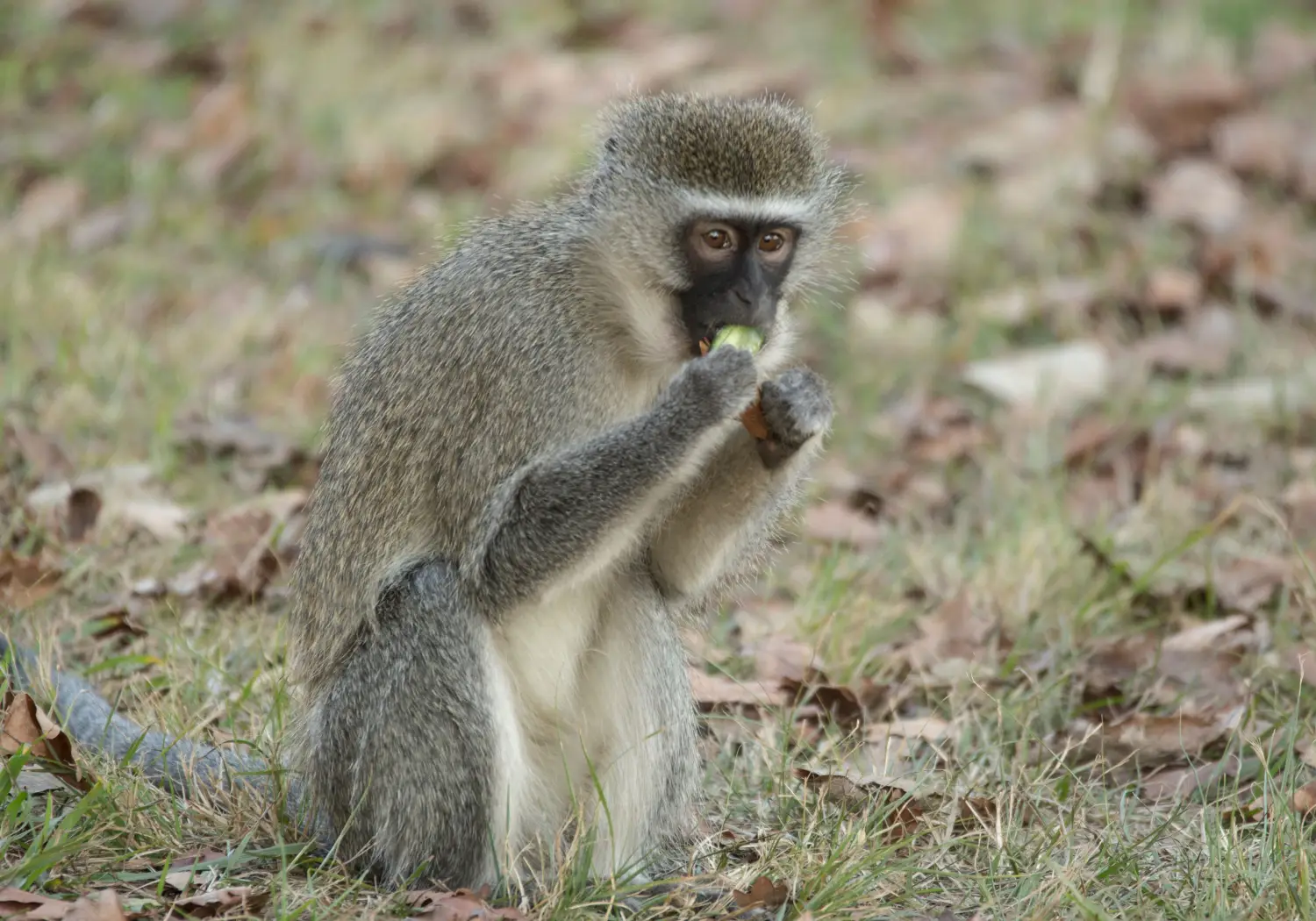
The vervet monkey (Chlorocebus pygerythrus), known in Swahili as tumbili, is a small, agile monkey with a grizzled grey-green coat, a black face framed by white fur, and a long tail. It is one of the most common monkeys in East Africa and one many safari-goers meet first, often around lodges and campsites. Vervets are also famous in science. Research in Kenya's Amboseli National Park showed that they give different alarm calls for different predators, such as leopards, eagles and snakes, and that troop members respond to each call in the right way.
Quick answer: The vervet monkey lives in savanna, woodland and riverine forest from Ethiopia and Somalia through Kenya and Uganda to South Africa. In Kenya, it is common almost everywhere there are trees and water, including Amboseli, Lake Naivasha, Lake Nakuru, the Masai Mara, Samburu and the coast. Sightings are very likely but never guaranteed.
What Does a Vervet Monkey Look Like?
The vervet monkey is a slim, medium-sized monkey with long legs and a long tail. Its coat is grizzled grey to olive-green on the back, with a pale whitish belly. Its face is black, surrounded by a band of white fur across the forehead and white cheeks, which give it an alert, expressive look. Its hands and feet are often darker. Adult males are larger than females and have a striking bright blue scrotum and red area beneath the tail, which signal status. Infants are born with dark fur and a pink face.
Vervet Monkey vs Other Kenyan Monkeys
Kenya has several monkeys. Here's how to pick out the vervet.
- Vervet monkey: small and slim, grey-green with a black face and white brow; common in savanna woodland and around lodges.
- Sykes' monkey (blue monkey): larger and darker, with a white throat patch; lives in forests such as Kakamega, Mount Kenya and the coast.
- Olive and yellow baboons: much bigger, with long dog-like muzzles; live in large troops on the ground.
- Black-and-white colobus: black with a white mantle and a long white tail; lives high in forest trees.
Where Do Vervet Monkeys Live?
Vervet monkeys live across eastern and southern Africa, from the Ethiopian Rift Valley and Somalia through Kenya, Uganda and Tanzania to South Africa. They live in savanna, open woodland, riverine forest, acacia and fever-tree groves, lake shores and coastal bush, and they adapt well to farmland, gardens and lodges. They usually stay close to water and need tall trees for sleeping.
In Kenya, Hilgert's vervet monkey is found in places such as Samburu and Amboseli. Browse our wildlife guide and Kenya national parks to learn more.
What Do Vervet Monkeys Eat?
Vervet monkeys are omnivores. They eat fruit, flowers, seeds, leaves, buds, acacia gum and pods, along with insects, eggs and, occasionally, small birds or lizards. Their diet changes with the seasons, and near people they quickly learn to raid crops, bins and unattended food.
Vervet Monkey Behaviour
Vervet monkeys are active by day, spending time both on the ground and in trees. They live in troops of about 10 to 50, made up of several adult males, more adult females and their young. Females stay in their birth troop for life, while males move to new troops as they mature.
Alarm Calls for Different Predators
Vervets are famous for their alarm calls. Each type of predator gets its own call, and troop members respond in a way that suits the danger:
- Leopard call: monkeys run up into the trees, out onto thin branches where a leopard can't follow.
- Eagle call: monkeys look up and dive into dense bushes or down from the treetops.
- Snake call: monkeys stand on their hind legs and scan the ground around them.
Social Life
Troops have clear ranks. Grooming, alliances and close family ties are an important part of daily life, and troops defend their territory with calls and displays.
Predators
Leopards, martial and crowned eagles, pythons, baboons and servals prey on vervets, especially the young.
Breeding
After a pregnancy of about five and a half months, the female usually gives birth to one infant, which clings to her belly. Other females in the troop often help care for infants.
Famous Research in Amboseli
From 1977, researchers Dorothy Cheney and Robert Seyfarth studied vervet monkeys in Amboseli National Park, building on earlier work with Peter Marler. By recording alarm calls and playing them back to wild troops, they showed that vervets respond appropriately to each call even when no predator is present, suggesting the calls carry information about the type of danger. According to the Wisconsin National Primate Research Center, this long-term research made Amboseli's vervets a classic example in the study of animal communication.
Is the Vervet Monkey Endangered?
No. The vervet monkey is listed as Least Concern on the IUCN Red List, last assessed in 2022. However, the Born Free Foundation notes that exact numbers are unknown and appear to be falling. Vervets are often shot, trapped or poisoned as crop pests, hit by cars, electrocuted on power lines, and captured for the pet and laboratory trade. Monkeys that are fed by people often become bold and end up in conflict. You can explore recorded sightings on iNaturalist.
Learn how your trip can support wildlife with our conservation-based safaris in Kenya.
Vervets at Lodges and Camps: Stay Safe
Vervets are clever and quick, and at many lodges and campsites they have learned that people mean food. They can grab food from tables, open bags and even get into rooms.
- Never feed vervets, and keep food, drinks, sugar and fruit out of sight.
- Close windows, doors and tent zips when you leave your room or tent.
- Keep bags closed and don't leave belongings unattended on balconies or tables.
- Don't stare at or chase a vervet, and if one grabs something, let it go.
Where to See Vervet Monkeys in Kenya
Vervets are common and easy to see in most Kenyan parks. Look for troops in trees near water, around picnic sites and in lodge grounds.
Where to Look
- Amboseli: fever-tree groves and the edges of the swamps, the home of the famous alarm-call research. See our Amboseli National Park guide.
- Lake Naivasha and Lake Nakuru: acacia woodland and lakeshore lodges. See our Lake Naivasha and Lake Nakuru National Park guides.
- Masai Mara: riverine forest along the Mara and Talek rivers. See our Masai Mara National Reserve guide.
- Samburu and Buffalo Springs: riverine trees along the Ewaso Ng'iro. See our Samburu National Reserve guide.
- Nairobi National Park and the coast: riverine forest close to the city, and coastal bush around Diani and Shimba Hills. Try our Nairobi National Park private 4x4 safari.
Listen for Alarm Calls
If vervets suddenly start calling and running for the trees or looking up, there may be a leopard or eagle nearby. Ask your guide to listen with you.
Watch the Troop
Spend a few minutes watching grooming, playing youngsters and squabbles. You may also spot the bright blue colouring of adult males.
Build a Route With Variety
The 7 Day Kenya Elephants, Lakes and Masai Mara Safari passes Amboseli, Naivasha, Nakuru and the Mara, all good places for vervets. For families, see our Kenya family safaris.
Responsible Wildlife Viewing
Watch vervets from a respectful distance and never feed them. Feeding makes them aggressive and dependent on people, and fed monkeys are often trapped or killed. Keep food out of sight, close windows and tents, and don't leave rubbish where monkeys can reach it.
Frequently Asked Questions About the Vervet Monkey
What is a vervet monkey?
A small, grey-green African monkey with a black face and white brow. Its scientific name is Chlorocebus pygerythrus.
How big is a vervet monkey?
About 40–60 cm long plus a 30–50 cm tail. Males average about 5.5 kg and females about 4.1 kg.
What do vervet monkeys eat?
Fruit, flowers, seeds, leaves, gum, insects, eggs and occasionally small animals.
Why are vervet monkeys famous?
Research in Amboseli showed that they give different alarm calls for different predators, and that other vervets respond to each call appropriately.
Are vervet monkeys dangerous?
They are usually harmless, but monkeys that have been fed can become bold and may bite or grab things. Never feed them.
Where can I see vervet monkeys in Kenya?
Almost everywhere with trees and water, including Amboseli, Lake Naivasha, Lake Nakuru, the Masai Mara, Samburu, Nairobi National Park and the coast. Sightings are very likely but never guaranteed.
Are vervet monkeys endangered?
No. They are listed as Least Concern, though numbers may be falling.
Plan Your Kenya Safari
Want to see vervets, baboons and the Big Five on a safari designed around you? Olengugih Safaris can create a private, flexible itinerary through Amboseli, the Rift Valley lakes, the Mara and the coast. Start planning your safari or contact our team for a free quote.
Sources
- Average weights (males 5.5 kg, females 4.1 kg), the move to the genus Chlorocebus, range from Ethiopia to Kenya and Tanzania, and research by Cheney and Seyfarth in Amboseli since 1977: Wisconsin National Primate Research Center
- Subspecies, Hilgert's vervet in Samburu and Amboseli, active by day and mainly on the ground, predator-specific alarm calls and Least Concern status: Handbook of the Mammals of the World, via Zenodo
- Responses to leopard, eagle and snake calls in playback experiments: Animal communication summary of Seyfarth, Cheney and Marler
- Quantitative analysis confirming that leopard, eagle and snake alarm calls differ: Price et al. (2015), Scientific Reports
- Size of 40–60 cm and a 30–50 cm tail, escape responses, the 2022 IUCN assessment and possible decline: Born Free Foundation
- Subspecies ranges and calls such
Interesting facts and identification clues
Interesting Facts About the Vervet Monkey
- Vervets give different alarm calls for leopards, eagles and snakes.
- Troop members react to each call in a different way, even when no predator is in sight.
- Adult males have a bright blue scrotum.
- Females stay in their birth troop for life, while males move between troops.
- Vervets in Amboseli have been studied since the 1970s.
- In Swahili, the vervet monkey is called tumbili.
Content reviewed 28 Oct 2026