
About the Golden Jackal
For more than a century, the sandy, long-legged wild dog of East Africa's plains was called the golden jackal. In 2015, a genetic study published in Current Biology showed that it is not a jackal at all. It is a separate species more closely related to grey wolves, now known as the African golden wolf (Canis lupaster). The true golden jackal (Canis aureus) lives only in Europe, the Middle East and Asia. In East Africa, guides and field guides still often use the old name, so if you hear "golden jackal" on safari, this is the animal they mean.
Quick answer: The African golden wolf, still widely called the golden jackal, lives in North, West and East Africa, including Kenya and Tanzania. It is less common in Kenya than the black-backed jackal, and is most often seen on dry, open plains. Tanzania's Serengeti and Ngorongoro Crater are among the best places to see it. Sightings are never guaranteed.
What Does a Golden Jackal (African Golden Wolf) Look Like?
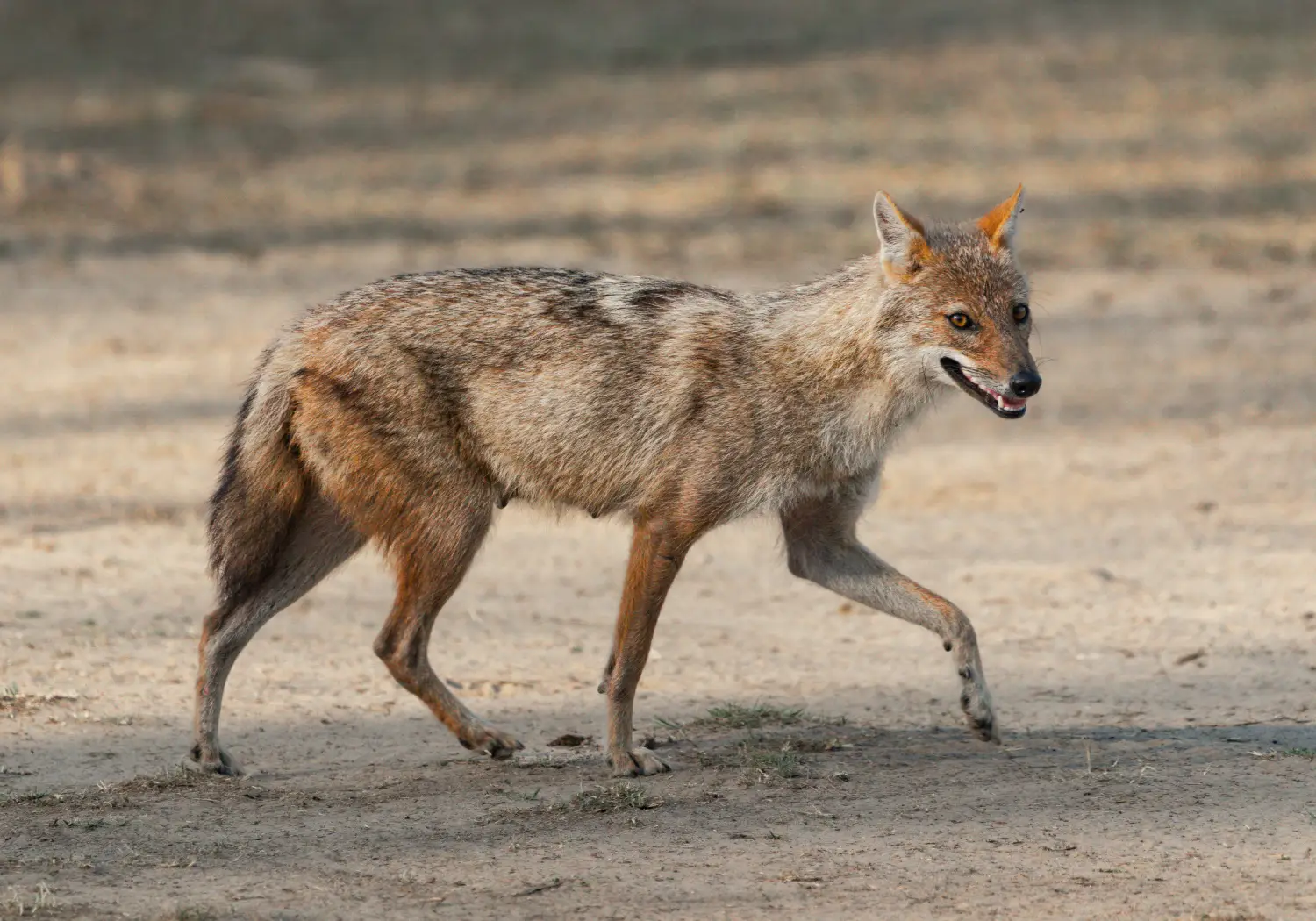
The African golden wolf is a slender, long-legged wild dog with a narrow muzzle and tall, pointed ears. Its coat is sandy, yellowish or golden-grey, often with black, brown or white streaks along the back that can form a faint darker saddle. The throat and belly are pale, the legs are reddish, and the bushy tail is black at the tip. Compared with the Eurasian golden jackal, it has a more pointed muzzle, longer ears and stronger teeth.
The East African form, sometimes called the Serengeti wolf, is the smallest. It weighs about 6–10 kg, about the same as a black-backed jackal. Animals in North and West Africa are noticeably larger and more wolf-like.
Golden Wolf vs Black-Backed and Side-Striped Jackals
Kenya has three jackal-like canids, and telling them apart is a fun safari challenge.
- African golden wolf (golden jackal): sandy or golden-grey, with no bold saddle and a fairly plain back. It prefers dry, open plains.
- Black-backed jackal: reddish, with a striking black saddle flecked with silver. It is the most commonly seen jackal in Kenya. Read our black-backed jackal profile.
- Side-striped jackal: greyer, with a pale stripe along each side and a white-tipped tail. It prefers wooded and wetter areas.
Where Does the African Golden Wolf Live?
The African golden wolf lives across North Africa, the Sahel, West Africa, the Horn of Africa and East Africa. According to the Mammal Diversity Database, its range runs from Morocco and Senegal to Egypt, Ethiopia, Somalia, Uganda, Kenya and Tanzania. It favours dry, open grassland, short-grass plains, semi-desert and scrub, and in the Atlas Mountains it has been recorded up to about 1,800 m.
In East Africa, it is most often seen on the short-grass plains of the Serengeti and in the Ngorongoro Crater. In Kenya, it is less common and more localised than the black-backed jackal. Browse our wildlife guide and Kenya destinations to learn more.
What Does the African Golden Wolf Eat?
The African golden wolf is an opportunistic omnivore. In the Ngorongoro Crater, studies found that insects, especially dung beetles, are its most common food in both wet and dry seasons. It also hunts rodents, hares, birds and young gazelles such as Thomson's gazelle fawns, scavenges carrion, and eats fruit, including wild melons.
African Golden Wolf Behaviour
African golden wolves are monogamous and territorial. A pair defends its home range and drives out other golden wolves.
Family Helpers
As with black-backed jackals, young golden wolves often stay with their parents to help raise the next litter, guarding the den and bringing food.
The Howl of East Africa
The African golden wolf is a keen howler, and in East Africa its howls carry across the plains at night. Where it lives alongside black-backed jackals, those jackals often call less.
Predators
Lions, leopards and spotted hyenas kill golden wolves, and eagles may take pups.
Breeding
Females give birth in a den, often an old burrow, after a pregnancy of about two months. Litters usually have a few pups, which are raised by both parents and their helpers.
Is the African Golden Wolf Endangered?
No. It is listed as Least Concern on the IUCN Red List, but that assessment was made when it was still grouped with the Eurasian golden jackal. Researchers writing in Mongabay note that very little is known about its true population and range, and new surveys are needed. Like other wild dogs, it is persecuted as a livestock predator and can catch rabies and distemper from domestic dogs. You can explore recorded sightings on iNaturalist.
A "New" Species Hiding in Plain Sight
The 2015 study in Current Biology, led by researchers at the Smithsonian and UCLA, compared the genomes of golden jackals from Kenya, North Africa and Eurasia. It found that African and Eurasian animals had been separated for more than a million years. National Geographic called it the first new canid species recognised in 150 years. Scientists later settled on the name Canis lupaster for the species.
Learn how your trip can support wildlife research and conservation with our conservation-based safaris in Kenya.
Where to See the Golden Jackal (African Golden Wolf)
Golden wolves are shyer and less common than black-backed jackals in Kenya, so a sighting is a real bonus.
Where to Look
- Serengeti National Park, Tanzania: the short-grass southern plains are one of the best places in East Africa to see golden wolves. See our Serengeti National Park guide.
- Ngorongoro Crater, Tanzania: open grassland on the crater floor, where they are often seen near hyena and lion kills.
- Kenya: golden wolves have been reported on dry, open plains such as those of Amboseli, Samburu, Tsavo and the Masai Mara. Ask your guide which jackals have been seen recently.
Combine Kenya and Tanzania
The Mara and Serengeti form one ecosystem, so a cross-border trip gives the best chance of seeing all three jackal-like canids. Ask about our multi-country safaris or browse our migration safaris in Kenya.
Go Early and Late
Golden wolves are most active around dawn and dusk, and you may hear them howling at night from camp.
Look Closely at Every Jackal
When you spot a jackal, check for the black saddle. If the back is plain sandy or golden-grey, you may be looking at a golden wolf.
Travel in the Dry Season
Short grass makes small carnivores easier to spot. The drier months are generally June to October and January to February. Travelling in the wet months instead? Read Can I do a Kenya safari during the rainy season?
Responsible Wildlife Viewing
Keep your distance, switch off the engine and stay in the vehicle, especially near dens. Never feed jackals or wolves at camps; it makes them bold and spreads disease. Give them space at kills so they can feed naturally.
Frequently Asked Questions About the Golden Jackal
Is there a golden jackal in Kenya?
Yes, but scientists now call it the African golden wolf (Canis lupaster). The true golden jackal (Canis aureus) lives only in Europe, the Middle East and Asia.
Why was the golden jackal renamed the African golden wolf?
A 2015 genetic study showed that African "golden jackals" are a separate species, more closely related to grey wolves than to Eurasian golden jackals.
How do you tell a golden wolf from a black-backed jackal?
The golden wolf is sandy or golden-grey with no bold saddle. The black-backed jackal is reddish with a striking silver-black saddle.
How big is the African golden wolf?
In East Africa, about 40–42 cm at the shoulder and about 6–10 kg. North African animals are larger.
What does the African golden wolf eat?
Insects, especially dung beetles, plus rodents, birds, gazelle fawns, carrion and fruit.
Where can I see golden jackals in East Africa?
Tanzania's Serengeti and Ngorongoro Crater are among the best places. In Kenya, look on dry, open plains such as Amboseli, Samburu, Tsavo and the Masai Mara. Sightings are never guaranteed.
Is the African golden wolf endangered?
No. It is listed as Least Concern, though scientists say more research is needed on its numbers.
Plan Your Kenya and Tanzania Safari
Want to look for golden wolves, jackals and the big cats of the Mara–Serengeti? Olengugih Safaris can design a private, flexible itinerary across Kenya and Tanzania. Start planning your safari or contact our team for a free quote.
Sources
- The 2015 genome study showing African and Eurasian golden jackals are separate species, with samples from Kenya: Koepfli et al. (2015), Current Biology, via Smithsonian Research Online and Phys.org
- First new canid species in 150 years: National Geographic
- The name Canis lupaster and its range across Africa: Mammal Diversity Database and Viranta et al. (2017), University of Oslo repository
- East African form (Serengeti wolf): size, coat and Ngorongoro diet: Wikipedia: Serengeti wolf
- Monogamy, helpers, insect diet and Atlas altitude: Simple Wikipedia: African golden wolf
- Lack of data on numbers and range: Mongabay
Interesting facts and identification clues
Interesting Facts About the Golden Jackal (African Golden Wolf)
East Africa's golden jackal was shown in 2015 to be a separate species, now called the African golden wolf.
It was the first new canid species recognised in about 150 years.
It is more closely related to grey wolves than to the true golden jackal of Europe and Asia.
In the Ngorongoro Crater, dung beetles are one of its favourite foods.
Young golden wolves often stay home to help raise their younger brothers and sisters.
The East African form is the smallest of all African golden wolves.
Content reviewed 22 Oct 2026