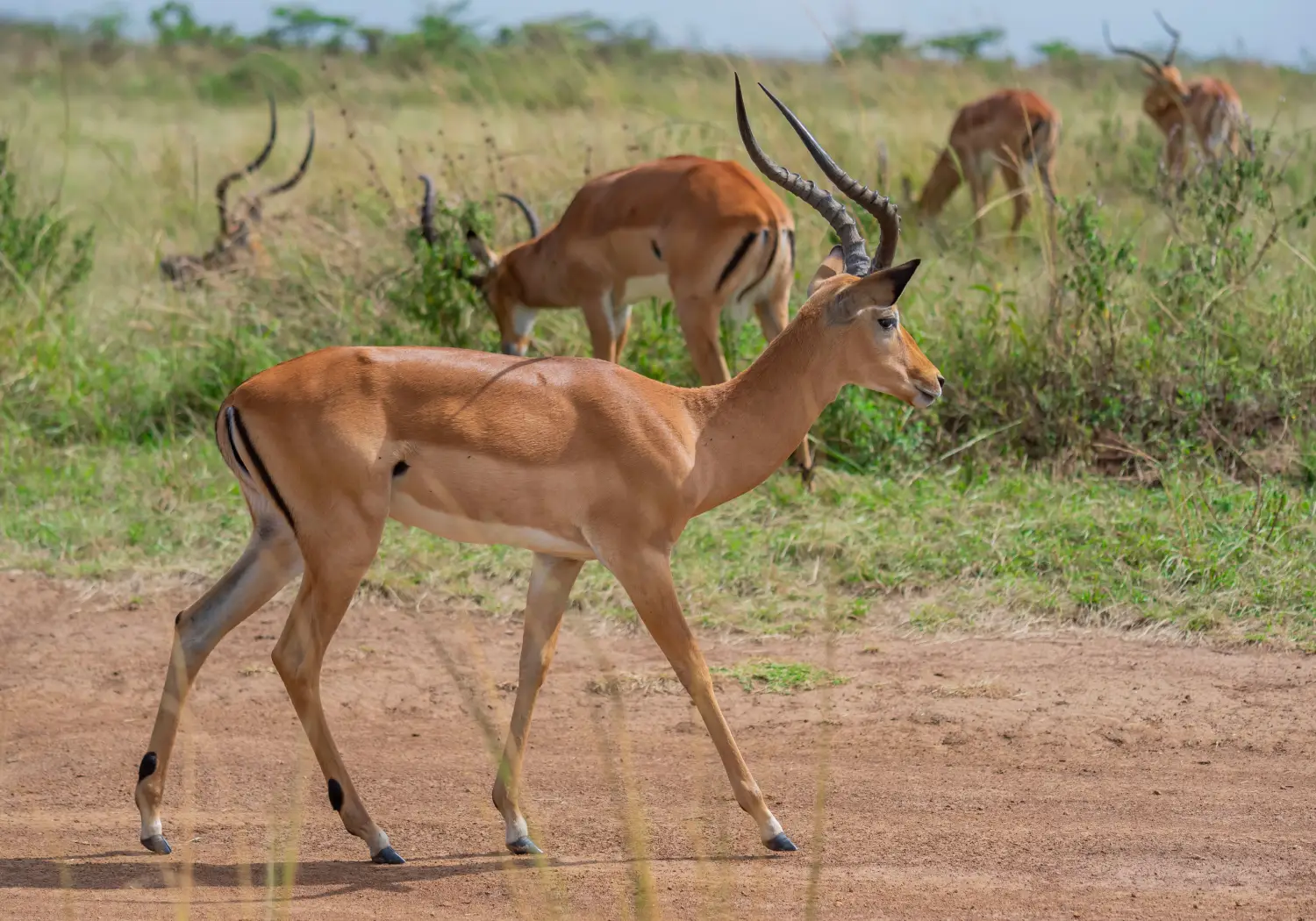
About the Impala
The impala (Aepyceros melampus) is a medium-sized, reddish-brown antelope with a paler flank, a white belly and a black "M" marking on its rump. Males carry long, ridged, lyre-shaped horns. Impalas are famous for their leaps: when startled, they can jump about 3 metres high and 10 metres long. In Swahili the impala is called swala pala, and Kenya's 2021 national wildlife census counted 25,541.
Quick answer: The impala is a common antelope of eastern and southern Africa that lives where grassland meets woodland. In Kenya, look for it in the Masai Mara, Lake Nakuru, Nairobi National Park, Samburu and Tsavo, usually in herds near woodland edges. Sightings are never guaranteed.
What Does an Impala Look Like?
The impala is slender and long-legged, with a glossy reddish-brown back, lighter tan flanks and a white belly, chin and throat. A black stripe runs down each thigh and down the tail, forming an "M" shape on the rump. Black tufts of hair sit just above the hind hooves, covering scent glands. These tufts give the impala its scientific name: melampus means "black-footed" in Greek.
Only males carry horns. These are heavily ridged and sweep up, back and out in a lyre shape, reaching about 45–92 cm. They take several years to grow to full length.
Impala vs Gazelle: What Is the Difference?
Impalas are often mistaken for gazelles, but they belong to a group of their own.
- Horns: only male impalas have horns. Both male and female Grant's and Thomson's gazelles carry horns.
- Markings: impalas have a black "M" on the rump and black heel tufts. Thomson's gazelles have a bold black side stripe instead.
- Colour: impalas are a richer reddish-brown, with a two-tone back and flank.
- Habitat: impalas prefer woodland edges, while gazelles favour open short-grass plains.
- Escape: impalas leap and scatter into bush; gazelles race and stott across the open plain.
Where Do Impalas Live?
Impalas live where grassland meets woodland: light acacia woodland, bushy savanna and riverine strips. They like to stay within reach of water, though they can go without drinking for a while when their food is green. Their range runs from Kenya and Uganda south to South Africa.
In Kenya they are common in most savanna parks and conservancies. Browse our wildlife guide and Kenya destinations to see where these habitats are found.
What Do Impalas Eat?
Impalas are mixed feeders, which is one reason they are so successful. In the wet season they graze fresh green grass. In the dry season they switch to browsing leaves, shoots, flowers, fruit and acacia seed pods. Being able to do both gives them a reliable food supply all year.
Impala Behaviour
Impalas live in three kinds of group: breeding herds of females and young, bachelor herds of young males, and territorial males. Female herds usually hold from about 30 to 200 animals.
The Famous Leap
When a predator appears, a herd explodes in all directions. Impalas leap up to about 3 metres high and 10 metres long, often over bushes or each other, to confuse the hunter. They then dash for thick cover rather than open plain. Leopards, cheetahs, lions, wild dogs, hyenas and crocodiles hunt them, and martial eagles and pythons take young calves.
The Rut
During the breeding season, territorial males roar, snort and chase rivals. They clash horns to win control of a group of females. Holding a territory is exhausting, so a male rarely keeps it for long.
Breeding
Females give birth to a single calf after a pregnancy of about six and a half to seven months. The mother gives birth away from the herd and hides the calf for a few days before bringing it back. Young calves gather in nursery groups within the herd.
Is the Impala Endangered?
No. The impala is listed as Least Concern on the IUCN Red List, with an estimated population of about 2 million, and numbers are broadly stable. About half live on private land and a quarter in protected areas. One form, the black-faced impala of Namibia and Angola, is much rarer. In Kenya, the 2021 national census counted 25,541 impalas. Local threats include bushmeat poaching, drought and the loss of woodland to farming. You can explore recorded sightings on iNaturalist.
Learn how your trip can support wildlife with our conservation-based safaris in Kenya.
How to See Impala on Safari in Kenya
Impalas are one of the easiest antelopes to see in Kenya. Look along woodland edges rather than out on the open plains.
Check the Woodland Edges
- Masai Mara: herds along the acacia woodland and the Mara and Talek rivers. See our Masai Mara National Reserve guide.
- Lake Nakuru: impalas in the acacia woodland around the lake. See our Lake Nakuru National Park guide.
- Nairobi National Park: woodland and valley edges close to the city. Try our Nairobi National Park private 4x4 safari.
- Samburu and Tsavo: riverine woodland along the Ewaso Ng'iro and Galana rivers. See our Samburu National Reserve and Tsavo East National Park guides.
- Laikipia: conservancies such as Ol Pejeta and Lewa. Browse all Kenya conservancies.
Go Early and Late
Impalas are active all day, but morning and late afternoon bring the most activity, the best light and the best chance of seeing predators hunt.
Build a Route With Variety
The 7 Day Kenya Elephants, Lakes and Masai Mara Safari passes Lake Nakuru and the Mara, both excellent for impala. The 8 Day Kenya Safari: Samburu, Ol Pejeta, Naivasha, Mara adds northern Kenya. You can also browse our Kenya wildlife safaris.
Travel in the Dry Season
Animals gather near water and the bush thins out. The drier months are generally June to October and January to February. Travelling in the wet months instead? Read Can I do a Kenya safari during the rainy season?
Photograph the Leap
Catching an impala mid-leap takes a fast shutter speed and burst mode, so be ready when a herd starts to fidget. Our photographic safaris in Kenya are built for moments like this.
Responsible Wildlife Viewing
Keep your distance, switch off the engine and avoid sudden movements. A calm herd will keep grazing in view, while a startled one scatters into the bush. Give territorial males space during the rut.
Frequently Asked Questions About the Impala
What is an impala?
A medium-sized, reddish-brown antelope of eastern and southern Africa, famous for its leaps and the male's lyre-shaped horns. Its scientific name is Aepyceros melampus.
How high can an impala jump?
About 3 metres high and up to 10 metres in a single bound.
Do female impalas have horns?
No. Only males carry horns.
What do impalas eat?
Grass in the wet season, and leaves, shoots, flowers, fruit and seed pods in the dry season.
Is an impala a gazelle?
No. Impalas belong to their own group. Unlike gazelles, only male impalas have horns, and impalas have a black "M" on the rump and black heel tufts.
Where can I see impala in Kenya?
Try the Masai Mara, Lake Nakuru, Nairobi National Park, Samburu, Tsavo and Laikipia conservancies. Sightings are never guaranteed.
Are impalas endangered?
No. The impala is listed as Least Concern, with about 2 million in the wild.
When is the best time to see impala?
Year-round. Early morning and late afternoon are best, and the dry months, June to October and January to February, give the clearest views.
Plan Your Kenya Wildlife Safari
Want to watch impalas leap, leopards stalk and elephants roam? Olengugih Safaris can design a private, flexible Kenya itinerary through the Mara, Nakuru, Samburu, Nairobi and beyond. Start planning your safari or contact our team for a free quote.
Interesting facts and identification clues
- An impala can leap about three metres high and ten metres long.
- Only male impalas grow horns, and the horns take years to reach full length.
- The black tufts above its hind hooves cover scent glands and gave the impala its scientific name, which means black-footed.
- The word impala comes from the Zulu language.
- Impalas both graze and browse, which lets them find food all year round.
- During the rut, males roar and snort loudly enough to be heard a long way off.
Content reviewed 19 Oct 2026