
About the Topi
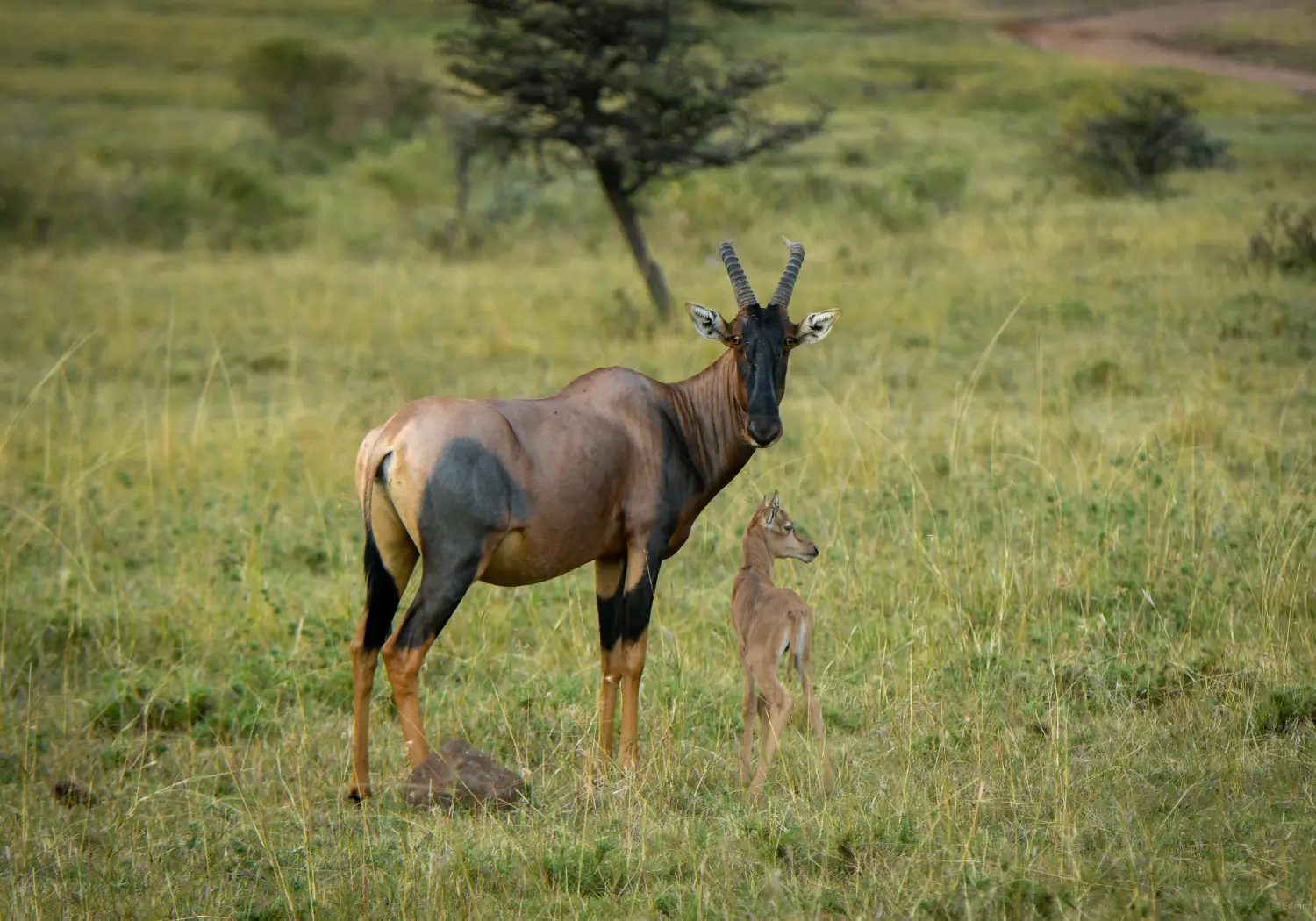
The topi (Damaliscus lunatus jimela) is a fast, social antelope with a glossy reddish-brown coat, a long face and dark purplish patches on its upper legs and face that guides often say look like a pair of faded "blue jeans". Both sexes carry ringed, lyre-shaped horns. Topi are famous for standing on termite mounds for hours, keeping watch over the plains. They are also known for something more surprising: research in the Masai Mara found that males sometimes give false alarm snorts to stop females from leaving their territory. The word topi is Swahili.
Quick answer: The topi lives on open grassland and floodplains in East and Central Africa. In Kenya, the best place to see it is the Masai Mara and its conservancies, where herds graze the plains and males stand guard on termite mounds. A separate coastal topi lives in Kenya's Lamu and Tana River areas. Sightings are never guaranteed.
What Does a Topi Look Like?
The topi is a medium-to-large antelope with a sloping back, high shoulders and a long, narrow face. Its short coat is a rich, glossy reddish-brown that can shine almost purple in sunlight. Dark purplish-black patches cover the face and the upper parts of the legs, while the lower legs are yellowish-tan. Males are larger and darker than females.
Both sexes carry ringed, lyre-shaped horns that curve gently up, back and slightly outwards. Males' horns are heavier. Topi have scent glands in front of the eyes and on the front hooves, which they use to mark territory.
Topi vs Hartebeest: How to Tell Them Apart
Topi share the Mara plains with Coke's hartebeest, and the two look similar at a distance.
- Colour: topi are darker and glossier, with dark patches on the legs and face. Hartebeest are a plain, pale sandy-fawn.
- Horns: topi horns curve smoothly in a gentle lyre. Hartebeest horns rise from a bony pedicle on top of the head and bend sharply backwards.
- Face: hartebeest have an even longer, narrower face.
- Behaviour: both stand on termite mounds, but topi are the more famous sentinels.
Where Do Topi Live?
Topi live on open grassland, floodplains and lightly wooded savanna, usually in flat lowlands below about 1,500 m. Where conditions suit them they can be very common, but they are patchily spread and absent from many areas. The topi (D. l. jimela) is found in Kenya, Tanzania, Uganda, Rwanda and DR Congo. In Kenya, the main population lives in the Masai Mara, with the separate coastal topi found in the Lamu, Garissa and Tana River areas.
Browse our wildlife guide and Kenya conservancies to see where these grasslands are found.
What Do Topi Eat?
Topi are selective grazers. Their narrow muzzle and flexible lips let them pick the freshest green grass leaves, taking many small bites quickly. When they can find enough green grass they rarely need to drink, but they drink daily when grass is dry.
Topi Behaviour
Topi are social, living in herds that range from a few animals to hundreds. Mature males hold territories, and herds move between pastures with the seasons.
Sentinels on Termite Mounds
A topi standing on a termite mound is one of the classic sights of the Mara. From the mound, it can watch for predators and show off to rivals and females. Topi also rest and sometimes doze on these raised platforms.
Lekking Males
In parts of the Masai Mara and Rwanda's Akagera, male topi gather on breeding grounds called leks, each defending a tiny territory. Females visit and often choose males in the centre of the lek.
False Alarms
A study published in The American Naturalist found that male topi in the Masai Mara sometimes give fake alarm snorts when a female is about to leave their territory. The snort makes the female think a predator is ahead, so she stays. National Geographic reported that the trick gives the males more chances to mate.
Speed and Predators
Topi are among the fastest antelopes and can outrun many predators. Lions, spotted hyenas, cheetahs and leopards hunt them, and jackals take newborn calves.
Breeding
Females give birth to a single calf after a pregnancy of about eight months. Calves can follow their mothers soon after birth.
Is the Topi Endangered?
The wider species, Damaliscus lunatus, is listed as Least Concern on the IUCN Red List. The topi of the Mara–Serengeti region is listed separately as Vulnerable, and the coastal topi of eastern Kenya as Endangered.
In Kenya, topi numbers have fallen sharply. Aerial surveys counted an average of about 126,000 topi in Kenya in 1977–1980, but only about 22,000 by 2011–2013. Studies in and around the Masai Mara found a decline of more than 70% between the late 1970s and late 2000s, and Kenya's 2021 national wildlife census counted 8,627. The 2024–25 census reported further declines in plains game, including topi. The main causes are the loss of grassland to farming and settlement, fencing, overgrazing by livestock and poaching. You can explore recorded sightings on iNaturalist.
Community conservancies around the Mara help keep grasslands open for topi and other plains animals. Learn more with our conservation-based safaris in Kenya.
How to See Topi on Safari in Kenya
The Masai Mara is one of the best places in Africa to see topi, and they are easy to find on its open plains.
Where to Look
- Masai Mara National Reserve: herds across the open grassland, with males on termite mounds. See our Masai Mara National Reserve guide.
- Mara conservancies: quieter viewing with fewer vehicles, in places such as Naboisho, Mara North and Olare Motorogi.
- Serengeti, Tanzania: large numbers on the plains. See our Serengeti National Park guide.
- Uganda: the Ishasha plains of Queen Elizabeth National Park and Lake Mburo National Park. Ask about our multi-country safaris.
Scan the Termite Mounds
Look for a lone animal standing tall on a termite mound. It is very often a male topi keeping watch.
Build a Route With Variety
The 3 Day Luxury Masai Mara Flying Safari at Mara Serena, the 3 Day Masai Mara Group Joining Safari and the 7 Day Kenya Elephants, Lakes and Masai Mara Safari all include the Mara. You can also browse our migration safaris in Kenya.
Travel in the Dry Season
Short grass makes herds easy to spot, and topi gather on fresh grazing. The drier months are generally June to October and January to February. Travelling in the wet months instead? Read Can I do a Kenya safari during the rainy season?
Photograph the Sentinel
A topi standing on a termite mound against a big Mara sky is one of the classic safari photos. Shoot from low down in soft morning or evening light. Our photographic safaris in Kenya are built for moments like this.
Responsible Wildlife Viewing
Keep your distance, switch off the engine and stay on the tracks. Don't drive towards a topi on its termite mound; let it keep its lookout. In the conservancies, follow your guide's lead on off-road rules.
Frequently Asked Questions About the Topi
What is a topi?
A fast, social antelope of East African grasslands, with a glossy reddish-brown coat, dark leg patches and lyre-shaped horns. Its scientific name is Damaliscus lunatus jimela.
Why do topi stand on termite mounds?
To watch for predators and to show off to rivals and females. They also rest on the mounds.
Do female topi have horns?
Yes. Both sexes have ringed, lyre-shaped horns; males' are heavier.
What is the difference between a topi and a hartebeest?
Topi are darker and glossier, with dark leg patches and smoothly curved horns. Hartebeest are pale and plain, with sharply angled horns on a raised base.
Do topi really fake alarm calls?
Yes. Research in the Masai Mara found that males sometimes snort false alarms to keep females in their territory.
What do topi eat?
Fresh green grass, which they pick selectively with their narrow muzzles.
Where can I see topi in Kenya?
The Masai Mara and its conservancies are the best places. Sightings are never guaranteed.
Are topi endangered?
The species is listed as Least Concern, but the topi subspecies is Vulnerable and Kenya's numbers have fallen sharply since the 1970s.
Plan Your Masai Mara Safari
Want to see topi on their termite mounds, big cats on the hunt and the Great Migration? Olengugih Safaris can design a private, flexible Masai Mara itinerary with expert guides. Start planning your safari or contact our team for a free quote.
Sources
- False alarm snorts by male topi in the Masai Mara: Bro-Jørgensen & Pangle (2010), The American Naturalist and National Geographic
- Weight, horns in both sexes, termite-mound sentinel behaviour and the meaning of lunatus: Ultimate Ungulate
- Kenya population trend (about 126,000 in 1977–1980, about 22,000 in 2011–2013), the Mara decline of more than 70%, leks and the Swahili origin of "topi": Wikipedia: Topi
- Species Least Concern status: IUCN Red List: Damaliscus lunatus
- Coastal topi Endangered status and range: IUCN Red List: coastal topi
- Kenya 2021 census count of 8,627: The Star
- Declines in plains game, including topi, in the 2024–25 census: Capital FM
Interesting facts and identification clues
Interesting Facts About the Topi
Topi often stand on termite mounds for hours, keeping watch over the plains.
Male topi sometimes give false alarm snorts to stop females from leaving their territory.
The word topi comes from Swahili.
The dark patches on its upper legs are often likened to a pair of faded jeans.
In parts of the Masai Mara, males gather on breeding grounds called leks.
Topi are among the fastest antelopes in Africa.
Content reviewed 22 Oct 2026