About the Egyptian Mongoose
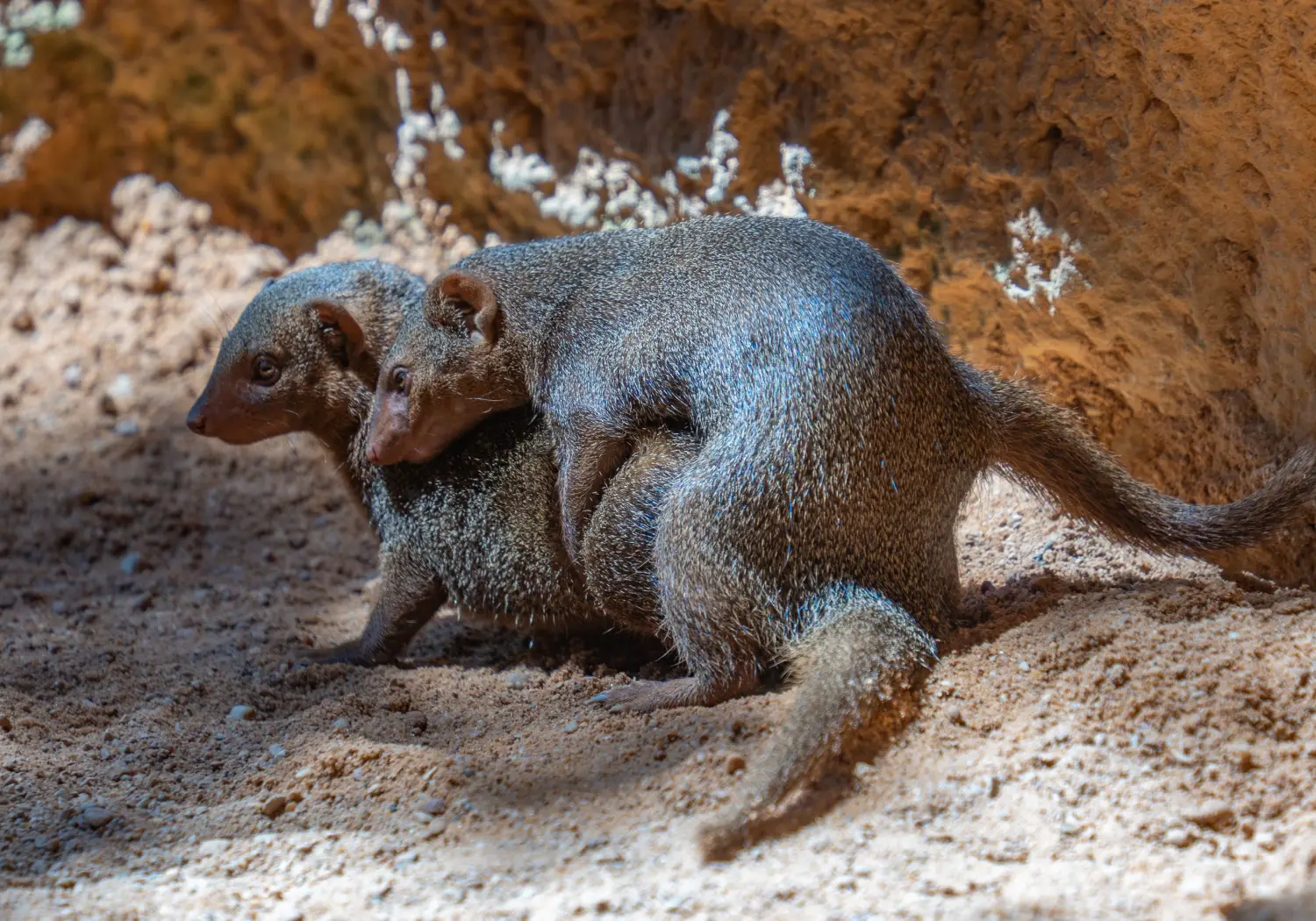
The Egyptian mongoose (Herpestes ichneumon), also called the ichneumon or large grey mongoose, is one of Africa's biggest mongooses. It has a long, low-slung body, short legs, a pointed snout and coarse, grizzled grey fur flecked with brown and yellow. Its long tail, almost as long as its body, ends in a distinctive black tassel. Ancient Egyptians revered it as a snake killer, sometimes mummifying it and casting bronze statues in its likeness. Today it lives across much of Africa, usually near water.
Quick answer: The Egyptian mongoose lives near rivers, lakes, swamps and reedbeds across much of Africa, as well as in the Middle East, Spain and Portugal. In Kenya, look for it along water edges at Lake Naivasha, Lake Nakuru, the Masai Mara and Nairobi National Park, usually by day. Sightings are never guaranteed.
What Does an Egyptian Mongoose Look Like?
The Egyptian mongoose has a slender, elongated body that looks almost torpedo-shaped as it moves, with short legs, a pointed snout and small rounded ears. Its long, coarse fur is grey to reddish-brown, finely ticked with brown and yellow, giving a grizzled look. The legs and feet are darker, almost black. Its long tail is thick at the base and tapers to a black tuft at the tip, which helps tell it apart from other mongooses. Males are slightly larger than females.
Egyptian Mongoose vs Other Mongooses in Kenya
Kenya has many mongoose species. Here's how to recognise the Egyptian mongoose.
- Egyptian mongoose: large, grizzled grey, with a long black-tufted tail; active by day near water.
- Banded mongoose: smaller, with dark bands across the back; lives in large packs. Read our banded mongoose profile.
- Dwarf mongoose: tiny and plain brown; lives in family groups in termite mounds.
- White-tailed mongoose: similar size but with a bushy white tail; mostly nocturnal.
- Marsh mongoose: dark brown and shaggy; mostly nocturnal along streams and swamps.
- Slender mongoose: much smaller and slimmer, with a black-tipped tail it flicks up as it runs.
Where Do Egyptian Mongooses Live?
Egyptian mongooses live across most of Africa, apart from the driest deserts and the central rainforests, and also in the Middle East, Turkey, Spain and Portugal. They are usually found near water: riverbanks, lake shores, swamps, marshes and reedbeds, as well as moist savanna and scrub with thick cover. In Ethiopia they have been recorded as high as 3,000 m.
In Kenya, they are most often seen along rivers and around Rift Valley lakes. Browse our wildlife guide and Great Lakes of Kenya to see where these habitats are found.
What Do Egyptian Mongooses Eat?
Egyptian mongooses are opportunistic hunters. They catch rodents, rabbits and hares, frogs, fish, crabs, snakes (including venomous ones), lizards, birds and their eggs, and insects. They also eat some fruit. Like other mongooses, they may break eggs by throwing them against a rock. In ancient Egypt, they were valued for killing snakes and eating crocodile eggs.
Egyptian Mongoose Behaviour
Unlike many mongooses, the Egyptian mongoose is active mainly by day. It is often seen alone or in pairs, but family groups of up to about seven, usually a male, females and young, also form.
Moving in Single File
A family group sometimes travels nose to tail in a tight line, which can look like one long, wriggling animal moving through the grass.
Snake Fighter
The Egyptian mongoose is famous for tackling snakes. It relies on speed and agility to dodge strikes, and its coarse fur gives some protection. It is not immune to venom.
Swimmers and Diggers
Egyptian mongooses swim well and hunt along water edges. They shelter in burrows, rock crevices, hollow trees and thick vegetation.
Predators
Large birds of prey, pythons, leopards, black-backed jackals and other carnivores hunt Egyptian mongooses, especially the young.
Breeding
After a pregnancy of about 11 weeks, the female gives birth to two to four pups in a den. They are born blind and almost hairless, and open their eyes at about a week old.
Is the Egyptian Mongoose Endangered?
No. The Egyptian mongoose is listed as Least Concern on the IUCN Red List because it is widespread and adaptable. Locally, it can be affected by the draining of wetlands, the clearing of riverside vegetation, persecution by poultry farmers, snares and road traffic. In Egypt, where it was once common in the fields, Egyptian Streets reports it is now far less visible. You can explore recorded sightings on iNaturalist.
Learn how your trip can support wildlife and wetland conservation with our conservation-based safaris in Kenya.
How to See Egyptian Mongooses in Kenya
Egyptian mongooses are active by day but shy, often slipping into reeds or long grass. Scan the edges of water and tracks carefully.
Where to Look
- Lake Naivasha: lakeshore reeds and acacia woodland, including walking areas such as Crescent Island. See our Lake Naivasha guide.
- Lake Nakuru: lake edges, streams and woodland. See our Lake Nakuru National Park guide.
- Masai Mara: riverbanks along the Mara and Talek rivers and around marshes. See our Masai Mara National Reserve guide.
- Nairobi National Park: dams, streams and riverine forest. Try our Nairobi National Park private 4x4 safari.
- Amboseli: the edges of the permanent swamps. See our Amboseli National Park guide.
Scan the Water's Edge
Drive slowly along rivers, lake shores and swamps, watching for a long grey shape with a black-tipped tail crossing the track or slipping into reeds.
Go in the Morning
Egyptian mongooses are active by day, but early morning and late afternoon are often best, when they forage along tracks and water edges.
Build a Route With Variety
The 7 Day Kenya Elephants, Lakes and Masai Mara Safari visits Lake Naivasha, Lake Nakuru and the Mara, all good places to look. You can also browse our Kenya wildlife safaris.
Travel in the Dry Season
Wildlife gathers near permanent water, making mongooses easier to find. The drier months are generally June to October and January to February. Travelling in the wet months instead? Read Can I do a Kenya safari during the rainy season?
Responsible Wildlife Viewing
Keep your distance, switch off the engine and stay quiet. On walking safaris, such as at Lake Naivasha, stay with your guide and never follow a mongoose into reeds. Don't feed mongooses at lodges or camps.
Frequently Asked Questions About the Egyptian Mongoose
What is an Egyptian mongoose?
A large, grizzled grey mongoose with a long, black-tipped tail that lives near water across Africa and parts of the Middle East and Europe. Its scientific name is Herpestes ichneumon.
How big is an Egyptian mongoose?
The body is about 48–60 cm long, the tail about 33–54 cm, and it weighs about 1.7–4 kg.
Do Egyptian mongooses kill snakes?
Yes, including venomous snakes. They rely on speed and agility, as they are not immune to venom.
What do Egyptian mongooses eat?
Rodents, frogs, fish, crabs, snakes, lizards, birds, eggs, insects and some fruit.
Why is it called the Egyptian mongoose?
It was well known in ancient Egypt, where it was revered for killing snakes, and it still lives along the Nile.
Where can I see Egyptian mongooses in Kenya?
Near water at Lake Naivasha, Lake Nakuru, the Masai Mara, Nairobi National Park and Amboseli. Sightings are never guaranteed.
Are Egyptian mongooses endangered?
No. They are listed as Least Concern.
Plan Your Kenya Lakes Safari
Want to explore Kenya's Rift Valley lakes, rivers and wetlands, and the wildlife that lives along them? Olengugih Safaris can design a private, flexible itinerary through Naivasha, Nakuru, the Mara and beyond. Start planning your safari or contact our team for a free quote.
Sources
- Least Concern status, size, grizzled fur, black-tipped tail and Ethiopian highland records: Wikipedia
- Habitat near water, active by day, two to three pups after an 11-week pregnancy, and a lifespan of over 20 years in captivity: JungleDragon
- Weight of 1.7–4 kg, reverence in ancient Egypt, mummies and bronze statues, and its decline in Egyptian fields: Egyptian Streets
- Snake handling and crocodile eggs in ancient Egypt: New World Encyclopedia
- "Ichneumon" meaning tracker: Wikipedia: White-tailed mongoose
- Groups of up to seven and litters of two to four: Wikipedia for Schools
Interesting facts and identification clues
Interesting Facts About the Egyptian Mongoose
- The Egyptian mongoose is one of the largest mongooses in Africa.
- Its long tail ends in a distinctive black tassel.
- Ancient Egyptians revered it as a snake killer and sometimes mummified it.
- Family groups sometimes travel nose to tail in a line, looking like one long animal.
- Its other name, ichneumon, comes from the Greek for "tracker".
- It is one of the few mongooses found in Europe, living in Spain and Portugal.
Content reviewed 22 Oct 2026