About the Banded Mongoose
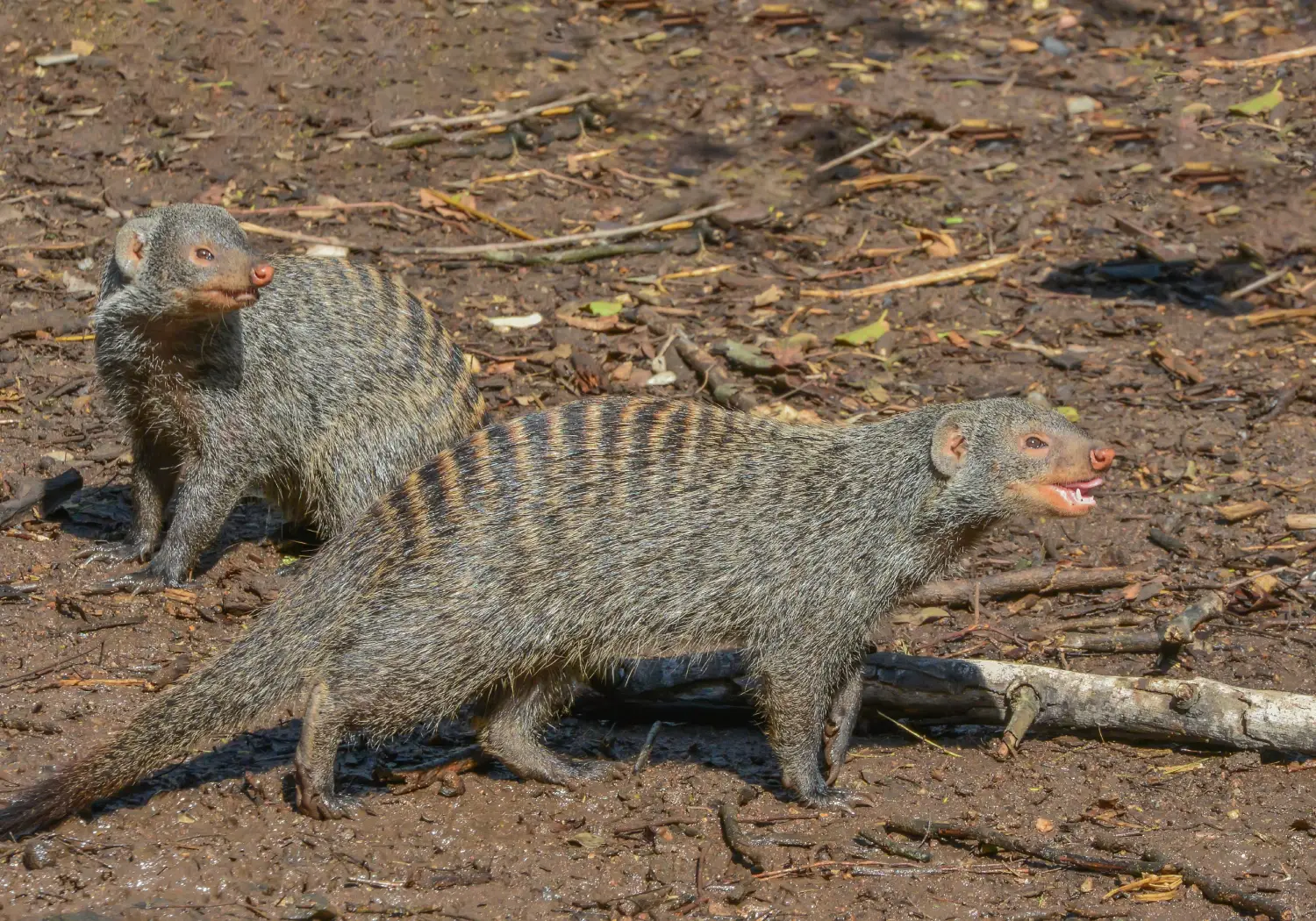
The banded mongoose (Mungos mungo) is a small, sturdy carnivore with a grizzled grey-brown coat and a series of dark bands running across its back from the shoulders to the tail. Unlike most mongooses, it lives in noisy, close-knit packs of up to about 40. Pack members forage, travel and fight off predators together, and almost all the females give birth on the same night, so the whole group raises the pups as one. Watching a pack bustle across the plains, chattering and squabbling, is one of the liveliest small-animal sightings on safari.
Quick answer: The banded mongoose lives in savanna, open woodland and grassland across much of sub-Saharan Africa, often near water and termite mounds. In Kenya, look for packs in the Masai Mara, Nairobi National Park, Lake Nakuru, Samburu and Tsavo, especially in the morning. Sightings are never guaranteed.
What Does a Banded Mongoose Look Like?
The banded mongoose is a sturdy little animal with a large head, small rounded ears, short muscular legs and a long, bushy tail almost as long as its body. Its coarse coat is grizzled grey-brown, with 10 to 15 dark bands running across its back from the shoulders to the base of the tail. The legs and tail tip are darker, and the nose ranges from grey-brown to orange-red. Strong claws on its front feet make it a powerful digger. Males and females are much the same size.
Banded Mongoose vs Other Mongooses in Kenya
Kenya has several mongoose species. Here's how to pick out the banded mongoose.
- Banded mongoose: medium-sized, grey-brown with clear dark bands across the back; lives in packs.
- Dwarf mongoose: Africa's smallest carnivore, plain reddish-brown with no bands; lives in small groups, often in termite mounds.
- Slender mongoose: slim and solitary, with a long black-tipped tail that it flicks up as it runs.
- Marsh and white-tailed mongooses: larger, solitary and mostly nocturnal.
Where Do Banded Mongooses Live?
Banded mongooses live across much of sub-Saharan Africa, from Gambia and Senegal east to Ethiopia and south to Angola and north-eastern South Africa. They prefer savanna, open woodland, grassland and bush, often near water, and avoid rainforest, true desert and high mountains. Termite mounds are a favourite place to den, as they have many entrances and air holes. Packs move den every few days.
In some places they live at high densities. Uganda's Queen Elizabeth National Park, home to a long-running research project, has around 18 per square kilometre. Browse our wildlife guide and Kenya destinations to learn more.
What Do Banded Mongooses Eat?
Banded mongooses are mainly insect eaters. Millipedes and beetles make up most of their diet, along with termites, ants, crickets, grasshoppers, caterpillars and snails. They also catch frogs, lizards, small snakes and rodents, and eat the eggs of ground-nesting birds and reptiles. To break an egg or a snail shell, a mongoose grips it in its front paws and hurls it backwards between its legs against a rock.
They forage as a pack, but each mongoose searches for its own food, keeping in touch with constant chirps and twitters.
Banded Mongoose Behaviour
Banded mongooses are active by day and live in permanent packs, usually of about 10–40 animals. Unlike most social mongooses, all the females in a pack can breed.
Born on the Same Night
In most packs, nearly all the pregnant females give birth on the same night. Research on banded mongooses in Uganda, reported by CNN, found that this creates a "veil of ignorance": mothers can't tell which pups are theirs, so they care for the whole litter equally.
Pup Escorts
When the pups leave the den, each one pairs up with an adult, called an escort, who feeds, carries and protects it, and teaches it how to forage. National Geographic notes that pups often copy their escort's own foraging style.
Mobbing Predators
When a predator appears, the pack bunches together and advances as one, looking like a single large animal. They have been seen mobbing jackals, birds of prey and even lions. Predators include eagles, marabou storks, pythons, monitor lizards, leopards and black-backed jackals.
Groomers of Warthogs
In Kenya and Uganda, banded mongooses have been seen climbing onto resting warthogs and picking off ticks and other parasites, a rare partnership that benefits both animals.
Breeding
After a pregnancy of about 60 days, the females give birth in an underground den. One or more adults stay behind to babysit while the rest of the pack forages. The pups start foraging with their escorts at about a month old.
Is the Banded Mongoose Endangered?
No. The banded mongoose is listed as Least Concern on the IUCN Red List. It is widespread, adaptable and found in many protected areas, and in some places farming has even helped it by creating more insect-rich ground. Local threats include habitat loss, persecution near farms, being hunted for bushmeat, road accidents and diseases such as tuberculosis passed on from people and livestock. You can explore recorded sightings on iNaturalist.
Learn how your trip can support wildlife with our conservation-based safaris in Kenya.
How to See Banded Mongooses on Safari in Kenya
Banded mongooses are common in many Kenyan parks, and once you spot a pack, they're fun to watch for a long time.
Where to Look
- Masai Mara: packs around termite mounds and along woodland edges. See our Masai Mara National Reserve guide.
- Nairobi National Park: grassland and woodland edges just outside the city. Try our Nairobi National Park private 4x4 safari.
- Lake Nakuru: acacia woodland around the lake. See our Lake Nakuru National Park guide.
- Samburu, Tsavo and Amboseli: dry bush and riverine woodland. See our Samburu National Reserve, Tsavo East and Amboseli guides.
- Uganda: Queen Elizabeth National Park, where packs often live around the Mweya Peninsula. Ask about our multi-country safaris.
Check the Termite Mounds
In the morning, packs often emerge from termite mounds to sunbathe before setting off to forage. Scan mounds near the track for small heads popping up.
Listen for the Chatter
A foraging pack keeps up a constant chorus of chirps and twitters. If you hear it in long grass, wait quietly and the pack may cross the track.
Watch Warthogs Closely
If you see a warthog lying down near a mongoose pack, watch for the mongooses climbing on to groom it.
Build a Route With Variety
The 7 Day Kenya Elephants, Lakes and Masai Mara Safari passes Amboseli, Lake Nakuru and the Mara, all good mongoose country. For families, browse our Kenya family safaris.
Travel in the Dry Season
Shorter grass makes small animals easier to see. The drier months are generally June to October and January to February. Travelling in the wet months instead? Read Can I do a Kenya safari during the rainy season?
Photograph the Pack
A row of banded mongooses standing up on a termite mound makes a charming photo. Get low, use a fast shutter speed and be patient. Our photographic safaris in Kenya are built for moments like this.
Responsible Wildlife Viewing
Keep your distance, switch off the engine and stay quiet so the pack keeps foraging naturally. Never feed mongooses at lodges or camps. It harms their health and makes them bold around people. Avoid driving over termite mounds where packs may be denning.
Frequently Asked Questions About the Banded Mongoose
What is a banded mongoose?
A small, sociable African carnivore with dark bands across its back that lives in packs. Its scientific name is Mungos mungo.
How big is a banded mongoose?
About 30–45 cm long plus a long tail, and about 1.5–2.25 kg.
What do banded mongooses eat?
Mainly millipedes and beetles, plus other insects, snails, frogs, lizards, small snakes, eggs, rodents and fruit.
Why do banded mongooses give birth on the same night?
So mothers can't tell which pups are theirs, and the whole pack cares for all the pups equally.
Do banded mongooses really groom warthogs?
Yes. In Kenya and Uganda, they have been seen picking ticks off resting warthogs.
Where can I see banded mongooses in Kenya?
The Masai Mara, Nairobi National Park, Lake Nakuru, Samburu, Tsavo and Amboseli. Sightings are never guaranteed.
Are banded mongooses endangered?
No. They are listed as Least Concern.
Plan Your Kenya Family Safari
Want to watch mongoose packs, warthogs and big cats on a fun, flexible trip? Olengugih Safaris can design a private Kenya itinerary through Nairobi, the Rift Valley lakes, the Mara and beyond. Start planning your safari or contact our team for a free quote.
Sources
- Size and weight, Least Concern status, diet of mainly millipedes and beetles, all females breeding, and Queen Elizabeth NP densities: Wikipedia
- Synchronised births, the "veil of ignorance" and pup escorts, from the Uganda study: CNN, via WRAL
- Escorts as mentors: National Geographic
- Grooming warthogs in Kenya and Uganda: Potawatomi Zoo and JungleDragon
- Hurling eggs, predators and range: Amnéville Zoo
- Pack size of about 6–40 and standing up to lions: Kruger National Park
- Habitat, tuberculosis and bushmeat threats: Namibia Carnivore Red Data Book
Interesting facts and identification clues
Interesting Facts About the Banded Mongoose
Banded mongooses live in packs of up to about 40.
In most packs, nearly all the females give birth on the same night.
Each pup is paired with an adult "escort" who feeds and protects it.
They break eggs by hurling them backwards between their legs against a rock.
They sometimes groom warthogs, picking off their ticks.
When threatened, a pack bunches together and advances like one large animal.
Content reviewed 22 Oct 2026