About the Honey Badger
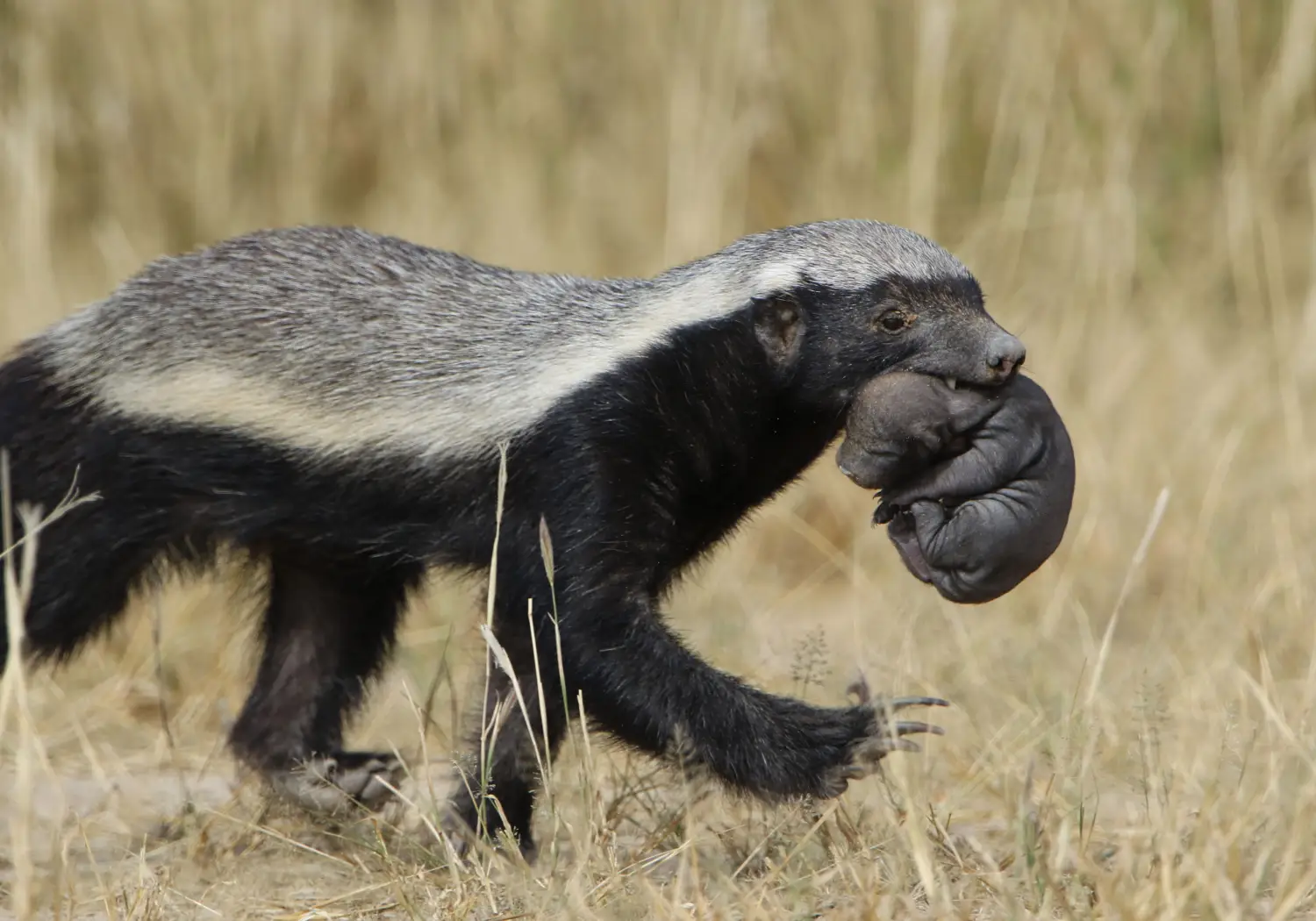
The honey badger (Mellivora capensis), also called the ratel and known in Swahili as nyegere, is a stocky, low-slung carnivore with a black body and a broad silver-grey mantle from the crown to the tail. Despite its name, it is not a true badger but a member of the weasel family. It is famous for its toughness: thick, loose skin lets it twist round and bite an attacker, it raids beehives for larvae and honey, and it hunts venomous snakes. It is shy and wide-ranging, so seeing one on safari is a real stroke of luck.
Quick answer: The honey badger lives across most of sub-Saharan Africa, as well as parts of the Middle East and India. In Kenya, it occurs in most savanna parks but is rarely seen. Your best chances are on early-morning, evening or night drives in places such as Laikipia's Ol Pejeta Conservancy, Samburu and the Masai Mara. Sightings are never guaranteed.
What Does a Honey Badger Look Like?
The honey badger is a short, stocky animal with a broad back, short, powerful legs and a short tail. Its body and legs are black, while a wide band of silver-grey or white hair runs from the top of its head down to the base of its tail. The head is broad and flat, with small eyes and tiny ears set in thick skin. Its front feet carry long, strong claws for digging, and males are larger than females.
Built Tough: Fact vs Myth
The honey badger's reputation has grown online, so here is what the science says.
- Loose, thick skin (fact): its skin is remarkably loose, letting it twist round inside it to bite an attacker that grabs it. Mpala Research Centre in Laikipia notes that the skin also protects it from bee stings and snakebites.
- Snake venom (partly true): honey badgers hunt venomous snakes, including cobras and mambas, and seem to have some resistance to venom. They can still be harmed or killed by a bad bite.
- Warning colours (fact): its bold black-and-silver coat warns predators that it is not an easy meal, and a gland under the tail produces a foul smell.
- The honeyguide partnership (probably a myth): it is often said that the greater honeyguide bird leads honey badgers to beehives. According to the Handbook of the Mammals of the World, no complete observation of this has ever been recorded. Honeyguides do famously guide people to hives.
Where Do Honey Badgers Live?
Honey badgers have one of the widest ranges of any carnivore. They live across most of sub-Saharan Africa and into Arabia, Iran, western Asia and India. They are found in almost every habitat except the wettest rainforest and the driest true desert: savanna, woodland, scrub, semi-desert, rocky hills and forest edges, from sea level to about 4,000 m. They shelter in burrows they dig themselves or take over, as well as rock crevices and hollow trees.
Browse our wildlife guide and Kenya destinations to see where these habitats are found.
What Do Honey Badgers Eat?
Honey badgers are opportunistic omnivores. Bee larvae and honey are favourites, which they reach by tearing open hives. They also dig out rodents, scorpions, large spiders and insects, and hunt snakes, lizards, frogs, birds and their eggs, and small mammals. They eat carrion, roots, bulbs and fruit too. In some areas they also take poultry and young livestock, which can bring them into conflict with farmers and beekeepers.
Honey Badger Behaviour
Honey badgers are mostly solitary, although mothers and cubs travel together. They cover large areas while foraging and can be active by day or night, often becoming more nocturnal near people.
Digging Machines
With powerful front claws, a honey badger can dig into a burrow or hard ground in minutes. Jackals and birds of prey sometimes follow a digging badger to catch rodents that bolt from the hole.
Fearless Defence
Honey badgers seldom pick fights they can't win, but when threatened they stand their ground, rattle, growl and attack. They have been seen confronting animals far larger than themselves, including lions and hyenas. Leopards and lions are their main predators.
Climbers and Swimmers
Honey badgers can climb trees to reach beehives and birds' nests, and are good swimmers.
Breeding
Females give birth in a burrow after a pregnancy of about 50–70 days, usually to a single cub, rarely two. The mother raises it alone, moving it between dens, and it stays with her for more than a year while it learns to forage.
Is the Honey Badger Endangered?
No. The honey badger is listed as Least Concern on the IUCN Red List because it is widespread and adaptable. However, it naturally lives at low densities, and National Geographic notes that it is persecuted in some regions by beekeepers and farmers, hunted for bushmeat and used in traditional medicine. Poisoning, snares and road accidents also take a toll. You can explore recorded sightings on iNaturalist.
Badger-Friendly Honey
In several African countries, beekeepers now raise their hives on stands or hang them from trees, out of a honey badger's reach. This protects the bees and the badgers, and some honey is sold as "badger-friendly".
Learn how your trip can support wildlife and the communities who live alongside it with our conservation-based safaris in Kenya.
How to See Honey Badgers in Kenya
Honey badgers are found in most of Kenya's savanna parks, but they are shy, travel widely and are often active at night. A sighting is a real highlight.
Where to Look
- Laikipia: conservancies such as Ol Pejeta, Lewa and Loisaba, where night drives are possible.
- Samburu: dry bush and riverine woodland. See our Samburu National Reserve guide.
- Masai Mara: plains and woodland edges, and the conservancies. See our Masai Mara National Reserve guide.
- Tsavo and Amboseli: dry country where they forage widely. See our Tsavo East and Amboseli guides.
- Nairobi National Park: occasionally seen at dawn and dusk. Try our Nairobi National Park private 4x4 safari.
Book a Night Drive
Private conservancies in Laikipia and around the Mara offer guided night drives, which give the best chance of seeing honey badgers and other nocturnal animals.
Go Early and Late
Early morning and late evening drives catch them heading out or returning to their dens. Watch for a low, black-and-silver animal trotting purposefully along a track.
Watch the Diggers
If you see jackals or birds of prey hovering around a patch of ground, check for a digging honey badger.
Build a Route With Variety
The 8 Day Kenya Safari: Samburu, Ol Pejeta, Naivasha, Mara covers several of the best areas. You can also browse our Kenya wildlife safaris.
Travel in the Dry Season
Shorter grass makes small carnivores easier to spot. The drier months are generally June to October and January to February. Travelling in the wet months instead? Read Can I do a Kenya safari during the rainy season?
Responsible Wildlife Viewing
Honey badgers are shy and can be aggressive if cornered. Stay in the vehicle, keep your distance and don't follow one off-track. On night drives, keep spotlights off its eyes for long. Never leave food out at camps, as honey badgers are clever raiders of bins and kitchens.
Frequently Asked Questions About the Honey Badger
What is a honey badger?
A stocky, black-and-silver carnivore of the weasel family, famous for its toughness and love of honey. Its scientific name is Mellivora capensis.
Is the honey badger really fearless?
It is very bold, and will defend itself fiercely against much larger animals. But it usually avoids fights it can't win.
Are honey badgers immune to snake venom?
They seem to have some resistance, and their thick skin helps, but they are not fully immune. A bad bite can still harm or kill them.
Do honeyguide birds really lead honey badgers to beehives?
Probably not. No complete observation of a honeyguide leading a honey badger to a hive has ever been recorded.
What do honey badgers eat?
Bee larvae and honey, rodents, snakes, lizards, scorpions, insects, birds, eggs, carrion, roots and fruit.
Where can I see honey badgers in Kenya?
Laikipia, Samburu, the Masai Mara, Tsavo, Amboseli and Nairobi National Park, especially on early, late or night drives. Sightings are never guaranteed.
Are honey badgers dangerous to people?
They avoid people but can attack if cornered. Always keep your distance.
Are honey badgers endangered?
No. They are listed as Least Concern, though they face persecution in some areas.
Plan Your Kenya Safari
Want to look for honey badgers, leopards and other secretive animals on a private conservancy safari? Olengugih Safaris can design a flexible Kenya itinerary with night drives in Laikipia and the Mara. Start planning your safari or contact our team for a free quote.
Sources
- Swahili name nyegere, skin protecting against stings and snakebite, vocalisations, the stink gland and jackals following digging badgers: Mpala Research Centre (Laikipia, Kenya)
- Size and weight ranges, altitude up to 4,050 m, diet and the unproven honeyguide relationship: Handbook of the Mammals of the World, via Plazi
- Loose skin, Least Concern status, a 50–70-day pregnancy and cubs staying with the mother for over a year: Wikipedia
- Persecution, bushmeat and traditional medicine, and shoulder height: National Geographic
- Climbing, swimming, resistance to venom and badger-friendly honey: San Diego Zoo Wildlife Alliance
- The honeyguide myth and the meaning of the scientific name: Mental Floss and Discover Wildlife
Interesting facts and identification clues
Interesting Facts About the Honey Badger
The honey badger is not a true badger but a member of the weasel family.
Its loose skin lets it twist round inside it to bite an attacker.
Its scientific name, Mellivora capensis, means "honey-eater of the Cape".
In Swahili the honey badger is called nyegere.
The popular story of honeyguide birds leading honey badgers to beehives has never been fully documented.
Jackals and birds of prey sometimes follow a digging honey badger to catch fleeing rodents.
Content reviewed 22 Oct 2026