About the Aardwolf
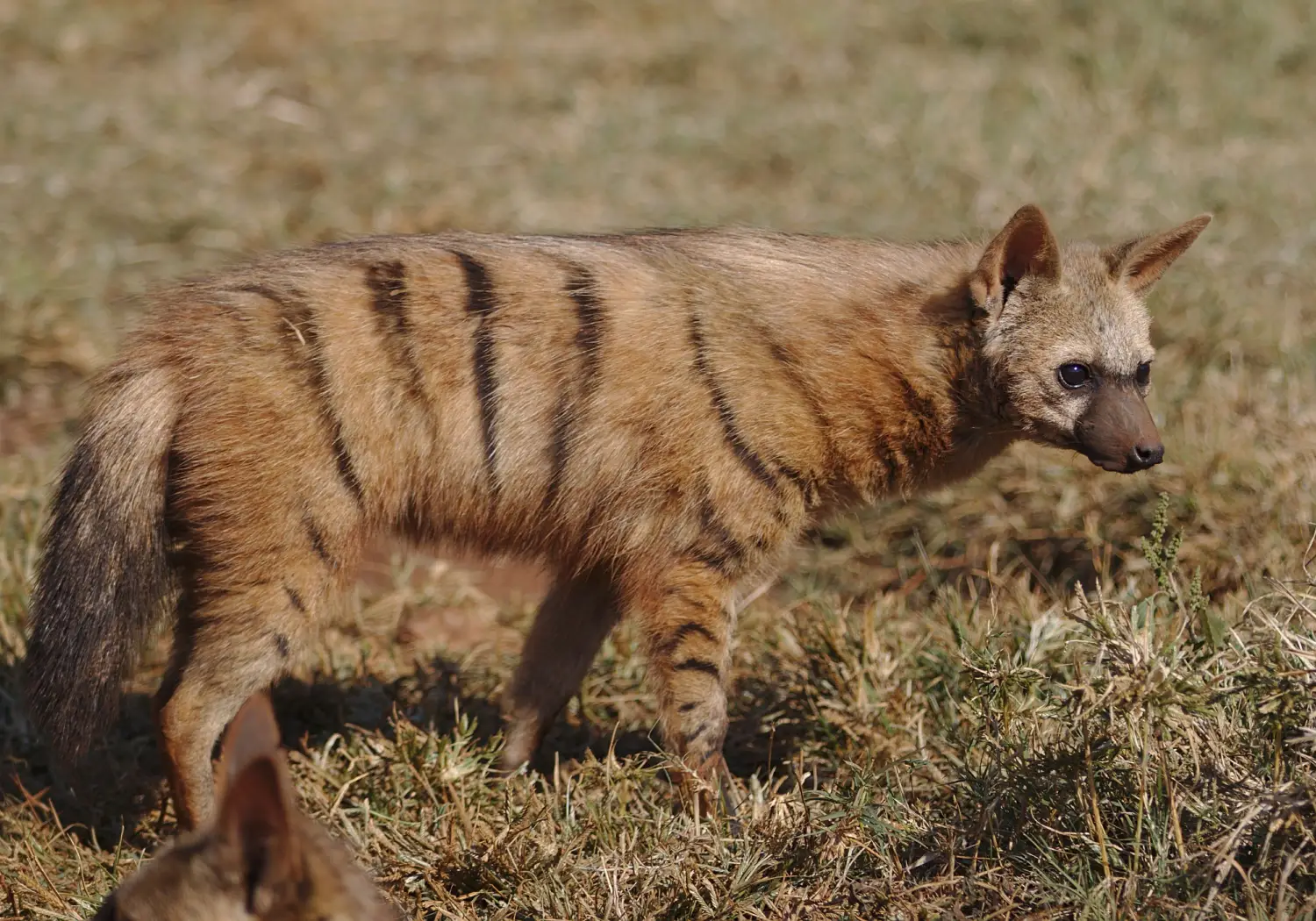
The aardwolf (Proteles cristatus) is neither an aardvark nor a wolf. It is the smallest and most unusual member of the hyena family. About the size of a fox, it has a sandy-yellow coat with bold black stripes, a long erectile mane down its back, big pointed ears and a bushy, black-tipped tail. Instead of hunting large animals, it lives almost entirely on termites. Using its long, sticky tongue, a single aardwolf can lap up an estimated 200,000–300,000 termites in one night. Shy and nocturnal, it is one of the most sought-after sightings on a night drive.
Quick answer: The aardwolf lives on dry, open grassland and savanna in two separate parts of Africa: East Africa and southern Africa. In Kenya, look for it on night drives in the conservancies around the Masai Mara, such as Naboisho, and in Laikipia, such as Ol Pejeta. It also occurs in dry country such as Samburu and Tsavo. Sightings are never guaranteed.
Aardwolf: Quick Identification (At a Glance)
Field | Detail |
|---|---|
Scientific name | Proteles cristatus |
Other names | Civet hyena; East African form P. c. septentrionalis |
Category | Mammals (carnivore, hyena family Hyaenidae) |
Size | About 55–80 cm long plus a 20–30 cm tail; about 8–14 kg |
Key features | Sandy-yellow coat with black vertical stripes, long mane along the back, large pointed ears, black lower legs, bushy black-tipped tail |
Range | Two separate areas: East and North-East Africa (Ethiopia, Somalia, Kenya, Tanzania) and southern Africa |
Typical habitat | Dry, open grassland, short-grass plains and savanna with plenty of termites |
Diet | Almost entirely termites, especially Trinervitermes snouted harvester termites; some other insects and larvae |
Where to see it in Kenya | Masai Mara conservancies, Laikipia conservancies, Samburu, Tsavo |
Viewing pattern | Nocturnal; alone or in pairs, resting in burrows by day |
Breeding | Socially monogamous pairs; litters of two to four cubs, which emerge from the den at about six weeks |
Conservation status | Least Concern (IUCN Red List) |
What Does an Aardwolf Look Like?
The aardwolf looks like a small, slender striped hyena. It has a sandy-yellow to buff coat marked with three or four black vertical stripes on each side and a few on the legs. A long, coarse mane runs from the neck to the base of the tail and can be raised to make the animal look much bigger when it feels threatened. Its muzzle is long and dark, its ears are large and pointed, its lower legs are black, and its bushy tail has a black tip. It has five toes on its front feet, unlike other hyenas, which have four.
Its teeth are unusual. It still has well-developed canines, used for fighting and defence, but its cheek teeth have shrunk to small, widely spaced pegs, since it has no need to chew meat. Its long, broad, sticky tongue is its main feeding tool.
Aardwolf vs Hyenas and Aardvarks
The aardwolf is often confused with other animals because of its name and looks.
- Aardwolf: small (8–14 kg), striped, with a mane; eats termites by licking them up without destroying the mound.
- Striped hyena: much larger, with similar stripes and mane, but it is a scavenger and hunter with powerful jaws. It lives in northern and eastern Kenya.
- Spotted hyena: much larger and spotted, with no mane; a powerful hunter and scavenger. Read our spotted hyena profile.
- Aardvark: not related at all; a pig-sized, long-snouted digger that breaks open termite mounds with huge claws. The name "aardwolf" means "earth wolf" in Afrikaans, and "aardvark" means "earth pig".
Where Do Aardwolves Live?
Aardwolves live in two separate parts of Africa. One population ranges from Egypt and Sudan through Ethiopia and Somalia to Kenya and Tanzania. The other lives in southern Africa, from Angola and Zambia to South Africa. They prefer dry, open grassland, short-grass plains and lightly wooded savanna. Because they depend on snouted harvester termites, which thrive in heavily grazed grassland, they are often found where large herds of grazers, or livestock, keep the grass short.
They rest by day in burrows, often old aardvark or springhare holes that they enlarge. According to Mpala Research Centre in Laikipia, they can reach about 1 per km² in good habitat such as the Serengeti. Browse our wildlife guide and Kenya conservancies to learn more.
What Do Aardwolves Eat?
Aardwolves are termite specialists. Their main prey is snouted harvester termites (Trinervitermes), which come to the surface at night to collect grass. An aardwolf walks slowly, listening and sniffing, then licks up termites from the ground surface with its sticky tongue. National Geographic reports that one aardwolf can eat 200,000–300,000 termites a night. Unlike most mammals, aardwolves can tolerate the toxic chemicals soldier termites spray. Because they don't destroy termite mounds, the colonies keep supplying food. Aardwolves get most of their water from termites, and in the cold season, when termites are scarce, they slow their metabolism and lose weight.
Aardwolf Behaviour
Aardwolves are shy and nocturnal, resting in burrows by day. In cooler weather they may come out in the late afternoon.
Faithful Pairs
Aardwolves live in socially monogamous pairs that share a territory, although both males and females sometimes mate with neighbours. Pairs mark their territory by pasting scent on grass stems, up to about 200 times a night.
Defence
When threatened, an aardwolf raises its mane to look twice its size, growls and barks, and can release a foul-smelling liquid from its anal glands.
Predators
Lions, leopards, spotted hyenas and African wild dogs can kill adults, and black-backed jackals often target cubs.
Breeding
Litters usually have two to four cubs, born in a den. They begin to emerge at about six weeks, and both parents help guard them.
Is the Aardwolf Endangered?
No. The aardwolf is listed as Least Concern on the IUCN Red List. It is widespread, and because its termite prey thrives in grazed grassland, it can live alongside livestock farming. Locally, aardwolves are threatened by road traffic at night, poisoning (including insecticides sprayed on termites and poisons laid for jackals), dogs, and persecution by farmers who wrongly believe they kill livestock. Because they are so hard to see, their numbers are poorly known. You can explore recorded sightings on iNaturalist.
Learn how your trip can support wildlife with our conservation-based safaris in Kenya.
How to See Aardwolves in Kenya
Aardwolves are shy and come out at night, so most people never see one. A guided night drive in a private conservancy gives by far the best chance.
Where to Look
- Masai Mara conservancies: night drives in conservancies such as Naboisho, Mara North and Olare Motorogi. Night drives are not allowed in the main Masai Mara National Reserve.
- Laikipia: night drives in conservancies such as Ol Pejeta, Lewa and Loisaba.
- Samburu and Tsavo: dry, open country where aardwolves occur but are rarely seen. See our Samburu National Reserve and Tsavo East guides.
Book a Night Drive
Scan short grassland with the spotlight for a slow-moving, striped animal with its nose to the ground, licking up termites.
Watch at Dusk and Dawn
In cooler weather, aardwolves sometimes emerge in the late afternoon or are still about at first light, so early and late game drives can also be lucky.
Build a Route With Variety
Combine the Mara and Laikipia conservancies on a tailor-made trip to maximise night-drive opportunities. The 8 Day Kenya Safari: Samburu, Ol Pejeta, Naivasha, Mara is a good starting point, and our luxury safaris in Kenya include conservancy stays.
Travel in the Dry Season
Short grass makes small night animals easier to spot. The drier months are generally June to October and January to February. Travelling in the wet months instead? Read Can I do a Kenya safari during the rainy season?
Responsible Wildlife Viewing
On night drives, keep the spotlight off the aardwolf's eyes for long, stay quiet and let it carry on feeding. Never drive close to a den. Drive slowly at night inside and outside parks, since aardwolves are often killed on roads.
What is an aardwolf?
A small, striped member of the hyena family that eats almost only termites. Its scientific name is Proteles cristatus.
Is an aardwolf a hyena?
Yes. It belongs to the hyena family, Hyaenidae, but it is much smaller and eats insects instead of meat.
What is the difference between an aardwolf and an aardvark?
They are not related. The aardwolf is a small hyena that licks termites off the ground. The aardvark is a pig-sized, long-snouted digger that breaks open termite mounds.
How many termites does an aardwolf eat?
About 200,000–300,000 in one night.
Is the aardwolf dangerous?
No. It is shy and harmless to people and livestock, despite its fierce defensive display.
Where can I see aardwolves in Kenya?
On night drives in the Masai Mara and Laikipia conservancies; they also occur in Samburu and Tsavo. Sightings are never guaranteed.
Is the aardwolf endangered?
No. It is listed as Least Concern.
Plan Your Kenya Night-Drive Safari
Want to see aardwolves, aardvarks, white-tailed mongooses and other secret creatures of the night? Olengugih Safaris can design a private conservancy safari with guided night drives in the Mara and Laikipia. Start planning your safari or contact our team for a free quote.
Sources
- Least Concern status, up to 300,000 termites a night, nocturnal habits, the hyena family, dependence on Hodotermitidae termites and monogamous pairs: Wikipedia
- Not an aardvark or a wolf, resemblance to the striped hyena, tolerance of soldier-termite chemicals, peg-like teeth, 200,000–300,000 termites a night, cubs emerging at six weeks, jackals preying on cubs, and winter metabolism: National Geographic
- Social monogamy with extra-pair mating, canines but no meat-chewing molars, late-afternoon activity in winter, and Serengeti density: Mpala Research Centre (Laikipia, Kenya)
- Trinervitermes termites, up to 250,000 per night, more termites in grazed grassland, and scent-marking rates: JungleDragon
- Weight of 7–15 kg, the alternative name civet hyena, and water obtained from termites: Active Wild
- Not destroying termite mounds and feeding cubs regurgitated termites: SA-Venues
Interesting facts and identification clues
- The aardwolf is a member of the hyena family, but it eats termites instead of meat.
- Its name means "earth wolf" in Afrikaans.
- One aardwolf can eat 200,000–300,000 termites in a single night.
- It can tolerate the toxic chemicals that soldier termites spray at attackers.
- It raises its mane to look twice its size when threatened.
- Unlike the aardvark, it never destroys termite mounds, so its food supply keeps going.
Content reviewed 27 Oct 2026